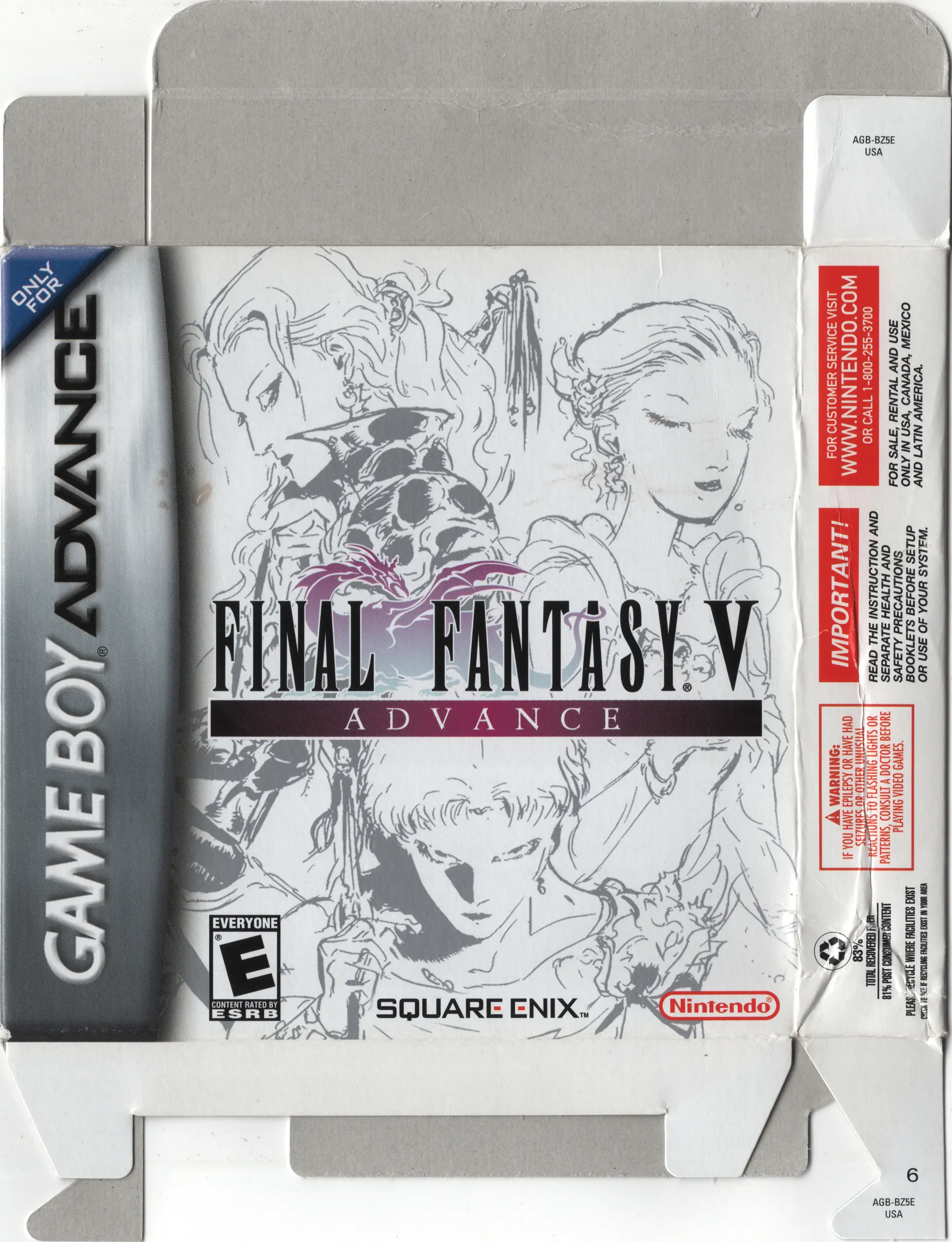
Final Fantasy V
"Four crystals. Twenty-two jobs. One very breakable world."
Overview
On December 6, 1992, Japanese players inserted a Super Famicom cartridge and met a wanderer named Bartz, a princess named Lenna, a pirate named Faris, and an amnesiac named Galuf. The four of them were chasing a meteor. What they found was a world held together by four elemental crystals, and a sorcerer named Exdeath waiting to get out. Square shipped Final Fantasy V that day and sold over two million copies in Japan. Then, for most of the 1990s, the game stayed there.
That long absence is the reason FFV has always sat a little apart from its neighbors in the West. Final Fantasy IV arrived in 1991 as Final Fantasy II, and Final Fantasy VI followed in 1994 as Final Fantasy III. FFV skipped the SNES entirely. North American players finally got it in 1999 on a PlayStation disc called Final Fantasy Anthology, paired with FFVI. Europe waited until 2002. By then the game had a reputation as the one that got away.
What they found when it arrived was not the opera of FFIV or the ensemble tragedy of FFVI. It was a job system. Twenty-two classes, each leveling independently, each learned ability able to be carried into another job. A Knight who casts black magic. A Ninja with dual-wield and white magic. A Chemist who mixes items into effects the game never explains. The story is lighter than its siblings, more Saturday-morning adventure than grand opera. The systems are not light at all. They are the reason people still argue about the best party build three decades later.
Gameplay
Every character starts as a Freelancer and can switch to any job the party has unlocked. A job has its own level, its own Ability Points, and its own command. Bank enough AP in Knight and you learn Cover. Bank enough in White Mage and you learn White Magic 6. The trick is that once an ability is learned, you can equip it while fighting in a different job. The game calls these support abilities and command abilities, and it lets you stack them. A Mystic Knight with dual-wield. A Time Mage with a Monk's barehanded damage. A Mime who copies whatever the rest of the party just did.
The original release has 22 jobs, from the starting six (Knight, Monk, Thief, White Mage, Black Mage, Blue Mage) to late-game additions like Mime and Chemist. The Game Boy Advance version added five more, including Necromancer, and a bonus dungeon called the Sealed Temple with a superboss, Omega Weapon Mk II. The Pixel Remaster keeps the original 22 and skips the GBA extras.
Combat runs on the Active Time Battle system introduced in FFIV, refined here with visible turn gauges and the ability to pause the gauge while choosing a command. The world map uses Mode 7, the SNES hardware trick that let the airship rotate and scale the terrain beneath it. Battles are sprite-based, side-view, and fast. The game never forces a fixed party composition, so two players can finish it with completely different builds and neither is wrong. That openness is also why it is less beginner-friendly than later entries: the game hands you a toolbox and very little instruction on which tool to use.
Story
A meteor falls near Tycoon. Bartz Klauser, a wandering traveler whose father died protecting him, rides out to see it and finds a young woman named Lenna and a pirate captain named Faris already there. The three of them meet an old man named Galuf who has lost his memory but not his purpose. The crystals are failing. The wind crystal shatters first, then water, then fire, then earth. Each crack loosens the seal on Exdeath, a sorcerer who wants the crystals gone so he can return to his own world and consume this one.
The second act moves the party to Galuf's homeworld, a place where the crystals already failed and Exdeath already won. Galuf dies there, and the game gives his granddaughter Krile his place in the party. The third act merges the two worlds into one and sends the party after Exdeath directly. The tone is lighter than FFIV's opera and FFVI's ensemble tragedy. There is a pirate captain who is secretly a princess, a recurring comic relief old man named Ghido, and a lot of running around on an airship. The job system carries the emotional weight, not the cutscenes.
Keywords
Sources
Game Info
- Developer
- Square
- Publisher
- Square
- Release Date
- 1992-12-06
- Modes
- Single-player, Multiplayer (Game Boy Advance link cable only)
- Platforms
- Super Nintendo Entertainment System, PlayStation, Game Boy Advance, iOS, Android, Microsoft Windows, Nintendo Switch, PlayStation 4, Xbox Series X/S
- Director
- Hironobu Sakaguchi
- Composer
- Nobuo Uematsu
- Character Design
- Yoshitaka Amano
- Original Platform
- Super Famicom
- Jobs in Original
- 22
- Japanese Sales
- Over 2 million copies
- First Western Release
- 1999 (Final Fantasy Anthology, North America)
Join the community
fans discussing