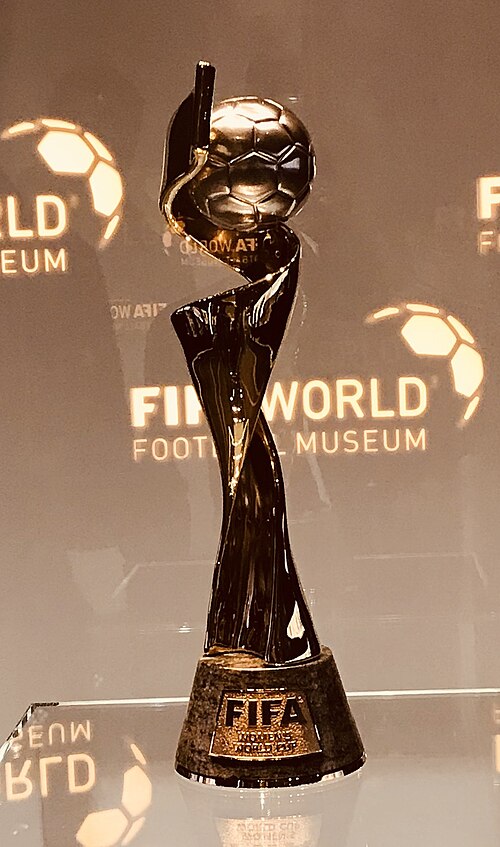
FIFA Women's World Cup
"The pinnacle of international women's football"
5+
Editions
90185
Peak Attendance
2000000000
Peak Viewership
About
The FIFA Women's World Cup is the top international tournament in women's football, bringing together senior national teams from across the globe every four years. Organized by FIFA, the sport's world governing body, the competition has grown from a 12-team invitational in 1991 into a 32-nation spectacle that commands billions of viewers. National teams qualify through regional tournaments over roughly three years, then gather in a host country for a month-long finals. The format pairs a group stage with a knockout round, ending in a single championship match. The United States has been the dominant force, lifting the trophy four times, but champions have also come from Norway, Germany, Japan, and Spain, reflecting the sport's expanding competitive depth. The tournament has become a cultural touchstone for gender equality in athletics, regularly drawing record crowds and sparking conversations about pay equity, investment, and visibility. Each edition produces breakout stars, dramatic upsets, and moments that echo far beyond the pitch.
History
The push for a FIFA-backed women's world championship gained momentum in the late 1980s. President Joao Havelange proposed the idea in 1989, following a series of unofficial tournaments. The 1970 Coppa del Mondo in Italy and the 1971 Mundial in Mexico had both been called "Women's World Cups" but were not sanctioned by FIFA. In the 1980s, Italy hosted several Mundialito tournaments featuring invited teams. FIFA tested the waters with an invitational event in China in 1988, which drew strong crowds and convinced the organization to launch an official championship.
The first official tournament, called the FIFA Women's World Championship for the M&M's Cup, took place in China in 1991. Twelve teams competed, and the United States beat Norway 2-1 in the final before 65,000 fans in Guangzhou. The name "World Cup" was not used until the 1999 edition. The tournament expanded from 12 to 16 teams in 1999, then to 24 in 2015, and to 32 in 2023. Host nations have included China, Sweden, the United States, Germany, Canada, France, and a co-hosted edition in Australia and New Zealand. Brazil will host in 2027, and a joint US-Mexico bid is proposed for 2031.
Notable Editions
1991: United States
510,000 (total) attendeesInaugural tournament in China; USA defeats Norway 2-1 in final
1999: United States
1,214,209 (total) attendeesRecord attendance; USA beats China on penalties; Brandi Chastain's celebration
2015: United States
1,353,506 (total) attendeesFirst 24-team field; artificial turf controversy; USA routs Japan 5-2 in final
2019: United States
1,131,312 (total) attendeesUSA defends title; Megan Rapinoe's activism; record global viewership
2023: Spain
1,978,274 (total) attendeesFirst co-hosted (Australia/New Zealand); 32 teams debut; Spain wins first title
Past Champions
| Year | Name |
|---|---|
| 1991 | United States |
| 1995 | Norway |
| 1999 | United States |
| 2003 | Germany |
| 2007 | Germany |
| 2011 | Japan |
| 2015 | United States |
| 2019 | United States |
| 2023 | Spain |
Notable Moments
1999
Brandi Chastain's celebration
After scoring the winning penalty in the final, Chastain dropped to her knees and pulled off her jersey, revealing a sports bra. The image became one of the most iconic in sports history.
2011
Japan's earthquake-inspired triumph
Japan won its first title just months after a devastating earthquake and tsunami. The team's resilience captured global hearts.
2015
Carli Lloyd's hat trick
Lloyd scored three goals in the first 16 minutes of the final against Japan, including a stunning strike from midfield, sealing a 5-2 victory.
2019
Megan Rapinoe's stance
Rapinoe used the tournament as a platform for social justice, speaking out on equal pay and LGBTQ+ rights while winning the Golden Boot and Golden Ball.
2023
USA eliminated in round of 16
The two-time defending champions were knocked out by Sweden on penalties, their earliest exit ever, signaling a shift in global power.
Cultural Impact
The Women's World Cup has been a primary driver of growth in women's football. The 1999 final, watched by 90,185 at the Rose Bowl, showed that women's sports could draw massive crowds and mainstream attention. That tournament directly led to the creation of professional women's leagues in the United States and elsewhere. The event has also become a platform for activism: players have used their visibility to advocate for equal pay, racial justice, and LGBTQ+ rights. Each edition inspires a new generation of girls to take up the sport, and the tournament's expanding reach has pressured federations to invest more in women's programs. The 2023 edition, with 32 teams and record broadcast numbers, cemented the Women's World Cup as one of the world's major sporting events.
Controversies
The 2015 tournament in Canada was played entirely on artificial turf, drawing criticism from players who argued it increased injury risk and changed ball behavior. A group of top players filed a human rights complaint, but FIFA did not switch to natural grass. Pay equity has been a recurring issue, most visibly with the U.S. Women's National Team's lawsuit against U.S. Soccer, which was settled in 2022 for $24 million. The 2023 final was overshadowed by a controversy involving Spanish federation president Luis Rubiales, who kissed player Jenni Hermoso without consent during the medal ceremony, sparking global outrage and leading to his suspension.
Broadcast Partners
Sponsors
Related Events
Keywords
Sources
Event Info
- Sport
- Football
- Frequency
- Quadrennial
- Founded
- 1991-11-16
- Organizer
- FIFA
- Most titles
- United States (4)
Join the community
fans discussing