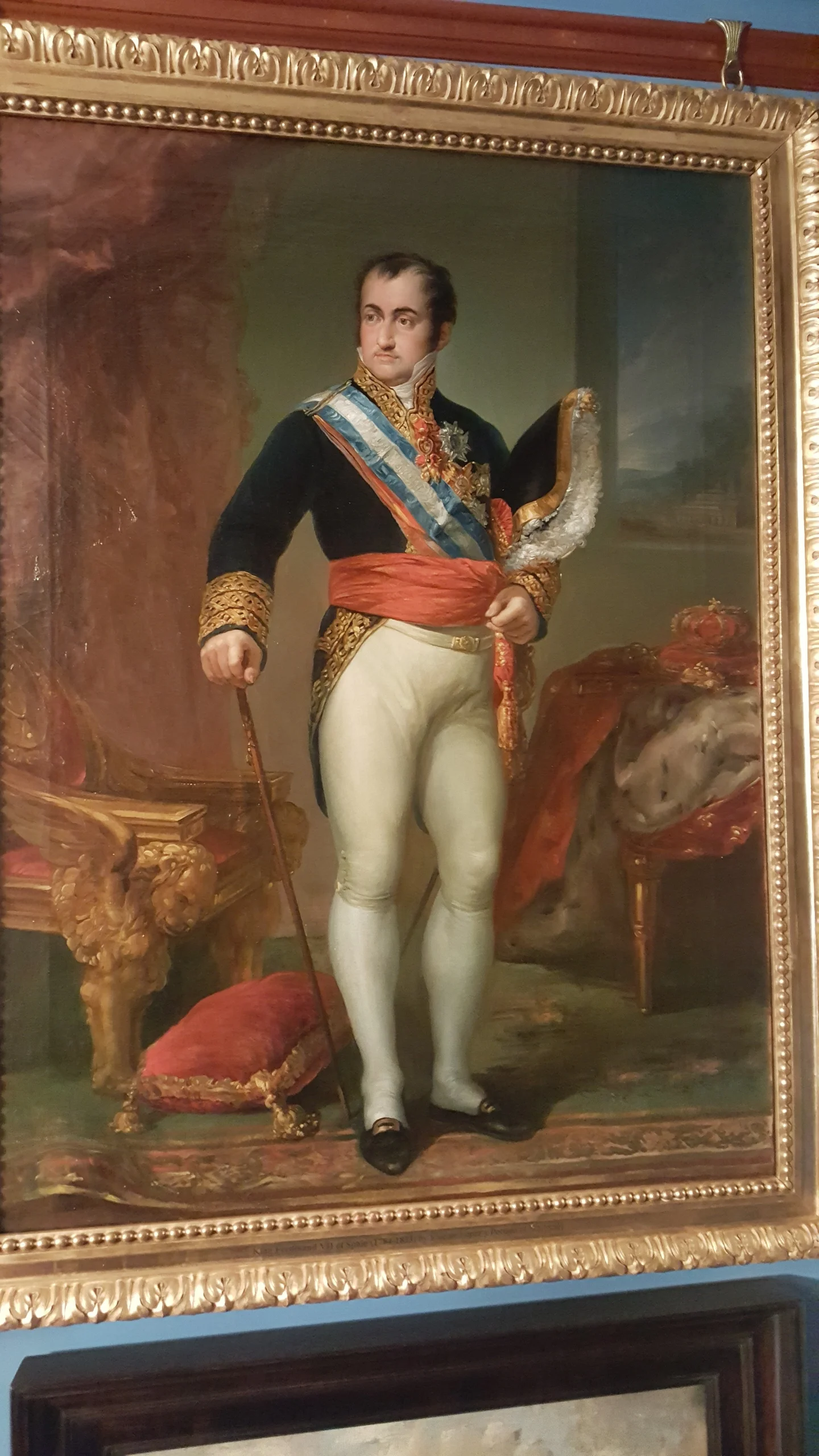
Ferdinand VII
 Spain
SpainAlso known as: Ferdinand the Desired, The Felon King
Birthday
October 14, 1784
Birth Sign
Libra
Birthplace
Royal Monastery of San Lorenzo de El Escorial, Spain
Age
Died at 48
About
Ferdinand VII was the King of Spain from 1808 until his death in 1833, with a brief interruption when Napoleon Bonaparte forced him to abdicate and held him captive in France for six years. He is remembered as one of the most controversial figures in Spanish history, a monarch whose reign saw the loss of nearly all of Spain's American colonies and the seeds of a devastating civil war.
Born into the House of Bourbon, Ferdinand ascended the throne after a popular uprising forced his father Charles IV to abdicate. But his time as king was short-lived; Napoleon intervened, and Ferdinand spent the Peninsular War imprisoned at Valençay. When he returned in 1814, he rejected the liberal Constitution of 1812 and reasserted absolute rule, earning him the nickname 'el Rey Felón' (the Criminal King) for his harsh repression of political opponents.
His reign swung between absolutism and forced liberalism, culminating in the Liberal Triennium (1820–1823) and a French-backed restoration of his absolute power. His decision to set aside Salic Law so his daughter Isabella could inherit the throne triggered the First Carlist War after his death. Ferdinand VII died at the Royal Palace of Madrid on September 29, 1833, leaving behind a fractured nation and a deeply contested legacy.
Early Life & Background
Ferdinand was born on October 14, 1784, at the Royal Monastery of San Lorenzo de El Escorial, the ninth of fourteen children of King Charles IV and Maria Luisa of Parma. Twin older brothers died in childhood, leaving him next in line to the throne. His upbringing was shadowed by his mother's infatuation with Manuel de Godoy, a handsome Royal Guards officer who rose to become virtual dictator of Spain by 1792. Ferdinand grew up excluded from any share in government, developing a deep hatred for his parents and the favourite.
His tutor, Juan Escoiquiz, encouraged him to scheme against his own family. By his late twenties, Ferdinand was secretly writing to Napoleon Bonaparte, begging for help to overthrow his father. In October 1807, he was arrested for his role in the El Escorial Conspiracy, a plot to secure French support for his own accession. He confessed and was pardoned, but the episode only deepened his reputation for treachery.
Career Growth
Ferdinand's reign began in March 1808 after the Tumult of Aranjuez forced his father to abdicate. But Napoleon summoned him to Bayonne and forced him to abdicate on May 6, 1808, keeping him under guard at the Château de Valençay for six years. While he was away, Spain fought the Peninsular War and the Cortes drafted the liberal Constitution of 1812.
Returning in 1814, Ferdinand abolished the constitution and unleashed a wave of repression. Political opponents vanished, prisons filled, and censorship tightened. In 1820, a military revolt led by Rafael del Riego forced him to restore the constitution, beginning the Liberal Triennium. But in 1823, a French army sent by the Congress of Verona reinstated him as absolute monarch. Under his rule, Spain lost nearly all of its American colonies, devastating its global power.
His final years were marked by the succession crisis. In 1830, he issued the Pragmatic Sanction to set aside Salic Law, allowing his daughter Isabella to inherit the throne. This decision led directly to the First Carlist War after his death.
Career Timeline
Public Image & Style
Ferdinand VII's public image is overwhelmingly negative. Historians describe him as cowardly, selfish, grasping, suspicious, and vengeful. His nickname 'el Rey Felón' (the Criminal King) reflects his reputation for betrayal and cruelty. Before 1813, he was called 'el Deseado' (the Desired), a name that became bitterly ironic after his return. He is often cited as the worst monarch in Spanish history, a figure whose personal failures had catastrophic consequences for his nation.
Fame & Fandom
Ferdinand VII's fanbase has no formal name, and no organized community exists around him in any contemporary sense. This is unsurprising for a monarch who reigned in the early nineteenth century, before the modern concept of celebrity fandom, and whose historical reputation is overwhelmingly negative. His only echo of fandom was political: the royalists who hailed him as 'el Deseado' (the Desired) during his imprisonment in France, a loyalty that soured dramatically upon his restoration, when he repaid their sacrifices with betrayal and absolutism. Today, his legacy endures not through fan activities but through the enduring cultural memory of his tyranny, from Goya's satirical etchings to the Carlist Wars he set in motion.
Despite the absence of a fan culture, Ferdinand VII's place in global attention is measurable. He is currently the 95th most famous person in Spain, holding steady from the previous cycle, according to the iFANN Global Fame Rankings. This placement reflects his persistent relevance in historical discourse, a figure whose name still evokes strong reactions in Spanish collective memory.
Interesting Facts and Legends
Ferdinand's mother's confessor claimed on her deathbed that none of her children were from the legitimate marriage, casting doubt on Ferdinand's paternity. He secretly wrote to Napoleon asking for help to overthrow his own parents. The Duke of Angoulême, who restored him to power in 1823, was so disgusted by Ferdinand's brutality that he refused the Spanish decorations offered to him. Ferdinand's fourth wife Maria Christina was 'mistress by his death-bed' and could 'put the words she chose into the mouth of a dead man.'
Family & Personal Life
Ferdinand was the eldest surviving son of King Charles IV and Maria Luisa of Parma, who had fourteen children, though only a few survived infancy. His mother's affair with Manuel de Godoy dominated his childhood. He married four times: first to his cousin Maria Antonietta of the Two Sicilies in 1802, who died in 1806 after miscarrying twice; then to his niece Maria Isabel of Portugal in 1816, who bore two daughters (one died in infancy) and died in 1818; then to Maria Josepha Amalia of Saxony in 1819, who died childless in 1829; and finally to Maria Christina of the Two Sicilies in 1829, who gave him two surviving daughters, Isabella II and Luisa Fernanda.
Notable Connections
Ferdinand VII's life was intertwined with key figures of his era. Manuel de Godoy, his mother's favourite, was his chief rival and object of hatred. Napoleon Bonaparte imprisoned him at Valençay for six years. His father Charles IV, whom he helped overthrow, and his mother Maria Luisa of Parma shaped his early years. His tutor Juan Escoiquiz encouraged his plots. Rafael del Riego led the 1820 revolt that forced him to restore the constitution. His brother Don Carlos became his rival claimant, and his fourth wife Maria Christina of Naples manipulated the succession.
Relationships & Dating History
Ferdinand VII married four times, a topic of considerable historical interest given his failure to produce a male heir until late in life. His first marriage in 1802 to his cousin Maria Antonietta of the Two Sicilies produced no children; her two pregnancies ended in miscarriages, and she died in 1806 after four years of marriage, with whispers that the marriage had never been consummated. In 1816, he married his niece Maria Isabel of Portugal, who bore him two daughters, the first of whom lived only a short time; she died in 1818. His third wife, Maria Josepha Amalia of Saxony, died childless in 1829. Finally, in 1829, he married Maria Christina of the Two Sicilies, who gave him two surviving daughters, including Isabella II. She persuaded him to set aside Salic Law so their daughter could inherit, leading to the First Carlist War. At the time of his death, he was married to Maria Christina.
- MarriedMaria Antonietta of the Two Sicilies1802 - 1806His first cousin; marriage produced no surviving children; she died in 1806.
- MarriedMaria Isabel of Portugal1816 - 1818His niece; bore two daughters, one died in infancy; she died in 1818.
- MarriedMaria Josepha Amalia of Saxony1819 - 1829Third wife; no children; she died in 1829.
- MarriedMaria Christina of the Two Sicilies1829 - 1833CurrentFourth wife; mother of Isabella II and Luisa Fernanda.
Death & Aftermath
Died
September 29, 1833 (aged 48)
Death Place
Madrid, Spain
Cause of Death
Acute intestinal colic and dropsy
Public reaction to the death of Ferdinand VII was deeply polarized, marked by significant political tension rather than unified mourning. While loyalist nobility and the clergy offered official tributes through church services, many liberal factions viewed the monarch as a tyrant whose passing signaled the potential end of the repressive Ominous Decade, resulting in relief rather than grief within those circles. Ferdinand VII died on September 29, 1833, at the Royal Palace of El Pardo near Madrid following months of severe physical deterioration. Contemporary medical records indicate he suffered from acute intestinal colic complicated by dropsy, with his final days marked by vomiting, diarrhea, delirium, and coma after a last public interaction on September 28 regarding his will. Although later historians have speculated about poisoning due to political rivals, no credible evidence or contemporary investigation substantiated claims of foul play, and the cause remained natural causes related to chronic illness as determined by royal physicians.
The funeral took place on October 5, 1833, at the Royal Basilica of San Francisco el Grande in Madrid, attended by high-ranking clergy and court officials loyal to the crown. His body was initially interred in the Royal Pantheon of Kings but was later moved to the Royal Monastery of El Escorial due to subsequent political turmoil, where his remains rest today in the Crypt of the Kings. Posthumously, he has been the subject of numerous academic studies often portraying him as a reactionary figure, while institutions like the Toilet Cabinet of Ferdinand VII in the Prado Museum serve as historical artifacts rather than honors.
Net Worth (Estate Value)
As a monarch who died in 1833, Ferdinand VII's personal net worth is not documented in modern financial terms. The Spanish crown's finances during his reign were severely strained; the treasury was nearly bankrupt after the Napoleonic Wars. His estate passed to his wife Maria Christina as regent and his daughter Isabella II. The Spanish royal patrimony included palaces, art collections, and crown properties, but the monarchy's financial position was precarious. No modern estate valuation exists, as the crown's assets were state properties rather than personal wealth.
Awards & Accolades
Known For
King of Spain
1808-1833 · Monarch
Keywords
Sources
Quick Facts
- Born
- October 14, 1784
- Birthplace
- Royal Monastery of San Lorenzo de El Escorial, Spain
- Died
- September 29, 1833
- Death Place
- Royal Palace of Madrid, Spain
- Gender
- Male
- Spouse
- Maria Christina of the Two Sicilies
Personal Details
- Full Name
- Fernando de Borbón y Borbón-Parma
- Spouse
- Maria Christina of the Two Sicilies
- Children
- Isabella II, Luisa Fernanda
Frequently Asked Questions
Was Ferdinand VII the worst king of Spain?
Why was Ferdinand VII called the Felon King?
Did Ferdinand VII have any children?
How many times was Ferdinand VII married?
What happened to Ferdinand VII during the Napoleonic Wars?
Join the community
fans discussing