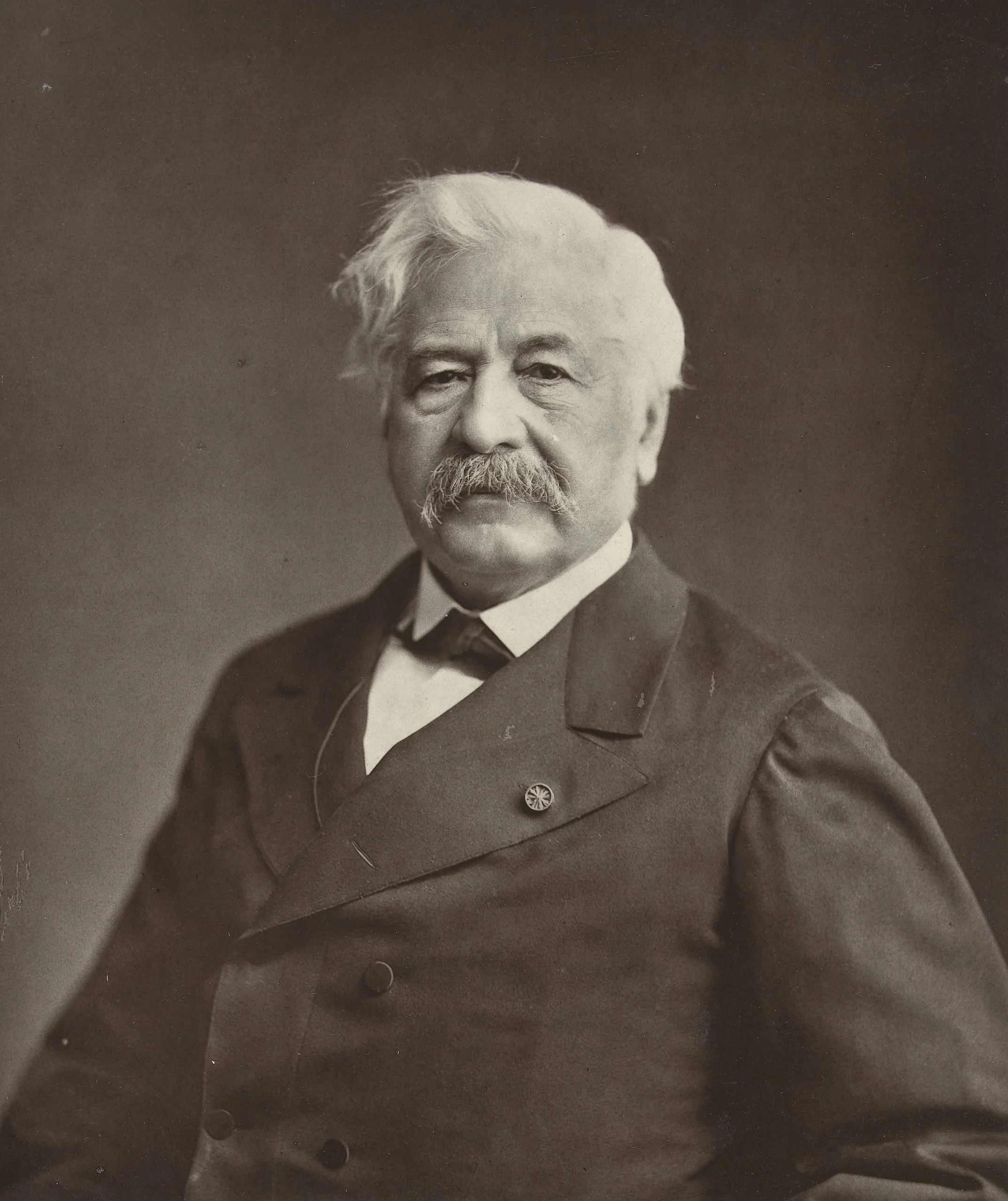
Ferdinand de Lesseps
 France
Also known as: Ferdinand Marie de Lesseps, Vicomte de Lesseps
Birthday
November 19, 1805
Birth Sign
Scorpio
Birthplace
Versailles, France
Age
Died at 89
Height
5 ft 9 in (175 cm)
About
Ferdinand Marie de Lesseps was a French diplomat and engineer best known for spearheading the construction of the Suez Canal. Born into a family of nobility in Versailles, he spent his formative years in Egypt where his father served as consul. This early exposure to the Middle East shaped his future career, leading him to become a pivotal figure in 19th-century geopolitics and engineering.
His most celebrated achievement remains the opening of the Suez Canal in 1869, a waterway that linked the Mediterranean Sea to the Red Sea and drastically shortened maritime routes between Europe and Asia. Despite this monumental success, his later attempt to build a sea-level canal across Panama ended in financial ruin and public scandal due to tropical diseases and poor planning.
Early Life & Background
Ferdinand de Lesseps entered the world on November 19, 1805, in Versailles, France. He was born into a family with deep ties to the French diplomatic service. His father, Mathieu de Lesseps, held the position of French consul in Egypt, which meant young Ferdinand spent much of his childhood traveling and living in the Middle East. This upbringing was far from typical for a French nobleman of the era. Instead of spending his days in Parisian salons, he absorbed the culture, language, and politics of the Ottoman Empire.
The experience of growing up in Alexandria and Cairo instilled in him a fluency in Arabic and a profound understanding of Oriental affairs. While he received a classical education and later studied law, his heart remained fixed on international commerce and diplomacy. By the time he turned 23, he had already been appointed vice-consul in Alexandria. This early entry into the diplomatic corps set the stage for his rise through the ranks, but it also planted the seeds of the grand ambitions that would define his life's work.
Career Growth
De Lesseps' career trajectory shifted dramatically in the mid-19th century when he began advocating for a canal across the Isthmus of Suez. Serving as Consul General in Cairo, he successfully convinced Sa'id Pasha, the ruler of Egypt, that a waterway connecting the Mediterranean and Red Seas was economically viable. In 1859, he founded the Compagnie Universelle du Canal Maritime de Suez to oversee the project. The excavation faced significant hurdles, including labor shortages and political opposition, but De Lesseps persevered.
The Suez Canal officially opened on November 17, 1869, following a lavish ceremony attended by Empress Eugénie of France and thousands of dignitaries. The canal reduced the sailing distance between Europe and Asia by approximately 8,000 kilometers, revolutionizing global trade and cementing De Lesseps' status as a global celebrity. Inspired by this triumph, he launched an ambitious project to build a sea-level canal across Panama in 1879. However, the venture was devastated by malaria and yellow fever epidemics, which decimated the workforce, and severe financial mismanagement. By 1889, the company went bankrupt, leading to a massive scandal involving bribes to French politicians. De Lesseps was personally ruined and died in disgrace relative to his earlier glory, though he was not criminally convicted.
Career Timeline
Public Image & Style
De Lesseps is viewed historically as a complex figure: a visionary diplomat who achieved one of the greatest engineering feats of the 19th century, yet also a symbol of overconfidence and colonial exploitation. In France, he is remembered as a national hero for the Suez Canal, while in Egypt and parts of Latin America, he is sometimes criticized for the human cost of the projects and the colonial nature of the enterprise. Recent controversies regarding statues of De Lesseps highlight the ongoing debate over his legacy as a symbol of oppression versus a builder of progress.
Fame & Fandom (iFAMOUS Rankings)
Ferdinand de Lesseps stands as a monumental figure in the annals of 19th-century engineering and diplomacy, though his legacy is currently unranked within the published Global Top 1,000 or any Top-100 scope list by iFANN. While modern metrics often favor living celebrities with active social media engagement, the historical weight of his achievements creates a unique form of enduring fame that transcends current numerical rankings. The absence of a formal placement reflects the reality that he does not hold a spot in contemporary popularity charts, yet his name remains instantly recognizable to historians and enthusiasts worldwide. Unlike modern stars who cultivate organized followings, Ferdinand de Lesseps never had a fandom in the traditional sense. There is no documented fanbase name, no subreddit dedicated to his life, and no community of fans engaging in birthday campaigns or charity drives in his honor. His audience consists primarily of academic historians, engineering students, and tourists visiting the Suez Canal or reading about the Panama Scandal. The lack of a specific fandom name aligns with the fact that he died long before the advent of mass media phenomena that allow for the formation of organized fan groups. Fans today do not gather to celebrate his birthday or push his work on streaming platforms; instead, interest is sparked by the dramatic arc of his life, the triumph of the Suez Canal and the catastrophic failure of the Panama project. The cultural mythology surrounding him is built on verified historical events rather than pop-culture folklore. The elaborate inauguration ceremony of the Suez Canal in November 1869, attended by European royalty, cemented his status as a global hero, while the subsequent Panama scandal transformed him into a cautionary tale of hubris. Recent debates regarding statues in Egypt have further complicated his image, shifting the narrative from a visionary builder to a symbol of colonial exploitation. This duality ensures that discussions about him remain vibrant among scholars and history buffs, even if they do not constitute a modern fandom.
Interesting Facts and Legends
Ferdinand de Lesseps famously insisted on building the Panama Canal at sea level, mirroring his successful Suez design, despite warnings from experts about the terrain and disease. This decision is now widely regarded as a fatal error that doomed the project. During the Panama scandal trials, he defended himself by stating, "I have made a mistake, but I have not been a criminal." The inauguration of the Suez Canal in 1869 was broadcast via telegraph worldwide, making it one of the first events to be experienced simultaneously by a global audience. Historical records indicate he died with very little liquid wealth, relying on the support of his family and friends after the Panama failure.
A story fans still retell involves an elaborate ceremony held in November 1869, where royalty and dignitaries gathered to celebrate the completion of the Suez Canal. This event cemented his status as a global hero in the 19th century, marking a triumph of European engineering over geographical barriers. Another enduring legend centers on the statue controversy in Egypt. While originally revered as a national hero, modern perspectives have shifted, transforming him into a symbol of oppression due to the deaths of thousands of forced laborers during construction. Debates regarding these statues highlight the ongoing dual narrative of visionary builder versus architect of exploitation.
Notable Quotes
“The Suez Canal is the greatest work of the century.”
“I am the man who will join the two seas.”
“I have made a mistake, but I have not been a criminal.”
Family & Personal Life
Ferdinand de Lesseps was married twice. His first marriage to Louise-Hélène Autard de Bragard in 1830 lasted until her death from tuberculosis in 1846. They had seven children together, including Charles, who assisted his father in the Suez Canal venture. After losing his wife, De Lesseps married Agathe Delamalle in 1847. She provided stability during his rise to fame and endured the subsequent scandal of the Panama failure. They had three children together: Marie, Jean, and another son. He lived in Guilly, France, where he passed away in 1894.
Notable Connections
Relationships & Dating History
Ferdinand de Lesseps was married twice, and his romantic history was relatively private compared to his public career. His first marriage to Louise-Hélène Autard de Bragard took place in 1830. Louise was the daughter of a wealthy French family, and they met through family connections in Paris. She accompanied him to Egypt during his early diplomatic postings. Her death from tuberculosis in 1846 devastated him and left him a widower with several children. They had seven children together, including Charles, who would later assist his father in the Suez Canal venture.
Shortly after the death of his first wife, De Lesseps married Agathe Delamalle in 1847. She provided stability during his rise to fame with the Suez Canal and endured the subsequent scandal of the Panama failure. She remained by his side until his death in Guilly, France. They had three children together: Marie, Jean, and another son. De Lesseps did not have any documented dating relationships outside of these two marriages; his life was characterized by long-term commitment to his spouses. As of the date of his death in 1894, he was widowed only briefly before passing away himself.
- MarriedLouise-Hélène Autard de Bragard1830 - 1846Met through family connections in Paris; she died of tuberculosis.
- MarriedAgathe Delamalle1847 - 1894Remained by his side until his death; survived the Panama scandal.
Death & Aftermath
Died
December 7, 1894 (aged 89)
Death Place
Saint-Cloud, France
Cause of Death
Reported natural causes due to advanced age and heart condition
The family of Ferdinand de Lesseps announced his passing on December 7, 1894, at his residence in Saint-Cloud, France, following a prolonged period of declining health. The eighty-nine-year-old diplomat and entrepreneur spent his final days in seclusion, having largely withdrawn from public life after the intense scrutiny of the Panama Scandal trial concluded in 1893. Although he had been sentenced to prison for corruption, President Félix Faure commuted the penalty due to his age and frailty, allowing him to remain free while his physical condition deteriorated over the months leading up to his death. Historical accounts attribute his passing to natural causes associated with advanced age and a heart condition, determined by the attending physician and family statement.
Public reaction upon his death was a complex mixture of mourning for his past triumphs and lingering resentment regarding the financial ruin caused by the Panama venture. Official tributes from the French government and the Académie française acknowledged his role in completing the Suez Canal, yet the tone remained subdued compared to earlier decades. A private funeral service took place shortly after his death in Saint-Cloud, attended only by family members and close associates, while high-profile state officials notably abstained from the ceremony. De Lesseps was laid to rest in the Cimetière de Montmartre in Paris, marking the end of a life that had swung from global celebrity to disgrace.
His memoirs, titled Souvenirs de quarante ans, were published posthumously to offer his personal account of both the Suez success and the Panama failure. While a statue erected in Port Said in 1899 served as a major posthumous tribute, it has since become a subject of historical controversy regarding forced labor during the canal's construction. The estate he left behind was heavily encumbered by debts from the Panama project and legal fines, leaving little inheritance for his descendants.
Net Worth (Estate Value)
$0
iFANN Editorial Team estimate
Ferdinand de Lesseps died on December 7, 1894, leaving behind an estate that was effectively worthless due to the catastrophic failure of the Panama Canal project. At the time of his death, he had lost his fortune, his home, and his reputation. Historical records indicate he died with very little liquid wealth, relying on the support of his family and friends. Unlike modern celebrities, De Lesseps did not have a commercial estate generating royalties from films or music. The Compagnie Universelle du Canal Maritime de Suez continued to generate revenue for decades under French and later British-Egyptian management, but this belonged to the state and shareholders, not his heirs. The Suez Canal Authority currently manages the canal, but it is a state-owned asset, not a private estate of De Lesseps. Any mention of his net worth in modern contexts is speculative or relates to the historical value of the canal itself, which is estimated to generate billions annually in tolls, but this belongs to the Egyptian state, not his descendants. Per iFANN's editorial analysis, Ferdinand de Lesseps' net worth is $0.
Awards Won (4)
De Lesseps received the highest national honours of the 19th century, including elevation to Viscount of the Empire by Napoleon III and the Grand Cross of the Legion of Honour for his role in the Suez Canal. He was also awarded the Order of the Medjidie (First Class) by the Ottoman Sultan and the Knighthood of the Order of St. John of Jerusalem for his humanitarian efforts during cholera outbreaks in Egypt.
1869 · Nobility
Service to France
1869 · National Decoration
Suez Canal Construction
Known For
Suez Canal
1869 · Developer
Panama Canal Project
1880 · Initiator
Keywords
Sources
Quick Facts
- Profession
- diplomat, entrepreneur, writer
- Born
- November 19, 1805
- Birthplace
- Versailles, France
- Died
- December 7, 1894
- Death Place
- Guilly, France
- Gender
- Male
- Spouse
- Louise-Hélène Autard de Bragard, Agathe Delamalle
- Birth Sign
- Scorpio
Personal Details
- Full Name
- Ferdinand Marie de Lesseps
- Height
- 5 ft 9 in (175 cm)
- Spouse
- Louise-Hélène Autard de Bragard, Agathe Delamalle
- Children
- Charles de Lesseps, Ferdinand de Lesseps, Marie, Jean
- Education
- Classical education; Law studies
Frequently Asked Questions
What was Ferdinand de Lesseps' most famous achievement?
Why did the Panama Canal project fail?
How many times was Ferdinand de Lesseps married?
Did Ferdinand de Lesseps go to prison?
Where was Ferdinand de Lesseps born?
Similar People
Join the community
fans discussing