“The epitome of British sitcom perfection, ‘Fawlty Towers’ remains hilariously relevant decades later.”
Christopher Orr
The Atlantic
 United Kingdom
"Don't mention the war!"
User Score
826 votes
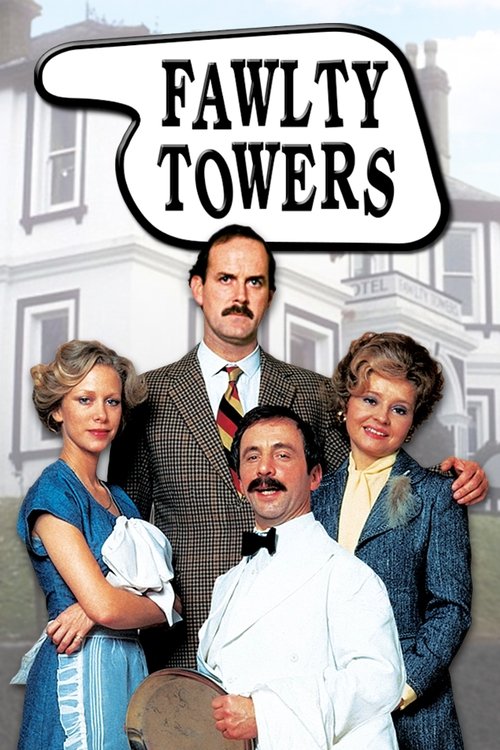
In the English seaside town of Torquay, a perpetually flustered hotelier named Basil Fawlty, brought to life by John Cleese, presides over the titular Fawlty Towers. He's supported by his sharp-tongued wife Sybil (Prunella Scales), the resourceful maid Polly Sherman (Connie Booth), and the hapless Spanish waiter Manuel (Andrew Sachs). This BBC Two sitcom, co-created by Cleese and Booth, ran for just two seasons and 12 episodes between 1975 and 1979.
The series thrives on Basil's desperate attempts to maintain standards and social decorum, constantly undermined by his own anxieties, his wife's business acumen, the eccentricities of their staff, and an endless parade of impossible guests. The humor leans heavily into slapstick and observational comedy, highlighting the absurdities of the hospitality industry and the frustrations of a man utterly unsuited for his chosen profession. Despite its short run, Fawlty Towers achieved immense popularity, earning widespread acclaim for its brilliant writing and unforgettable performances.
Stream
BritBox
BBC iPlayer
Availability and pricing can change. Confirm on the provider's site before purchasing.
Fawlty Towers chronicles the chaotic and often disastrous attempts of Basil Fawlty, a perpetually stressed and socially inept hotelier, to run a small hotel in the seaside town of Torquay, Devon. The series is set entirely within the confines of the Fawlty Towers hotel and its immediate surroundings, creating a microcosm of escalating comedic mishaps.
At its core, the central conflict of Fawlty Towers stems from Basil's desperate aspiration to elevate the hotel to a respectable establishment, attracting a sophisticated clientele, while simultaneously battling his own deeply ingrained anxieties, a volatile temper, and a profound lack of social grace. His efforts are constantly undermined by a series of factors: his domineering and more pragmatic wife, Sybil, who possesses a keen business sense but often clashes with Basil's methods; the well-meaning but utterly bewildered Spanish waiter, Manuel, whose grasp of English is rudimentary at best, leading to endless misunderstandings; and the resourceful and sharp-witted maid, Polly Sherman, who often finds herself the sensible mediator amidst the pandemonium.
The hotel itself is a character in its own right, a seemingly ordinary establishment that becomes a stage for the extraordinary. Basil's paranoia, his extreme reactions to minor inconveniences, and his often cruel treatment of both staff and guests are the primary drivers of the humor. He is constantly trying to impress, to maintain appearances, and to avoid confrontation, yet his attempts invariably backfire, leading to escalating situations that spiral far beyond his control. Whether it's trying to hide his true feelings from Sybil, dealing with demanding or eccentric guests, or attempting to cover up his own blunders, Basil’s journey is a relentless cycle of ambition, failure, and sheer panic.
The series is structured into two distinct seasons, each comprising six episodes. The first season, aired in 1975, establishes the core characters and the general premise. Episodes typically revolve around Basil's frantic efforts to manage a particular group of guests or a specific event, often involving elaborate schemes to avoid embarrassment or to achieve a desired outcome, only for these plans to unravel spectacularly. The humor in this season leans heavily into observational comedy, character-driven absurdity, and Basil's increasingly desperate attempts to maintain control.
The second season, which aired four years later in 1979, sees the characters and their predicaments evolve, though the fundamental dynamic remains the same. Basil's neuroses are perhaps even more pronounced, and the situations he finds himself in become even more outlandish. The writers skillfully build upon the established characters and their relationships, allowing for deeper exploration of their eccentricities and the comedic potential they offer. Each episode in both seasons presents a fresh set of challenges for Basil, from dealing with health inspectors and potential investors to accommodating guests with peculiar demands or navigating delicate social situations, all of which he handles with his signature blend of panic and incompetence. The overarching narrative is one of a man perpetually on the brink of a breakdown, striving for an ideal that remains perpetually out of reach, with his hotel serving as the battleground for his internal and external struggles.
Critical Consensus
A masterclass in British comedy, 'Fawlty Towers' delivers relentless laughs through its brilliant writing, unforgettable characters, and John Cleese's iconic performance as the perpetually exasperated hotelier Basil Fawlty.
“The epitome of British sitcom perfection, ‘Fawlty Towers’ remains hilariously relevant decades later.”
Christopher Orr
The Atlantic
“John Cleese’s Basil Fawlty is a monument to the modern man’s anxieties, a perfectly pitched portrait of polite society’s unraveling.”
Willa Paskin
Slate
“Every episode is a perfectly constructed farce, a testament to the genius of Cleese and Booth’s writing.”
Ed Cumming
The Independent
“Fawlty Towers is simply one of the funniest television shows ever made, a benchmark for comedic writing and performance.”
Robert Lloyd
Los Angeles Times
John Cleese
Basil Fawlty
Prunella Scales
Sybil Fawlty
Connie Booth
Polly Sherman
Andrew Sachs
Manuel
Ballard Berkeley
Major Gowen
Brian Hall
Terry the Chef
Gilly Flower
Miss Tibbs
Renee Roberts
Miss Gatsby
Director
John Howard Davies
Writers
Connie Booth, John Cleese
Composer
Derek Scott
Producers
Douglas Argent, Bill Cotton, John Howard Davies
British Comedy Awards (2004)
Best British Sitcom: Won
BAFTA TV Awards (1976)
Best Comedy Series: Nominated
Join the community
fans discussing