 Pakistan
About
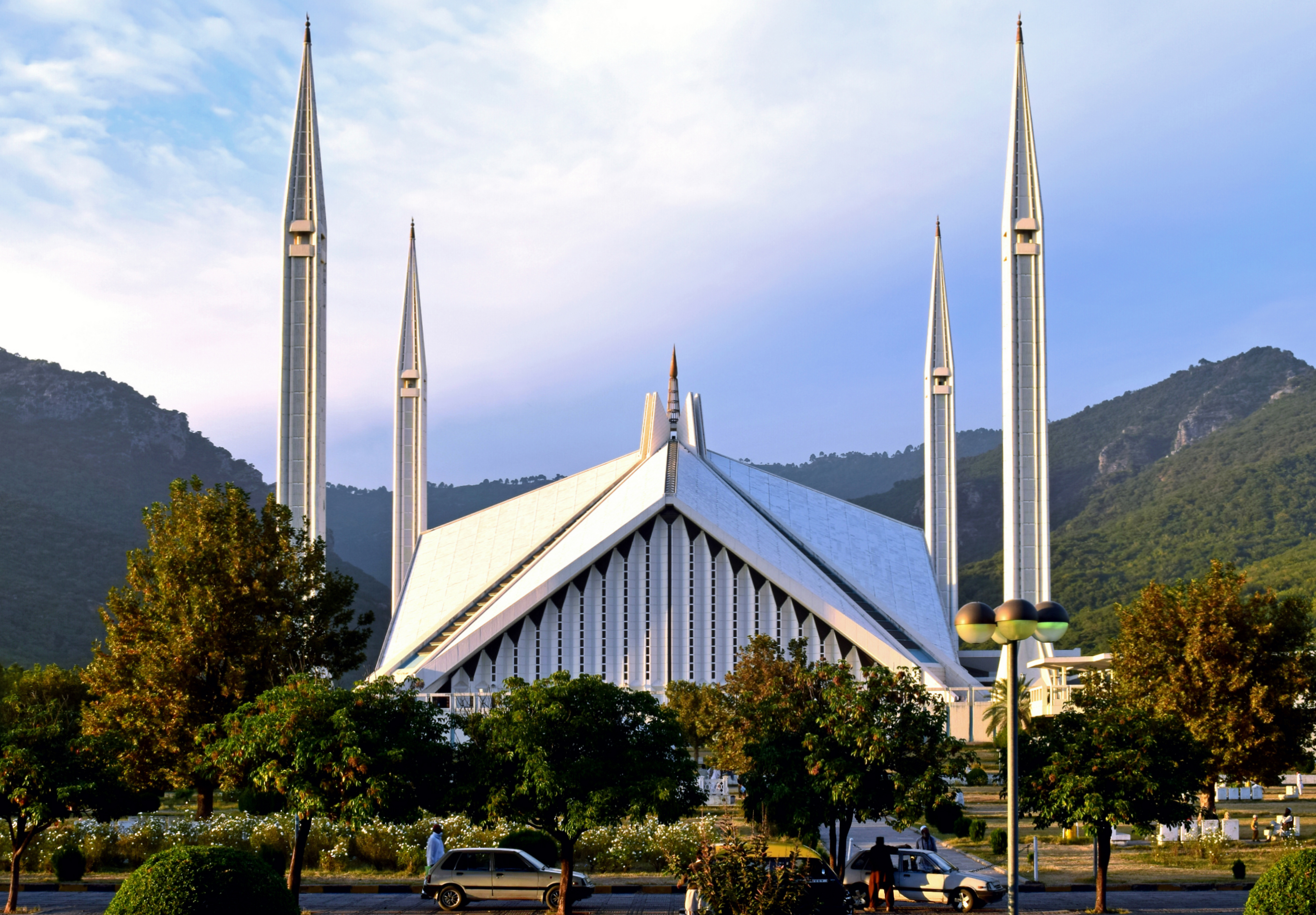
The Faisal Mosque rises from the foothills of the Margalla range, its eight-sided concrete shell and four pencil-thin minarets cutting a sharp silhouette against the sky. This is Pakistan's national mosque, a place that pulls both the faithful and the curious. Designed by Turkish architect Vedat Dalokay, it trades the traditional dome and arch for a geometry inspired by a Bedouin tent, a choice that felt radical when construction began in 1976 and still turns heads today. The mosque opened in 1986, named for King Faisal of Saudi Arabia, whose 28 million Saudi riyals grant made the project possible. He never saw it completed, assassinated in 1975, but his name lives on in the marble and concrete.
Capacity is a point of pride. The main hall and courtyard can hold around 100,000 worshippers at once, with some estimates stretching to 300,000 when the surrounding grounds are packed for Eid. That scale places it among the largest mosques on the planet, and the largest outside the Middle East. It is not just a place for Friday prayers. The mosque hosts national gatherings like the Ramadan Qiyam-ul-Lail special night prayers and week-long Qur'an recitation events organized by the Ministry of Religious Affairs. On those nights, the courtyard glows with lights and the sound of voices reciting in unison.
Beyond worship, the mosque has become a cultural anchor for Islamabad. Tourists from around the world climb the steps to photograph the interplay of white marble, green hills, and sharp angles. It appears in documentaries, travel vlogs, and news footage as shorthand for Pakistan itself. The design earned Dalokay international recognition, and architectural critics still debate its place in modern Islamic architecture. For many Pakistanis, it is simply home, a constant in a city that changes quickly around it.
Mission
The Faisal Mosque exists to serve as Pakistan's primary congregational mosque, a center for worship, education, and national religious life. It aims to accommodate the largest possible number of worshippers, from daily prayers to the massive crowds of Eid. The mosque also functions as a symbol of Islamic unity and Pakistan's ties to the broader Muslim world, hosting state events and international visitors. Its design, a deliberate break from tradition, reflects a mission to show that Islamic architecture can evolve while staying true to its spiritual roots.
History
The idea for a grand mosque in Islamabad took root in 1966, when Saudi Arabia's King Faisal visited Pakistan and offered to fund a national place of worship. The Pakistani government responded by launching an international design competition in 1969. Architects from around the world submitted entries, but it was Vedat Dalokay, a Turkish architect, whose vision stood out. His plan abandoned the familiar dome-and-arch vocabulary for an eight-sided, tent-like structure that seemed to grow out of the earth.
Construction began in 1976, but King Faisal did not live to see it. He was assassinated in March 1975, and the mosque was later named in his memory. The building process stretched over a decade, with workers shaping concrete and marble against the backdrop of the Margalla Hills. When it finally opened in 1986, the mosque immediately became a landmark, its silhouette unlike anything else in the Islamic world.
Over the years, the mosque has weathered both praise and security threats. In 2025 and 2026, the US Embassy issued terror warnings after Tehreek-e-Taliban Pakistan (TTP) posted threats, leading to heightened security around the complex. Despite these tensions, the mosque remains a center of daily life, hosting everything from Friday sermons to national Qur'an recitation gatherings that draw participants from across the country.
Notable People
Vedat Dalokay
Architect · 1969-1986
Won the 1969 international design competition and created the mosque's tent-inspired form
King Faisal bin Abdul Aziz
Benefactor · 1966-1975
Proposed the mosque and provided 28 million Saudi riyals in funding
Milestones
1966
King Faisal proposes building a mosque in Islamabad during his visit to Pakistan
1969
International design competition held; Vedat Dalokay wins with his tent-inspired concept
1976
Construction begins with a grant of 28 million Saudi riyals
1986
Mosque opens to the public, a decade after King Faisal's death
Sources
Organization Info
- Founded
- 1986
- Headquarters
- Shah Faisal Avenue, Islamabad, Pakistan
- Country
- Pakistan
- Parent
- Ministry of Religious Affairs, Government of Pakistan
- Type
- Religious
- Architect
- Vedat Dalokay
- Capacity
- 100,000 (up to 300,000 with grounds)
- Funding
- 28 million Saudi riyals from King Faisal
Join the community
fans discussing