 Japan
Japan“Kawamura's adaptation captures the game's claustrophobic dread while adding emotional depth through Ninomiya's haunted performance. A meditation on guilt disguised as a horror film.”
Mark Schilling
The Japan Times
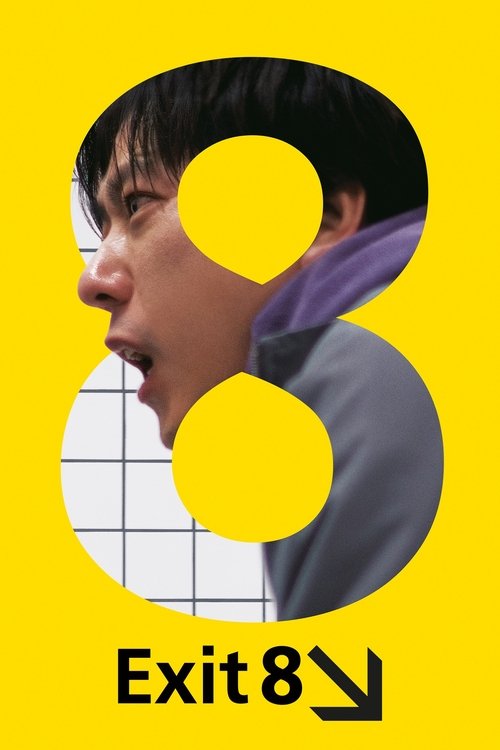
Genki Kawamura's Exit 8, released in August 2025, is a rare breed of horror film that understands less is more. Adapted from a minimalist indie game, the movie drops you into an endless, sterile subway corridor where the only rule is to watch for things that don't belong. A flickering light. A puddle that wasn't there. A woman standing perfectly still at the far end. Spot the anomaly and turn back. Miss it, and you start over. The film never explains why this loop exists or who built it, and that refusal to answer is precisely what makes it so unsettling.
Kazunari Ninomiya, best known as a former member of the pop group Arashi, anchors the film as the nameless protagonist called only The Lost Man. He brings a quiet, haunted quality to a role that requires him to run the same stretch of hallway hundreds of times. Shot in just 28 days on a single soundstage set, the production relied on practical effects for nearly every anomaly, with CGI reserved only for the final white room sequence. The score, composed by Shouhei Amimori and Yasutaka Nakata, uses drone sounds and the hum of fluorescent lights to build an atmosphere that feels both empty and menacing.
Exit 8 arrived at a moment when liminal space horror was gaining mainstream traction, and it became a cultural touchstone almost overnight. The film's anomaly-spotting mechanic spawned TikTok trends and internet memes, while its exploration of guilt and repetition resonated with post-pandemic audiences. On a budget of just $1.4 million, it grossed over $43 million worldwide, a 31x return that made it one of the most profitable horror films of the year. Critics praised its atmospheric direction and Ninomiya's performance, though some found the repetitive structure taxing. The film earned nominations at the Japan Academy Prize and won Best Director at Fantasia International Film Festival.
Availability and pricing can change. Confirm on the provider's site before purchasing.
A man wakes up disoriented on a subway platform in Tokyo. He has no memory of how he got there, no phone, no wallet, nothing but the clothes on his back. The platform is empty. The signs are blank. When he walks up the stairs, he finds himself in a long, sterile corridor lined with identical fluorescent lights, white tiles, and the occasional bench. At the far end, a sign reads EXIT 8. He walks toward it, but when he reaches the end, the corridor loops back to where he started. He tries again. Same result. He is trapped.
Scrawled on the wall in red marker, he finds a message: WATCH FOR ANOMALIES. IF YOU SEE ONE, TURN BACK. IF NOT, CONTINUE. MAKE A MISTAKE AND YOU RESET. The rules are cryptic but clear. He begins to walk, forcing himself to notice every detail. A poster that has shifted an inch to the left. A flickering light that wasn't flickering before. A puddle of water that appears and disappears between blinks. Each time he spots something wrong, he turns and walks the other way. Each time he fails to notice, the corridor dissolves and he finds himself back at the start, the message on the wall unchanged.
As he cycles through the loop, he encounters other people. A man in a suit who walks endlessly, never speaking. A woman standing at the far end of the hall, her face blank, her arms at her sides. A schoolgirl who appears in a doorway and vanishes when he blinks. A boy who whispers warnings he cannot quite hear. A mother and child sitting on a bench, perfectly still. None of them seem to see him. They are like ghosts trapped in the same space, each in their own version of the corridor. He tries to communicate, but they do not respond. The walking man simply walks past him. The woman does not blink.
The protagonist begins to keep a mental map of the anomalies, noting patterns. Some anomalies are subtle, almost imperceptible. Others are blatant, like the screaming man on the train that appears in a side tunnel, his face contorted in terror, his voice muffled by the glass. The protagonist learns that the loop is not random. Each anomaly is a clue, a piece of a larger puzzle. He also notices that the corridor changes in small ways over time. A crack in the tile that was not there before. A new message scrawled in a different hand. The sense that something is watching him from the vents.
He meets a YouTuber, HIKAKIN, who is filming himself walking through the corridor. The YouTuber seems unaware of the danger, treating it like a game. The protagonist tries to warn him, but the YouTuber disappears mid-sentence, resetting the loop. The protagonist realizes that he is not alone in the loop, but each person is isolated, unable to interact meaningfully. The only way out is to follow the rules perfectly, to reach EXIT 8 without making a mistake. But as he gets closer, the anomalies become more frequent and more disturbing. The corridor begins to feel alive, breathing around him. The lights dim and brighten in rhythm with his heartbeat. He is running out of time.
Final Trailer [Subtitled]
Official US Trailer [Subtitled]
Official Trailer [Subtitled]
Critical Consensus
Exit 8 successfully translates its video game source material's eerie, minimalist tension into a feature-length film, though its repetitive structure may test some viewers' patience. Strong performances and atmospheric direction elevate what could have been a one-note concept into a genuinely unsettling psychological horror experience.
“Kawamura's adaptation captures the game's claustrophobic dread while adding emotional depth through Ninomiya's haunted performance. A meditation on guilt disguised as a horror film.”
Mark Schilling
The Japan Times
“Exit 8 is a masterclass in building tension through repetition and subtle variation. The film's greatest strength is its ability to make the mundane terrifying.”
Maggie Lee
Variety
“While the film occasionally struggles to sustain its premise over 95 minutes, the final act delivers a gut-punch of existential horror that lingers long after the credits roll.”
David Ehrlich
IndieWire
“A fascinating, if uneven, experiment in liminal horror. The film's refusal to explain its mysteries is both its greatest asset and its most frustrating quality.”
Peter Bradshaw
The Guardian
“Kawamura has crafted a film that functions as a Rorschach test for anxiety. What you see in the anomalies says more about you than about the film itself.”
Richard Brody
The New Yorker
Kazunari Ninomiya
The Lost Man
Yamato Kochi
The Walking Man
Nana Komatsu
The Woman
Naru Asanuma
The Boy
Kotone Hanase
The Schoolgirl
Hirota Otsuka
Screaming Man on Train
Tara Nakashima
Mother on Train
Reo Soda
Child
Mikio Ueda
Man on Train
HIKAKIN
Passerby
Director
Genki Kawamura
Writers
Kotake Create, Genki Kawamura, Kentaro Hirase
Composers
Shouhei Amimori, Yasutaka Nakata
Cinematographer
Keisuke Imamura
Producers
Minami Ichikawa, Taichi Ueda, Yoshihiro Furusawa, Kenji Yamada, Tetsuto Yamamoto
Japan Academy Prize (2025)
Best Actor: Nominated
Japan Academy Prize (2025)
Best Music: Nominated
Japan Academy Prize (2025)
Best Cinematography: Nominated
Fantasia International Film Festival (2025)
Best Director: Won
Fantasia International Film Festival (2025)
Best Film: Nominated
Sitges Film Festival (2025)
Best Cinematography: Won
Sitges Film Festival (2025)
Best Feature Film: Nominated
Asian Film Awards (2025)
Best Actor: Nominated
Asian Film Awards (2025)
Best Editing: Nominated
Mainichi Film Awards (2025)
Best Score: Won
Mainichi Film Awards (2025)
Best Film: Nominated
Mainichi Film Awards (2025)
Best Director: Nominated
Join the community
fans discussing