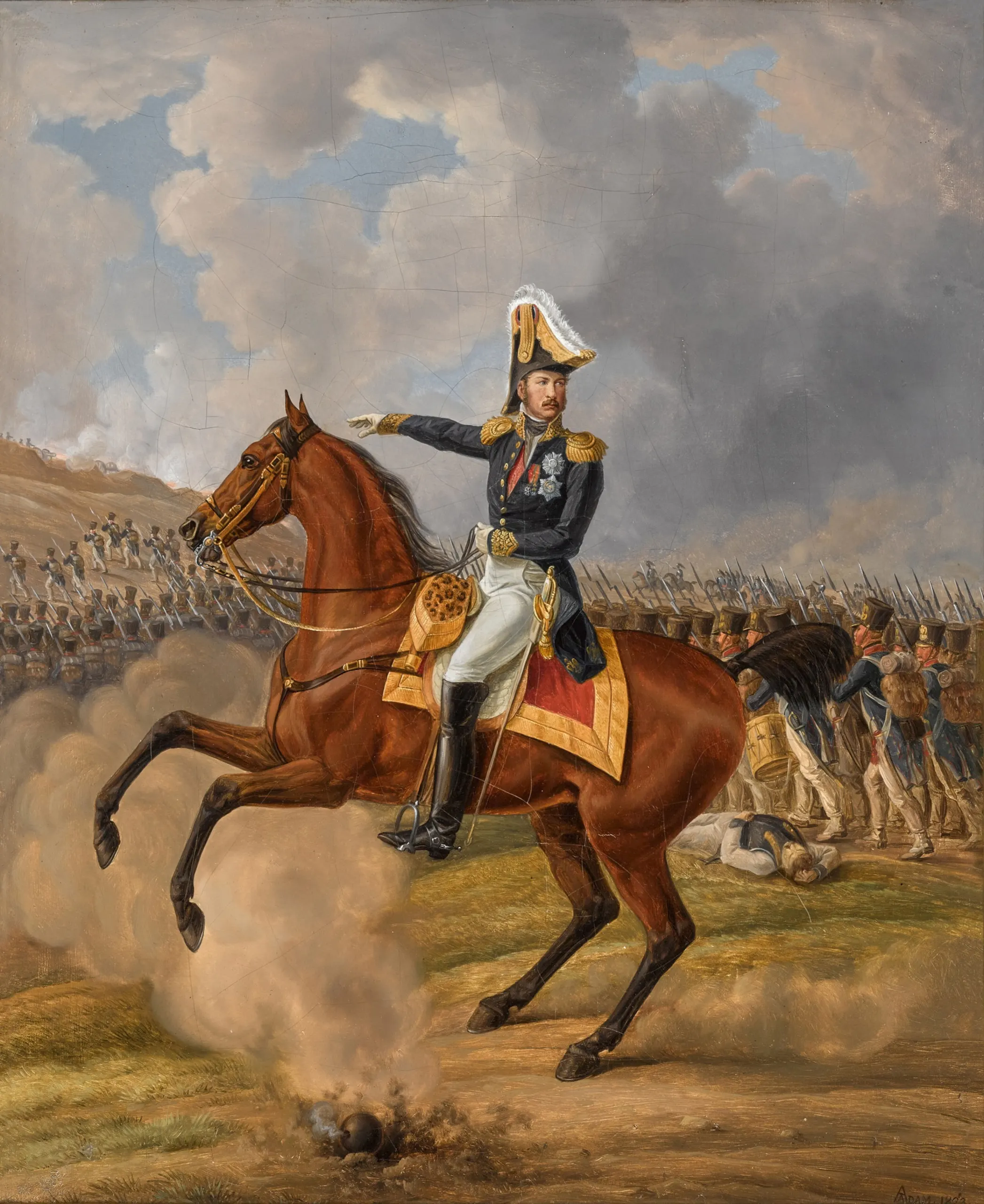
Eugène de Beauharnais
 France
politician•military officer•statesman
Also known as: Eugène Napoléon, Prince of Venice, Viceroy of Italy
Birthday
September 3, 1781
Birth Sign
Virgo
Birthplace
Paris, France
Age
Died at 42
About
Eugène Rose de Beauharnais (French: [øʒɛn d(ə) boaʁnɛ]; 3 September 1781 – 21 February 1824) was a French statesman and military officer who served in the French Revolutionary and Napoleonic Wars. Through the second marriage of his mother, Joséphine de Beauharnais, he was the stepson of Napoleon Bonaparte. Under the French Empire, he also became Napoleon's adopted son, though he was never the heir to the imperial throne. Consequently, he signed his name "Eugène Napoléon" while retaining his birth surname.
He was Viceroy of the Kingdom of Italy under his stepfather from 1805 to 1814, commanding the Army of Italy during the Napoleonic Wars. Historians consider him one of Napoleon's most able relatives and generals, noted for his administrative competence and loyalty. Unlike other members of the imperial family who often struggled with political viability, Eugène earned genuine respect for his military leadership and diplomatic skill in managing Italian affairs.
Early Life & Background
Born in Paris to Alexandre de Beauharnais and Joséphine de Tascher de la Pagerie, Eugène entered a world defined by rapid political upheaval. His childhood was marked by profound tragedy when his father, a nobleman who had opposed the radicalization of the Revolution, was executed by guillotine during the Reign of Terror in 1794. This event left Eugène and his younger sister Hortense orphans at the tender ages of thirteen and eleven, placing them under the guardianship of their mother.
Josephine remarried Napoleon Bonaparte in 1796, bringing Eugène into the orbit of one of history's most powerful figures. Although initially treated with some distance, Napoleon formally adopted Eugène in 1806, cementing his place within the imperial family. Before his rise to prominence as a Viceroy, Eugène received a rigorous education focused on military science and statecraft at the École Militaire in Paris. He began his service as an aide-de-camp to his stepfather, learning the intricacies of command and administration firsthand. By 1805, he had already distinguished himself in battle at Caldiero, proving his capabilities before receiving his first major independent command.
Career Growth
Eugène's career breakthrough arrived in 1805 when Napoleon appointed him Viceroy of the Kingdom of Italy, a position he held until 1814. This appointment made him one of the most powerful men in Europe, second only to Napoleon within the Italian territories. As Viceroy, he was not merely a figurehead but an active administrator who reformed the Italian legal system, established a national bank, and organized a standing army. His governance brought stability to the region and fostered a sense of Italian identity that would later influence the Risorgimento.
On the battlefield, he commanded the Army of Italy with notable success, particularly at the Battle of Raab in 1809, where he defeated Austrian forces and saved the French flank. During the disastrous Russian campaign of 1812, he managed the logistics and defense of the Italian front, preventing a total collapse of the southern flank. In 1813, as the Empire crumbled, he refused several proposals from Austria, Bavaria, and Joachim Murat to switch sides or lead an independent Italy, remaining steadfast to Napoleon even as defeat loomed. After Napoleon's abdication in 1814, Eugène retired to private life in France before returning to Italy to serve briefly under the Bourbon Restoration before focusing on his estate until his death.
Career Timeline
Public Image & Style
Eugène is viewed historically as the "ideal stepson" and a model of duty. Modern fans of Napoleonic history often refer to him affectionately as the "Viceroy of Italy" or "The Loyal Son." His public persona was defined by a blend of military prowess and administrative grace, setting him apart from the more flamboyant or politically unstable members of the imperial court. He cultivated an image of a statesman who cared deeply for the welfare of his subjects in Italy, earning the gratitude of many Italians who remembered his reforms favorably even after the fall of the Empire.
Fame & Fandom (iFAMOUS Rankings)
iFANN has not yet collected fame data for this person, so no current ranking is available. He does not appear on the August 2026 iFAMOUS Rankings flagship list. While there is no official fandom name, online communities dedicated to the Napoleonic Wars frequently discuss his biography and compare his leadership to that of his stepfather. These enthusiasts often focus on preserving the memory of his administrative reforms in Italy and his military strategies. Digital archives and historical societies maintain pages dedicated to his legacy, allowing modern audiences to explore his contributions to European history.
Interesting Facts and Legends
Eugène is famous for refusing to change his surname to "Bonaparte" despite his adoption, maintaining the "de Beauharnais" name to honor his birth family. He was also a dedicated patron of the arts and sciences in Italy, supporting institutions like the University of Pavia and funding various cultural projects. A legendary moment in his lore involves his conduct at the Battle of Raab, where he personally led a cavalry charge that turned the tide of the battle, a feat often retold in military academies. Another iconic story is his loyalty in 1813, where he rejected offers of independence for Italy from Austrian agents, choosing instead to fight for Napoleon until the very end. His signature style included the uniform of the Viceroy of Italy, often adorned with the decorations of the Legion of Honour and the Iron Crown of Italy.
Notable Quotes
“Brave, loyal”
Family & Personal Life
Eugène married Princess Augusta Amalia of Bavaria on January 14, 1806, in Munich. The marriage was arranged by Napoleon to strengthen ties between the French Empire and the Kingdom of Bavaria. Augusta was a devoted wife and mother, and the couple had six children: Charles, Eugène, Auguste, Henriette, Louise, and Josephine. The relationship was reportedly happy and stable, providing Eugène with a domestic anchor amidst his military campaigns. There are no records of romantic relationships prior to or outside of this marriage; his public image was that of a loyal son-in-law and dedicated family man. His mother, Joséphine, remained a central figure in his life, and he maintained close ties with his sister Hortense throughout his career.
Notable Connections
Relationships & Dating History
Eugène's only public relationship was with Princess Augusta Amalia of Bavaria. They married on January 14, 1806, in Munich in a union arranged by Napoleon to strengthen ties between the French Empire and the Kingdom of Bavaria. The marriage was reportedly happy and stable, producing six children: Charles, Eugène, Auguste, Henriette, Louise, and Josephine. There are no records of romantic relationships prior to or outside of this marriage; his public image was that of a loyal son-in-law and dedicated family man. As of his death in 1824, he was widowed only after his passing, having been married to Augusta until his final days.
- MarriedPrincess Augusta Amalia of Bavaria1806 - 1824Married in Munich; had six children together; she outlived him.
Death & Aftermath
Died
February 21, 1824 (aged 42)
Death Place
Milan, Kingdom of Lombardy-Venetia
Cause of Death
Tuberculosis
The news of Eugène's passing rippled through the courts of Europe, casting a somber shadow over Milan where he had served with such distinction. As Viceroy and a beloved figure within the Napoleonic dynasty, his loss was felt not merely as a personal tragedy but as a significant political event for the region that had known him as its ruler for nearly a decade. The city fell into a quiet mourning, with many recalling his steady hand during the turbulent years of the Empire. Eugène Rose de Beauharnais succumbed to tuberculosis on February 21, 1824, in Milan after a period of declining health that marked the final chapter of his life. Medical accounts from the time identified the disease as the primary cause, a condition that had gradually weakened his constitution despite his earlier resilience in the field.
His funeral became a solemn affair attended by high-ranking officials and former soldiers who had served under his command in Italy. The ceremony reflected the deep respect held for him as both a statesman and a military leader, honoring his long tenure as Viceroy and his role as Napoleon's adopted son. Following the services, the handling of his estate proceeded according to established protocols, ensuring that his legacy remained intact for his heirs without public controversy. The family retained their titles and lands, which were eventually absorbed into the Austrian-controlled Kingdom of Lombardy-Venetia, preserving the Beauharnais name within the European aristocracy.
Net Worth (Estate Value)
$9.7 Million
iFANN Editorial Team estimate
As a deceased historical figure, net worth is not applicable in the modern sense. His estate value is estimated based on the historical value of his lands and titles, which were largely absorbed into the Austrian-controlled Kingdom of Lombardy-Venetia after his death. The family's wealth was significant, derived from land holdings in France and Italy, but specific dollar figures do not exist. Posthumous earnings come from the sale of family artifacts and the licensing of historical IP, with recent auctions of Napoleonic relics reaching $9.7 million in 2025. iFANN currently estimates Eugène's net worth at approximately $9.7 Million based on the value of his family's enduring artifacts and historical significance.
Awards & Accolades
View 4 records, honours and achievementsKnown For
Kingdom of Italy
1805 · Viceroy
Napoleonic Wars
1805 · Commander
Keywords
Sources
Quick Facts
- Profession
- politician, military officer, military personnel
- Born
- September 3, 1781
- Birthplace
- Paris
- Died
- February 21, 1824
- Death Place
- Milan, Kingdom of Lombardy-Venetia
- Gender
- Male
- Spouse
- Princess Augusta Amalia of Bavaria
- Birth Sign
- Virgo
Personal Details
- Full Name
- Eugène Rose de Beauharnais
- Spouse
- Princess Augusta Amalia of Bavaria
- Children
- Charles, Eugène, Auguste, Henriette, Louise, Josephine
- Education
- École Militaire, Paris
Frequently Asked Questions
Who was Eugène de Beauharnais?
Did Eugène de Beauharnais have children?
How did Eugène die?
Was Eugène de Beauharnais Napoleon's heir?
What was Eugène's role in the Napoleonic Wars?
Similar People
Join the community
fans discussing