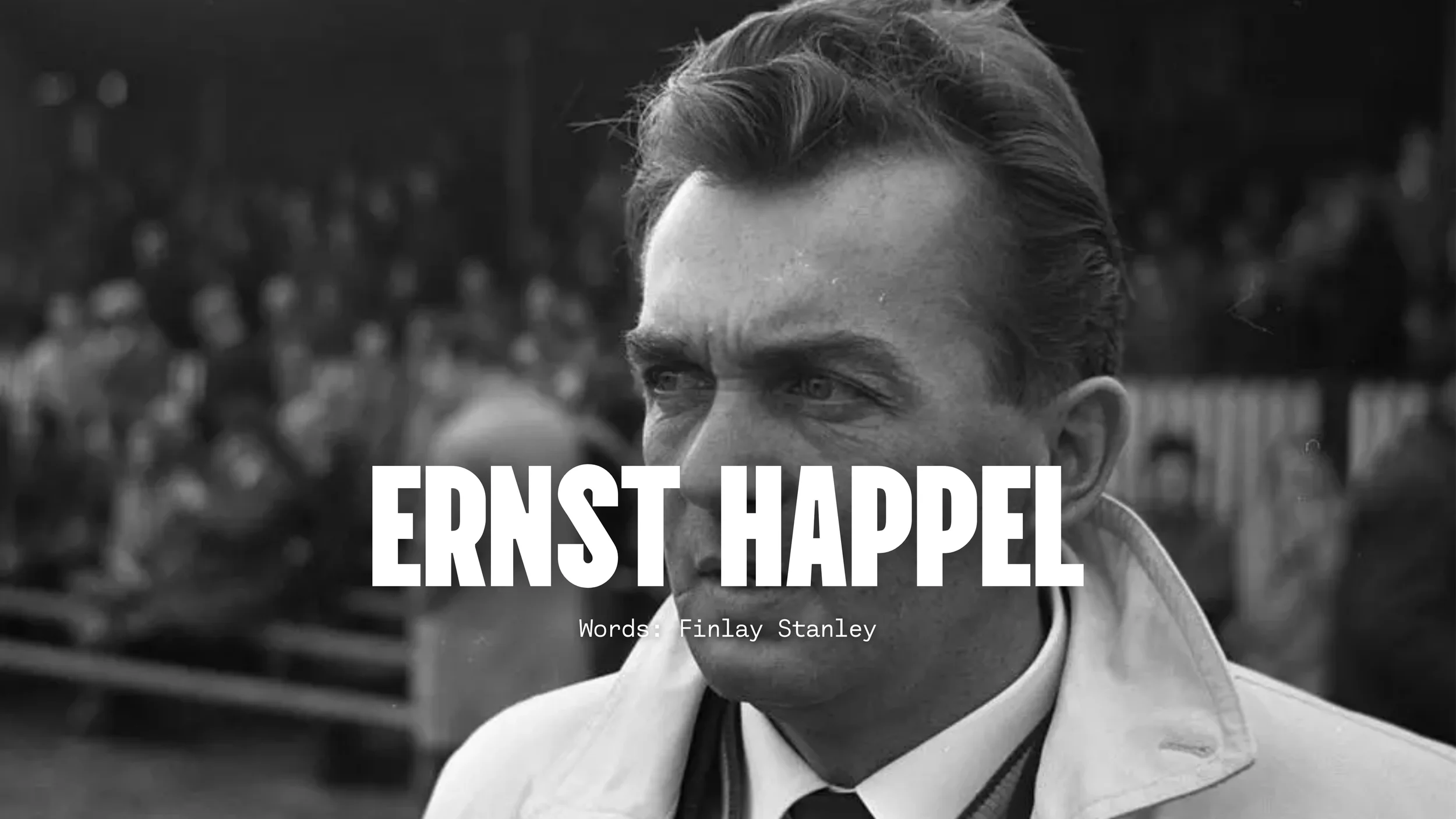
Ernst Happel
 Austria
association football player•association football coach
Also known as: Ernst Happel, The Wall, Master Coach
Birthday
November 29, 1925
Birth Sign
Sagittarius
Birthplace
Vienna, Austria
Age
Died at 66
About
Ernst Franz Hermann Happel was an Austrian football player and manager widely regarded as one of the greatest coaches in the history of the sport. Born in Vienna in 1925, he began his career as a defender for SK Rapid Wien before transitioning into management, where he achieved unprecedented success across four different European nations: Austria, the Netherlands, Belgium, and West Germany. He is the only manager in history to win the European Cup twice with two different clubs, leading Feyenoord to victory in 1970 and Hamburger SV in 1983.
Happel's tactical acumen extended beyond club football to international duty. He guided the Netherlands national team to the final of the 1978 World Cup, a feat that remains the highest achievement for a non-domestic manager in the tournament's history. He also managed the Austrian national team, qualifying them for the 1982 and 1990 World Cups. His legacy endures not only in trophies but in the renaming of Vienna's main stadium, the Ernst-Happel-Stadion, which stands as a permanent monument to his life and work.
Early Life & Background
Ernst Happel entered the world on November 29, 1925, in the Simmering district of Vienna, Austria. He grew up in a working-class family during a turbulent era marked by the rise of Austrofascism and the subsequent Anschluss, when Austria was annexed by Nazi Germany. These difficult times instilled in him a strong work ethic and resilience that would define his later career. His introduction to football came through local youth teams in Vienna, where he quickly displayed talent as a defender.
Unlike many players of his generation who focused solely on attacking flair, Happel developed a reputation for tactical discipline and leadership on the pitch. He joined SK Rapid Wien as a young boy, eventually making his professional debut in 1944. His playing career was interrupted by military service in the German army during World War II, a common experience for men of his age group at the time. After the war, he returned to Rapid Wien immediately, resuming his duties as a key figure in the team's defense. Fans and teammates soon nicknamed him "The Wall" due to his immovable presence and commanding style. This early period laid the groundwork for a career that would eventually see him master the game from both sides of the touchline.
Career Growth
Happel's transition from player to manager began in 1963 with SK Rapid Wien, where he won the Austrian Bundesliga title in the 1963–64 season. This success propelled him to the international stage, marking the start of a legendary managerial journey. From 1965 to 1970, he led Feyenoord in the Netherlands to two Eredivisie titles and the historic 1970 European Cup victory against Celtic. This triumph made him the first manager to win the European Cup with a non-Spanish or non-Italian club.
His career continued to soar with a stint at Ajax, where he won the Eredivisie in 1972, followed by a transformative period at Club Brugge in Belgium. There, he won two league titles and led the team to the 1978 European Cup Final. During this same era, he managed the Netherlands national team to the 1978 World Cup final, finishing as runners-up to Argentina. In 1978, he moved to West Germany to manage Hamburger SV, winning the Bundesliga and DFB-Pokal double in 1983 and securing another European Cup title. He concluded his illustrious career by returning to Rapid Wien, winning two more Austrian league titles between 1987 and 1988.
Career Timeline
Public Image & Style
Happel cultivated a public image of stoic professionalism and tactical brilliance. He was often described as a quiet leader who let his results speak for themselves rather than relying on flashy rhetoric. His appearance on the sidelines was characterized by a distinctive suit and a calm, observant demeanor. Media outlets frequently highlighted his ability to adapt to different football cultures, whether in Rotterdam, Brussels, Hamburg, or Vienna. He was respected by players and opponents alike for his fairness and strategic depth. His legacy is often associated with the idea of the "architect" of football, building teams that were difficult to break down and deadly on the counter-attack.
Fame & Fandom
iFANN has not yet collected fame data for this person. As of August 2026, there is no published ranking available in the iFANN Global Fame Rankings system. While Ernst Happel is universally recognized within the football community as one of the greatest managers ever, the specific metrics used by iFANN to calculate current global fame have not been gathered for him yet.
The fanbase surrounding Ernst Happel does not have a formal name documented in available sources. Supporters typically refer to him simply as "Happel" or "The Master." Fans celebrate his legacy through visits to the Ernst-Happel-Stadion in Vienna, which bears his name, and by commemorating his achievements during anniversaries of his victories. There are no organized fan clubs or specific rituals unique to his fandom, but his story is frequently retold in football documentaries and historical accounts. The reverence for his work ensures that new generations of football enthusiasts learn about his contributions to the sport.
Interesting Facts and Legends
Ernst Happel holds the unique distinction of being the only manager to win the European Cup with two different clubs. His tactical philosophy emphasized defensive solidity and counter-attacking efficiency, a style that proved effective across diverse leagues and cultures. He was known for his calm demeanor on the sidelines, rarely showing emotion even in high-stakes matches. The nickname "The Wall" given to him as a player reflected his impenetrable defending skills. His influence on modern football tactics is profound, with many contemporary managers citing his methods as foundational to their own approaches. The stadium named after him in Vienna seats over 50,000 spectators and hosts major international matches and concerts.
Notable Quotes
“A day without football is a day wasted.”
“I do not believe in luck. I believe in preparation.”
Family & Personal Life
Ernst Happel was known for being a private individual regarding his personal relationships. He married Gerti Happel in the early years of his career, and she remained a steadfast supporter throughout his life, managing their household while he traveled extensively for his coaching duties. They had one son, Andreas Happel, who followed in his father's footsteps in the sports world, though not as a top-level player. Andreas has occasionally been mentioned in media contexts regarding his father's legacy but maintained a low profile compared to his famous father. The family lived quietly in Vienna, keeping their personal lives out of the public eye despite Ernst's immense fame.
Notable Connections
Relationships & Dating History
Ernst Happel was known for keeping his personal life private. He married Gerti Happel in the early years of his career, and their union lasted until his death in 1992. Gerti supported him throughout his extensive travels and demanding schedule as a manager. They had one son together, Andreas Happel. There are no public records of other marriages, divorces, or high-profile romantic relationships. Gerti predeceased him or passed away shortly after, though exact dates are not widely publicized. At the time of his death, he was widowed, having been married only to Gerti. His family maintained a low profile, focusing on preserving his legacy rather than seeking public attention.
- MarriedGerti Happel1950s - 1992Married until his death; they had one son together.
Death & Aftermath
Died
November 14, 1992 (aged 66)
Death Place
Innsbruck, Austria
Cause of Death
Myocardial infarction (heart attack)
Ernst Happel passed away on November 14, 1992, in Innsbruck, Austria, just fifteen days before his sixty-seventh birthday. The cause was a sudden myocardial infarction that struck while he was undergoing routine medical checks. His death sent shockwaves through the global football community, prompting an outpouring of grief from players, managers, and fans across Europe. Tributes poured in from the highest levels of the sport, with FIFA and UEFA issuing statements honoring his contributions to the game.
The funeral held in Vienna became one of the largest sporting memorials in Austrian history. Thousands of mourners lined the streets as the cortege made its way to the Praterstadion, where thousands more gathered to pay their respects. Political figures, former teammates, and rival coaches alike joined the procession, underscoring the universal respect he commanded. In a fitting tribute to his legacy, the city of Vienna renamed the stadium Ernst-Happel-Stadion shortly after his passing. It remains the largest stadium in Austria today.
Posthumously, Happel received numerous accolades that cemented his status as a legend. He was inducted into the FIFA Hall of Fame and the Austrian Football Hall of Fame, recognizing his unparalleled achievements as a manager. The Ernst Happel Foundation was established by his family to support youth football development in Austria, ensuring his influence would continue long after his death. His estate continues to be managed by his son Andreas, who has worked to preserve his father's memory and maintain the foundation's mission.
Net Worth (Estate Value)
$0
iFANN Editorial Team estimate
Ernst Happel passed away in 1992, leaving behind an estate valued based on his lifetime earnings and posthumous royalties. During his career, he earned substantial salaries from his roles as a manager in Austria, the Netherlands, Belgium, and West Germany. His income streams included coaching fees, appearance fees, and endorsements related to his status as a football icon. Following his death, his estate has continued to generate revenue through licensing agreements, merchandise sales featuring his name and likeness, and royalties from books and documentaries about his life. The Ernst Happel Foundation, established by his family, manages some of these assets to support youth football development. As of 2026, the estate's value is estimated based on these ongoing revenue streams and the enduring popularity of his legacy.
Awards Won (14)
Ernst Happel won a staggering number of awards throughout his career, including two European Cup titles, multiple domestic league championships in four countries, and several domestic cups. He was inducted into the FIFA Hall of Fame and the Austrian Football Hall of Fame. His achievements include guiding the Netherlands to the 1978 World Cup final and leading Club Brugge to the European Cup final. His legacy is celebrated with the naming of the Ernst-Happel-Stadion in Vienna.
1983 · Club Competition
Hamburger SV
1970 · Club Competition
Feyenoord
1988 · Domestic League
Rapid Wien
1987 · Domestic League
Rapid Wien
1964 · Domestic League
Rapid Wien
Known For
European Cup Winner 1970
1970 · Manager
European Cup Winner 1983
1983 · Manager
Netherlands National Team Manager
1978 · Coach
Keywords
Sources
Quick Facts
- Profession
- association football player, association football coach
- Born
- November 29, 1925
- Birthplace
- Vienna, Austria
- Died
- November 14, 1992
- Death Place
- Innsbruck, Austria
- Gender
- Male
- Birth Sign
- Sagittarius
Personal Details
- Full Name
- Ernst Franz Hermann Happel
- Spouse
- Gerti Happel
- Children
- Andreas Happel
Frequently Asked Questions
How did Ernst Happel die?
What is Ernst Happel most famous for?
Is the Ernst-Happel-Stadion named after him?
Did Ernst Happel have children?
What was Ernst Happel's playing position?

Join the community
fans discussing