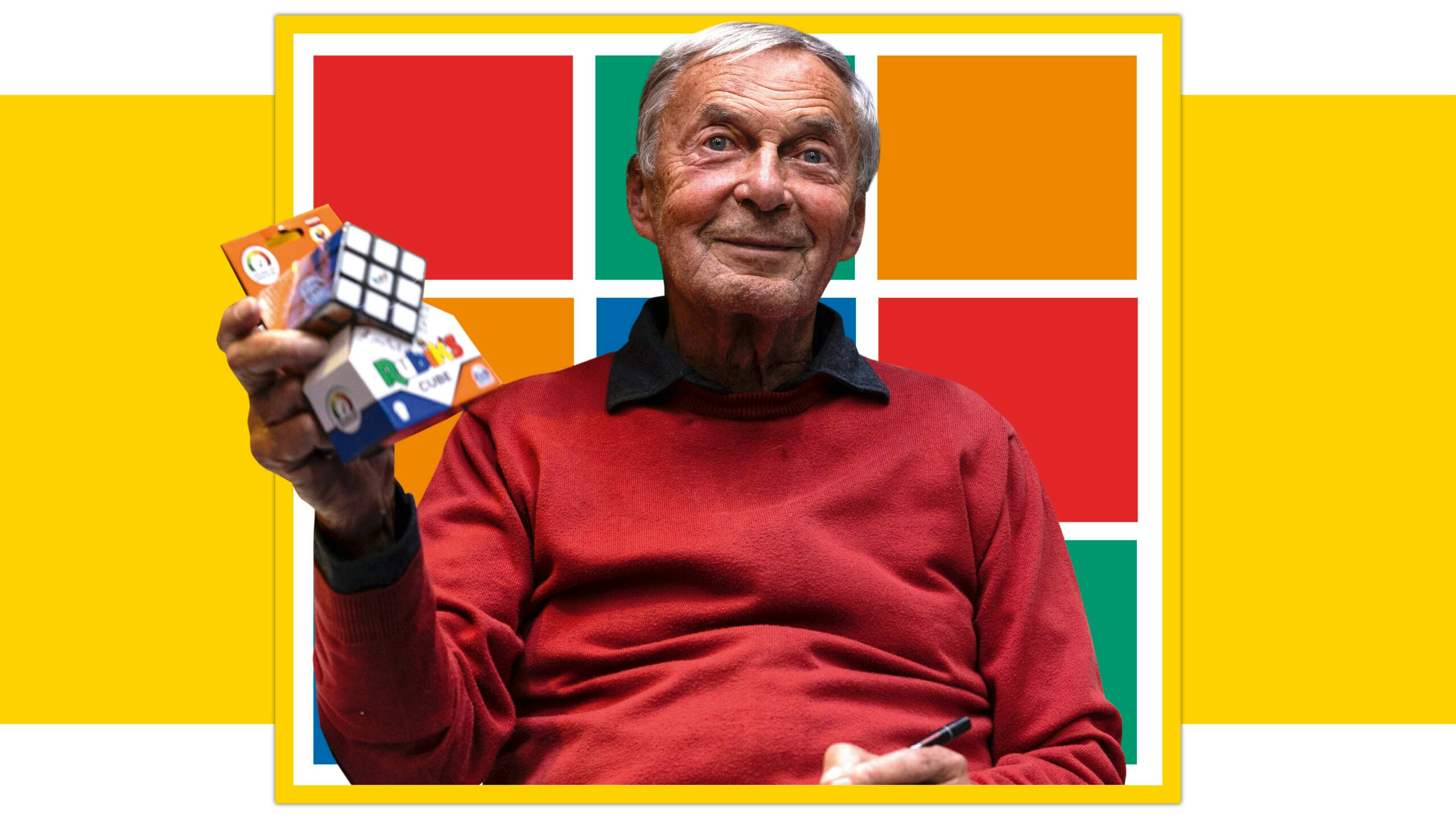
Ernő Rubik
 Hungary
architect•university teacher•engineer
Also known as: Erno Rubik, Ernö Rubik
Birthday
July 13, 1944
Birth Sign
Cancer
Birthplace
Budapest, Hungary
Age
82 years old
Height
5 ft 9 in (175 cm)
About
Ernő Rubik is a Hungarian architect, engineer, and university professor whose name is inseparable from the world's most famous puzzle. Born in Budapest on July 13, 1944, he has spent decades blending art, mathematics, and education. His invention, the Rubik's Cube, has sold over 450 million units worldwide and remains a cultural touchstone for problem-solvers of all ages.
Today Rubik focuses on educational outreach through the Rubik Learning Initiative and collaborations with other puzzle designers. He continues to speak at universities and events, championing the value of hands-on learning and spatial reasoning. His work has earned him honorary degrees from institutions like MIT and Cambridge, along with the Order of Merit of the Republic of Hungary.
Fans and educators alike celebrate him as a quiet genius who turned a classroom tool into a global phenomenon. His ongoing projects keep him active in the puzzle community, where he remains a revered and approachable figure.
Early Life & Background
Ernő Rubik grew up in Budapest in a household that prized both engineering and poetry. His father, an aircraft designer, and his mother, a poet, gave him an early appreciation for how structure and creativity could coexist. As a child, he was drawn to building blocks and geometric puzzles, often spending hours figuring out how shapes fit together.
He studied architecture at the Technical University of Budapest, graduating in 1967, then pursued sculpture at the Academy of Applied Arts and Design. That combination of technical and artistic training shaped his approach to design. He began teaching interior design and architecture, and it was during these early years that he started experimenting with three-dimensional models to help students grasp spatial relationships.
Rubik's first jobs were academic rather than commercial. He taught at the academy, where he became fascinated by the idea of a structure whose parts could move independently while still holding together. That curiosity eventually led him to build a working prototype from wood and rubber bands in 1974, a project he initially saw as a teaching aid, not a product.
Career Growth
In 1974, Ernő Rubik created the first working prototype of his Magic Cube, a 3x3x3 puzzle made from 27 wooden blocks. After scrambling it, it took him a month to solve, and he knew he had something special. He applied for a Hungarian patent in 1975, and the cube hit store shelves in Budapest in 1977.
The international breakthrough came in 1980 when Ideal Toy Corp began global distribution. Within three years, over 100 million units had been sold, and the cube became a worldwide craze. Rubik followed up with other puzzles like Rubik's Magic and Rubik's Snake, launching his own studio in 1984 to develop new ideas.
In the decades since, Rubik has shifted his focus to education. He founded the Rubik Learning Initiative and has supported the Judit Polgar Foundation, promoting science and math to children. In December 2025, he teamed up with Tetris creator Alexei Pajitnov to unveil a combined puzzle, released by Bandai Namco. As of 2026, he continues to work on new projects and promote the cube as a learning tool.
Career Timeline
Public Image & Style
Rubik is widely seen as a humble, intellectual figure who prioritizes education over celebrity. He speaks in measured, optimistic tones, often stressing that solvable problems offer comfort in a chaotic world. The speedcubing community, known as Cubers, treats him with near-reverence, and his birthday has become an informal holiday for puzzle enthusiasts.
His public appearances are marked by a casual style, typically a beard, glasses, and a modest wardrobe. He engages with fans through occasional social media posts and interviews, always steering the conversation back to learning and creativity. Media portrayals emphasize his role as a professor who stumbled onto a global phenomenon rather than a businessman chasing profit.
Fame & Fandom
Ernő Rubik stands as a singular figure in the history of play, his name echoing through classrooms and living rooms alike. While he remains a humble architect by trade, the global reach of his invention has propelled him into the upper echelons of international recognition. According to the iFANN Global Fame Rankings, he holds the position of the 11th most famous person from Hungary, a standing that has remained steady even as cultural tides shift across decades. This placement reflects not just the sales of a toy, but the enduring fascination with the logic and spatial reasoning it demands.
The community surrounding Rubik is vast yet strangely diffuse. Unlike the organized legions of pop stars or athletes, there is no formal moniker for those who revere the man himself. Fans identify primarily as cubers or speedcubers, an identity tied to the puzzle rather than the professor. They gather under the banner of the World Cube Association, organizing competitions that celebrate human dexterity over celebrity worship. A notable moment in this landscape occurred in August 2026, when Hungary's Tisza party received public nominations for the presidency that included Rubik alongside internet meme figures, signaling his status as a beloved national icon rather than a political candidate.
Rubik's personal engagement with this audience has been marked by quiet collaboration rather than grand spectacle. In December 2025, he met Alexey Pajitnov, the creator of Tetris, for the first time in forty years. Their union produced a joint puzzle unveiled by Bandai Namco, merging two of the world's most iconic mechanical challenges. This meeting cemented a new chapter in puzzle lore, bridging generations of problem-solvers. Today, fans celebrate his birthday annually with charity solves, turning a personal milestone into a global gathering that honors the joy of solving the unsolvable.
Interesting Facts and Legends
Ernő Rubik's original wooden prototype sits in a Budapest museum, a tangible relic of the moment the idea took shape. He once solved the cube in under a minute using a teaching method he developed, demonstrating the deep understanding behind the mechanism. A trained pianist, Rubik finds harmony between classical music and spatial logic in his spare time. He considered naming his invention the Magic Box before settling on Magic Cube, a choice that would define a generation of toys.
Speedcubers celebrate his birthday every year with online events and charity solves, turning his personal milestone into a global gathering. Legends surrounding his life often focus on the creation of the Magic Cube in 1974. As a professor of architecture, Rubik designed the mechanism to help students visualize three-dimensional objects, not to create a commercial toy. The story holds that it took him one month to solve the prototype after scrambling it, a tale often cited to illustrate the complexity of the puzzle even for its creator.
A widely retold story concerns the cube's explosive popularity in 1981 during 'Rubik's Cube fever.' Crowds gathered to watch speed-solvers, and one specific viral moment involving an extraordinarily short solve cemented the cube's status as an icon of intelligence. In December 2025, the collaboration between Rubik and Alexey Pajitnov became a significant narrative point, symbolizing the convergence of two influential puzzles in history.
Notable Quotes
“I wanted to show my students how to move parts independently in space.”
“When so many of life's problems are unsolvable, solvable problems are a comfort.”
“We have to look for entertainment that challenges us.”
“The cube is not just a toy; it is a tool for learning.”
Family & Personal Life
Ernő Rubik married Veronika Bajor, a fellow artist and sculptor, in 1971. They met while studying at the Academy of Applied Arts and Design. The couple has two children, Evelin and Barnabás. Veronika has collaborated with Rubik on artistic projects but keeps a low public profile. The family has lived in Budapest for most of their lives, and their long marriage is often cited as a source of stability for Rubik's creative work.
Notable Connections
Rubik's inner circle includes his wife Veronika Bajor, a sculptor, and his longtime collaborator Alexei Pajitnov, creator of Tetris. He has worked with educators and puzzle designers worldwide, and his initiatives have partnered with organizations like the Judit Polgar Foundation to promote STEM learning.
Relationships & Dating History
Ernő Rubik's personal life has been remarkably private, and his marriage to Veronika Bajor is the only significant relationship documented. They met while studying at the Academy of Applied Arts and Design in the late 1960s and married in 1971, three years before he invented the cube.
The couple has two children, Evelin and Barnabás, and has remained together through the decades of Rubik's fame. Veronika, an artist in her own right, has occasionally collaborated with her husband on creative projects but stays out of the public eye.
As of 2026, Rubik is still married to Veronika. There are no reports of separations, divorces, or other romantic partners in his life. His long-lasting marriage is often noted as a grounding influence in interviews.
- MarriedVeronika Bajor1971 - presentCurrentMet at the Academy of Applied Arts and Design; married in 1971, two children.
Salary, Net Worth In 2026
$12 Million
iFANN Editorial Team estimate
As of 2026, Ernő Rubik's net worth is estimated at $12 Million per iFANN's editorial analysis. This figure reflects the ongoing licensing revenue from the Rubik's Cube brand, which has sold more than 450 million units globally. Royalties from merchandise sales, books, and collaborations provide a steady income stream. Rubik's wealth has grown steadily over the past decade, buoyed by renewed interest in the cube and his educational ventures. In addition to licensing, he earns from speaking engagements and consulting for puzzle companies. He also owns real estate in Budapest and has invested in education-focused tech startups. Unlike many inventors, Rubik's income is tied almost entirely to his intellectual property rather than endorsements. The Rubik Learning Initiative, while not a major profit center, enhances his brand and opens doors for partnerships. His financial trajectory remains stable, with no major dips or windfalls reported in recent years.
Awards Won (4)
Ernő Rubik's honors reflect his impact on education and culture. He has received honorary degrees from the University of Cambridge and MIT, and in 2004 was awarded the Order of Merit of the Republic of Hungary. He was inducted into the National Inventors Hall of Fame in 2011 and received the Lemelson-MIT Prize for Innovation in 2012. The French government made him a Commandeur de l'Ordre des Arts et des Lettres in 2009.
2004 · Civilian Honor
Lifetime achievement
2009 · Cultural Honor
Contribution to culture
Known For
Rubik's Cube
1974 · Inventor
Rubik's Magic
1984 · Inventor
Rubik's Snake
1984 · Inventor
Keywords
Sources
Quick Facts
- Profession
- architect, university teacher, engineer
- Born
- July 13, 1944
- Birthplace
- Budapest, Hungary
- Gender
- Male
- Birth Sign
- Cancer
- Height
- 5 ft 9 in (175 cm)
- Spouse
- Veronika Bajor
- Children
- Evelin Rubik, Barnabás Rubik
- Education
- Technical University of Budapest, Academy of Applied Arts and Design
Personal Details
- Full Name
- Ernő Rubik
- Height
- 5 ft 9 in (175 cm)
- Spouse
- Veronika Bajor
- Children
- Evelin Rubik, Barnabás Rubik
- Education
- Technical University of Budapest (architecture), Academy of Applied Arts and Design (sculpture)
Frequently Asked Questions
How old is Ernő Rubik?
Who is Ernő Rubik married to?
What is Ernő Rubik's net worth?
Did Ernő Rubik ever solve the Rubik's Cube?
What is Ernő Rubik doing in 2026?
Social Media
Similar People

Join the community
fans discussing