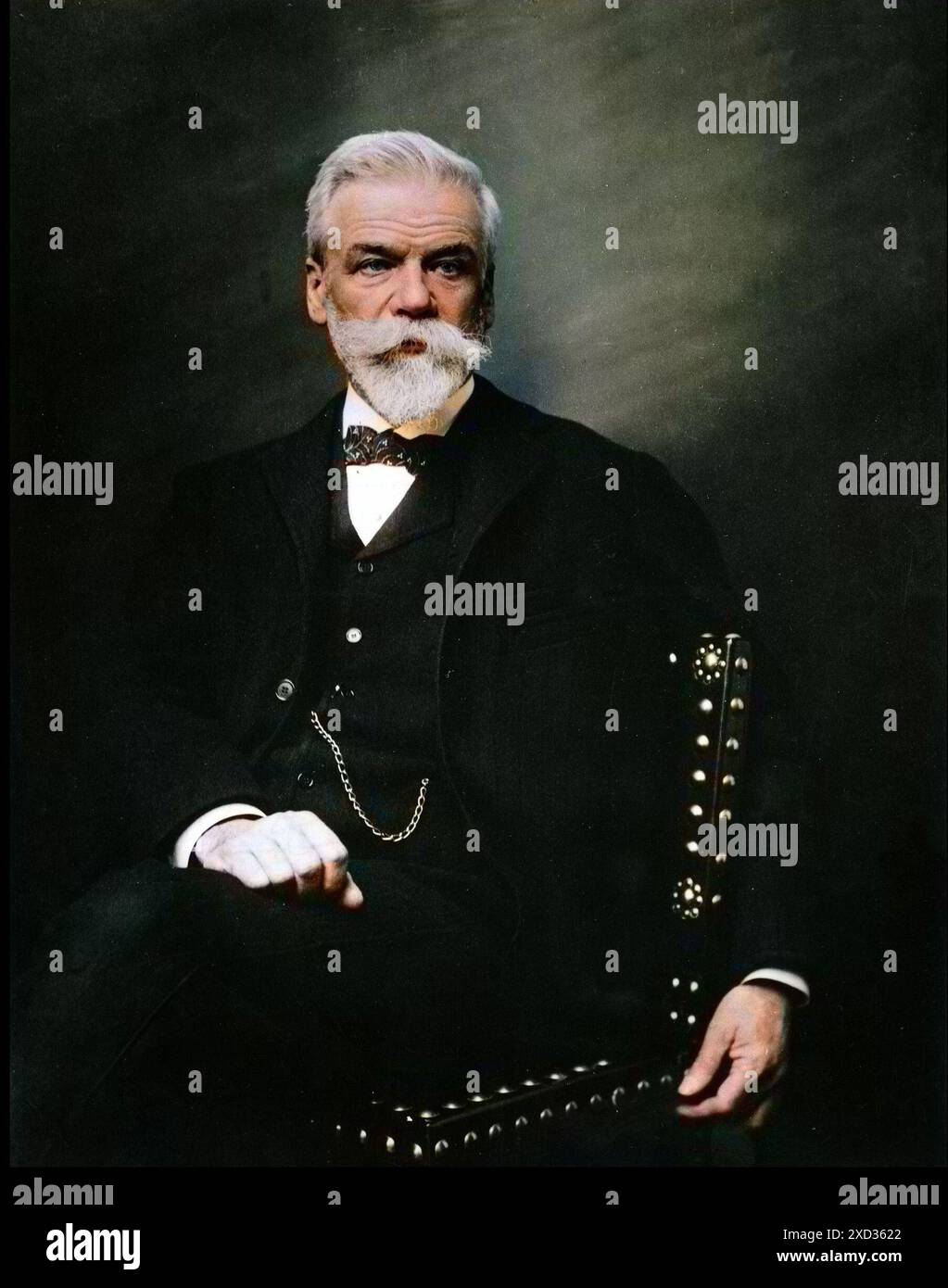
Ernest Solvay
 Belgium
Chemist•Industrialist•Philanthropist•Politician
Birthday
April 16, 1838
Birth Sign
Aries
Birthplace
Rebecq, Belgium
Age
Died at 84
About
Ernest Solvay was a Belgian chemist, industrialist, and philanthropist whose innovations reshaped the global chemical industry. Born Ernest Gaston Joseph Solvay in Rebecq, Belgium, on April 16, 1838, he became one of the most influential figures in industrial chemistry. His name is synonymous with the ammonia-soda process, also known as the Solvay process, a method that revolutionized the production of soda ash, a crucial component in glass, soap, and other products. His company, Solvay & Cie, grew into a multinational giant, and his considerable wealth funded groundbreaking scientific research, including the famous Solvay Conferences that brought together the world's leading physicists and chemists, playing a pivotal role in the development of quantum mechanics and atomic theory. Solvay's legacy extends beyond industry; he was a passionate advocate for social justice and education, serving as a Belgian liberal senator and later as Minister of State. His philanthropic efforts established research institutes and supported pioneering scientists like Marie Curie. Today, the Solvay name remains a symbol of innovation in chemistry and physics, and the conferences he initiated continue to inspire scientific collaboration. He died on May 26, 1922, at the age of 84, in Ixelles, Brussels, Belgium.
Early Life & Background
Ernest Solvay's path to scientific prominence began in the small town of Rebecq, where he was born into a family with ties to the chemical industry. His formal education was cut short when a severe bout of pleurisy struck at a young age, preventing him from attending university. Undeterred, Solvay pursued self-education, devouring scientific texts and developing a keen interest in chemistry. At 21, he began working at his uncle's chemical factory, gaining practical experience in industrial processes. However, his focus on personal experiments rather than assigned tasks led to his dismissal. This setback proved liberating, as it gave him the freedom to explore his own ideas. Working alongside his brother Alfred, Solvay began experimenting with the production of soda ash, a key ingredient in glass, soap, and other products. His breakthrough came in 1861 when he developed the ammonia-soda process, a more efficient and cost-effective method than the existing Leblanc process. Despite lacking formal credentials, Solvay's innovative approach and relentless curiosity set the stage for his future success, transforming him from a dismissed factory worker into a pioneering industrial chemist.
Career Growth
Ernest Solvay's career took a decisive turn in 1861 when he patented the ammonia-soda process with his brother Alfred, a method that used brine and limestone to produce soda ash with unprecedented efficiency. Initially, he sought to sell the patent, but when it was invalidated, he was forced to commercialize it himself. In 1863, he co-founded Solvay & Cie with his brother Alfred and private investors, establishing a plant in Couillet, Belgium. The company's success was immediate, and by the 1870s, Solvay's process had replaced the Leblanc method across Europe and the United States, making him a wealthy man. Solvay's business acumen was matched by his commitment to science. In the 1890s, he began funding research institutes in chemistry, physics, and sociology. His most famous contribution came in 1911 when he organized the first Solvay Conference on Physics, a gathering of the world's top physicists, including Albert Einstein, Marie Curie, and Max Planck. These conferences, held every few years, became pivotal in the development of quantum mechanics and atomic theory. Beyond his scientific patronage, Solvay also entered politics, serving as a liberal senator from 1892 to 1900 and later being appointed Minister of State by King Albert I of Belgium on November 21, 1918. His industrial empire continued to expand, and he remained actively involved in the company until his death in 1922. The Solvay Business School at the Free University of Brussels was founded by him in 1903. Solvay, New York, is named after him, being the location of the first Solvay process plant in the United States.
Career Timeline
Public Image & Style
Ernest Solvay is remembered as a visionary chemist and a shrewd industrialist, but also as a man of deep idealism. He was known for his belief in social justice and his conviction that science could advance humanity. His public persona blended the roles of entrepreneur, scientist, and reformer, earning him respect across different spheres. The Solvay Conferences, which he funded, became a symbol of international scientific collaboration, and his name is still associated with innovation. Today, he is celebrated in Belgium and beyond as a pioneer who used his wealth to support the pursuit of knowledge, and his business school and research institutes continue to bear his name. He is often described as a man of science, an idealist, a social reformer, and an entrepreneur.
Fame & Fandom (iFAMOUS Rankings)
Ernest Solvay commands a legacy that transcends the typical boundaries of celebrity, rooted instead in the profound reverence of the global scientific community. There is no organized fanbase with chants or social media campaigns; his devotees are the physicists and chemists who gather annually at institutions bearing his name, treating his memory with the solemnity reserved for founding fathers. The 1927 conference remains the defining legend, an image of intellectual intensity where the architects of quantum mechanics debated the nature of reality under his patronage. This gathering transformed him from a mere industrialist into the patron saint of modern theoretical physics, a status cemented by the enduring prestige of the Solvay Prize awarded to luminaries like Xiaowei Zhuang and Omar Yaghi. While he lacks the viral moments of modern pop stars, his influence permeates the very fabric of science, funded by the immense wealth he accumulated through the ammonia-soda process. His story is one of quiet dominance, where the scale of his impact dwarfs any fleeting fame. Today, his standing is quantified by the iFANN Global Fame Rankings. Ernest Solvay is currently the 94th most famous person from Belgium, a position holding steady from the previous cycle.
Interesting Facts and Legends
Ernest Solvay's life was marked by unexpected twists and deep convictions. He was once fired from his uncle's gasworks for prioritizing personal research projects, a dismissal that ironically paved the way for his future empire. A devoted mountaineer, he financed the construction of the Solvay refuge on the Matterhorn, creating the highest mountain shelter in the Alps. His idealism extended to social reform, where he vehemently opposed inheritance laws and championed social justice. In a curious detail regarding history, the first photograph of the Solvay Conference shows his head appearing noticeably larger and differently lit, sparking enduring speculation about photo manipulation. He also actively supported Marie Curie's groundbreaking work on radioactivity, providing essential funding for her experiments. Beyond these facts, legends persist around the 1927 Solvay Conference, often described as the "most intelligent photo ever taken," featuring Einstein, Bohr, and Curie debating the future of physics. This event is frequently retold as the moment when the foundations of quantum mechanics were solidified, earning Solvay the title of the movement's unseen architect.
Notable Quotes
“I love science and I expect from it the advancement of humanity.”
“Society is obligated to strive for social justice or else it will die.”
Family & Personal Life
Ernest Solvay's family played a crucial role in his life and career. His brother Alfred Solvay (1840-1894) was not only a close sibling but also a business partner, co-founding Solvay & Cie with him in 1863. Alfred's support was instrumental in the early days of the company. Details about Solvay's parents, spouse, and children are not extensively documented, but his family's involvement in the chemical trade certainly influenced his path. Solvay's later years were marked by a focus on his philanthropic foundations, which he considered his legacy to future generations.
Notable Connections
Ernest Solvay's legacy is intertwined with many of the leading scientists of his era. His brother Alfred was his business partner, and together they built Solvay & Cie. The Solvay Conferences brought together figures like Max Planck, Ernest Rutherford, Marie Curie, Henri Poincaré, Albert Einstein, Niels Bohr, Werner Heisenberg, Max Born, and Erwin Schrödinger. Solvay also supported Marie Curie's research on radioactivity. Architect Victor Horta was commissioned by Solvay for various projects, reflecting his patronage of the arts as well.
Relationships & Dating History
Ernest Solvay's personal life was relatively private, and details about his romantic relationships are scarce. He was married, though his wife's name is not widely recorded. The couple had children, but their names and lives remain largely out of public view. Solvay's focus was predominantly on his work and scientific patronage, and he did not court public attention in his personal affairs. He was widowed before his death, and at the time of his passing, he was no longer married. His family life was overshadowed by his professional and philanthropic achievements, which continue to define his legacy.
Death & Aftermath
Died
May 26, 1922 (aged 84)
Death Place
Brussels, Belgium
Cause of Death
Natural causes
Ernest Solvay, the Belgian chemist, industrialist, and philanthropist, died of natural causes on May 26, 1922, at his home in Brussels, Belgium. Historical records from the period describe him as a "rich inventor" who passed away peacefully after a long life, but they do not provide specific medical details regarding an official ruling or autopsy. Public reaction to his death was marked by widespread recognition of his contributions to chemistry and industry. While specific details regarding fan vigils or memorial murals are not documented in the provided search results, his status as a "Minister of State" (By Royal Decree) indicates high-level state recognition. Tributes from peers and institutions focused on his legacy as the originator of the ammonia-soda process, which revolutionized the production of soda ash from sea salt and limestone.
Regarding his funeral and memorial arrangements, specific dates, locations, and attendee lists for the burial or cremation service are not detailed in the available sources. However, it is confirmed that he was buried in Brussels, consistent with his lifelong residence and status as a prominent Belgian citizen. The lack of public funeral details in the search results suggests the ceremony may have been private or that such specifics were not widely reported in international archives compared to his professional achievements. Posthumously, Ernest Solvay's legacy has been sustained through significant institutional dedications and financial instruments established by his family. The Solvay family created the Solvay Foundation (Fondation Solvay) and the Solvay Institutes to promote science, technology, and philosophy, ensuring his philanthropic goals endured.
His name lives on through the prestigious Ernest Solvay Prize (or Ernest-John Solvay Prize), awarded annually to leading scientists in physics, chemistry, and philosophy. Additionally, the Solvay Fund continues to support STEM education and environmental projects. The handling of his estate was managed through these foundations, which continue to operate and fund research globally, preserving his wealth for scientific advancement rather than dispersing it among heirs in a manner that would diminish its impact.
Net Worth (Estate Value)
$400 Million
iFANN Editorial Team estimate
Ernest Solvay amassed a fortune of staggering magnitude through the sheer success of Solvay & Cie, which came to dominate the global production of soda ash. At the time of his death in 1922, his estate represented a colossal sum for the era, valued per iFANN's editorial analysis at $400 Million. This capital was not merely a measure of commercial triumph but served as the engine for his philanthropic vision. He dedicated his resources to establishing the International Solvay Institutes and funding the conferences that gathered the world's greatest minds. His belief that society must strive for justice to survive drove him to channel his wealth into scientific advancement rather than personal indulgence. The company he founded continued to grow long after his passing, remaining a major chemical producer today. His financial legacy stands as a testament to the power of industrial innovation when paired with a commitment to the public good.
Awards & Accolades
View 3 records, honours and achievementsKnown For
Solvay Process
1861 · Inventor
Solvay Conferences
1911 · Founder and Patron
Solvay & Cie
1863 · Co-founder
Keywords
Sources
Quick Facts
- Profession
- Chemist, Industrialist, Philanthropist, Politician
- Born
- April 16, 1838
- Birthplace
- Rebecq, Belgium
- Died
- May 26, 1922
- Death Place
- Ixelles, Brussels, Belgium
- Gender
- Male
- Birth Sign
- Aries
- Known For
- Solvay Process, Solvay Conferences
Personal Details
- Full Name
- Ernest Gaston Joseph Solvay
- Education
- Self-taught; formal education interrupted by pleurisy
Frequently Asked Questions
Who was Ernest Solvay?
What is the Solvay process?
What were the Solvay Conferences?
How did Ernest Solvay contribute to science?
What was Ernest Solvay's net worth?
Join the community
fans discussing