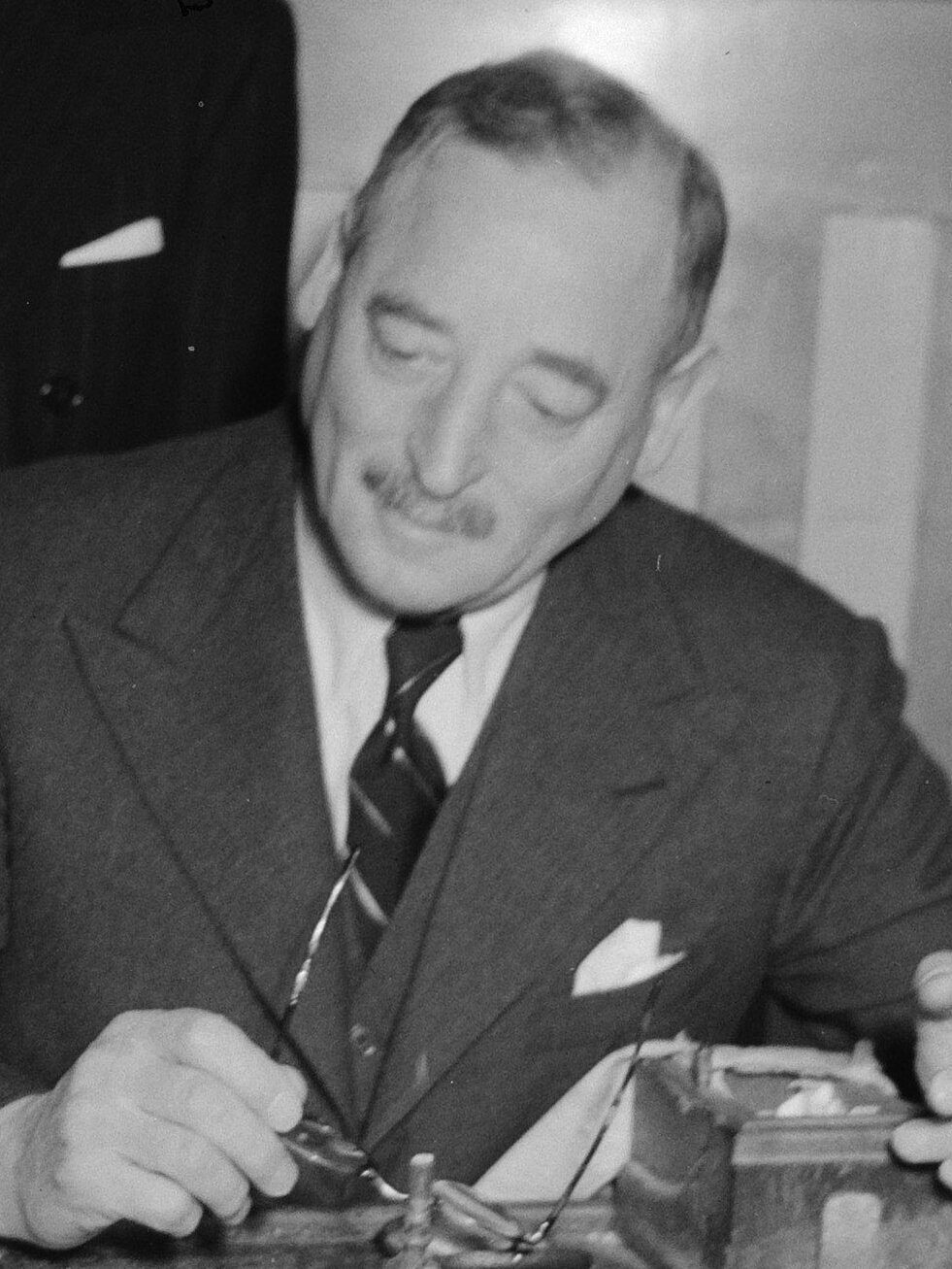
Ernest Oppenheimer
 South Africa
Mining magnate•financier•philanthropist
Also known as: Sir Ernest Oppenheimer
Birthday
May 22, 1880
Birth Sign
Gemini
Birthplace
Friedberg, Grand Duchy of Hesse, German Empire
Age
Died at 77
About
Sir Ernest Oppenheimer was a German-born South African mining magnate, financier, and philanthropist who reshaped the global diamond industry. He founded the Anglo American Corporation in 1917 and took control of De Beers in 1927, building a near-monopoly over the world's diamond production. His business acumen and strategic vision turned him into one of the most powerful and wealthiest figures of the 20th century.
Oppenheimer's influence extended beyond mining into politics and public service. He served as Mayor of Kimberley, sat in the South African Parliament, and was knighted in 1921. His legacy is carried on through the Brenthurst Library, which preserves his papers, and the continued prominence of the Oppenheimer family in global business.
Early Life & Background
Ernest Oppenheimer was born on 22 May 1880 in Friedberg, a small town in the Grand Duchy of Hesse, German Empire. His father, Eduard, was a cigar merchant, and his mother, Nanette, came from a Jewish family. The household was modest, and young Ernest's formal schooling ended early; he entered the workforce at 16 or 17 as a junior clerk at Dunkelsbuhler & Company, a London-based diamond brokerage.
His diligence and quick grasp of the trade impressed his employers. In 1902, at just 22, they sent him to Kimberley, South Africa, to represent the firm as a buyer. He never returned to Europe permanently. In Kimberley, he immersed himself in the diamond and gold industries, learning the intricacies of mining finance. He married Mary Lina Pollak in 1906 and built a home in the city, gradually becoming a partner in Dunkelsbuhler and taking the lead in its affairs.
His entry into public life came in 1908 when he was elected to the Kimberley city council. In 1912 he became mayor, a role he held until 1915. During his tenure, he worked to amalgamate the neighbouring municipalities of Kimberley and Beaconsfield and helped raise manpower for the Kimberley Regiment in World War I. But anti-German sentiment, stoked by the sinking of the Lusitania, turned against him. His house was stoned, and he resigned as mayor, sending his family to England for safety. That period of adversity only hardened his resolve.
Career Growth
Oppenheimer's breakthrough came in 1917 when he founded the Anglo American Corporation, backed by financier J.P. Morgan, with £1 million in capital. The company initially targeted the east Witwatersrand goldfield, but Oppenheimer's ambitions quickly expanded. In 1919 he formed Consolidated Diamond Mines of South West Africa, acquiring diamond mines that challenged De Beers' dominance.
By 1927 he had gained control of De Beers, the company originally built by Cecil Rhodes. Under his chairmanship from 1929, De Beers became a global monopoly, controlling the vast majority of the world's diamond supply. He established The Diamond Corporation in 1930 to stabilise prices and famously adopted the slogan 'A diamond is forever' to sustain demand. He also founded the Rhodesian Anglo American Corporation in 1929 to exploit copper in Northern Rhodesia, and later pioneered new goldfields in the Orange Free State.
Oppenheimer served as a member of the South African Parliament from 1924 to 1938, representing Kimberley. He stepped down as chairman of Anglo American in 1953 but remained chairman of De Beers until his death in 1957. His last major project was developing the Orange Free State goldfields, a venture that proved lucrative.
Career Timeline
Public Image & Style
To the public, Ernest Oppenheimer was something of a mystery man. The New Yorker described him in 1956 as 'really a mystery man' – not a society-column regular, not seen at Cannes, not a first-nighter. He preferred books and paintings, and staying at home.
In South Africa, he was seen as a towering figure of industry and philanthropy, admired for his business acumen and his contributions to public life. His reputation as a shrewd negotiator and a builder of monopolies was matched by a personal style that was understated and private. There is no official fandom for a historical mining magnate, but his legacy is studied in business and South African history contexts, and the Oppenheimer name remains synonymous with the diamond trade.
Fame & Fandom (iFAMOUS Rankings)
Ernest Oppenheimer's name still surfaces in YouTube comment sections and business-school case studies, but that's the extent of it. There is no formal fandom, no fan club, no convention circuit. His fanbase, if you can call it that, is a loose community of history buffs, old-money enthusiasts, and mining-industry watchers who share his story in digital spaces. They have no name, no shared rituals, no coordinated campaigns. The closest thing to organized activity around his legacy is institutional: the Oppenheimer Memorial Trust and the Brenthurst Foundation continue his philanthropic work, but those are family operations, not fan initiatives.
What Oppenheimer lacks in fandom, he makes up for in legend. The story of the young German immigrant who arrived in South Africa in 1902 with nothing and built a diamond empire is a rags-to-riches myth retold in documentaries and biographies. His 1921 knighthood, a Jewish immigrant knighted by the British Crown, remains a remarkable social ascent. And the 1929 De Beers chairmanship is often framed as a masterful corporate coup, a narrative that persists in business lore.
As for his standing in the global fame landscape, iFANN's Global Fame Engine has evaluated Ernest Oppenheimer, but he does not currently hold a placement in the published rankings. No Global Top 1,000, no Top-100 scope list. That may seem surprising for a man who once controlled the world's diamond supply, but fame is a fickle currency, and his brand of power, quiet, corporate, behind the scenes, doesn't translate into modern celebrity metrics.
Interesting Facts and Legends
Ernest Oppenheimer loved champagne and made a point of drinking it regularly after acquiring the taste in his early Kimberley days, a habit he kept for life. He was once dismissed by a sorting-room colleague as 'terribly bashful' and 'not very bright' – a misjudgment that became one of his favourite stories to tell. During World War I, anti-German riots in Kimberley led to his house being stoned and threats to burn it down, forcing him to send his wife and children to England for the rest of the war. He was naturalised as a South African citizen and spent most of his life in Johannesburg, preferring books, paintings, and staying at home over society events. His son Harry recalled that his father entered municipal politics 'as he said because he had nothing else to do, but actually with the idea of training himself for public life in a wider sphere.'
One legend that still circulates is the 'scarcity memo', a private note in which he purportedly wrote that the only way to raise a diamond's value is to make it scarce. While the exact document hasn't been publicly produced, the strategy it describes was real: De Beers under Oppenheimer deliberately controlled supply to maintain high prices. Another story fans of business history retell is the founding of Anglo American in 1917, when Oppenheimer, backed by American financiers, launched the company that would come to dominate global mining. His death in 1957 was itself an iconic moment, with The New York Times calling him 'last of the original founders of South Africa's mining industry.'
Notable Quotes
“Your telegram received; meet me at station to look after luggage.”
“I entered politics because I had nothing else to do, but actually with the idea of training myself for public life in a wider sphere.”
Family & Personal Life
Ernest Oppenheimer married Mary Lina Pollak, from London, on 19 June 1906. They had two sons: Frank and Harry. Mary died in 1934, and two years later he married Caroline Magdalen Harvey, the daughter of a knighted Briton. Caroline was at his side until his death in 1957.
The Oppenheimer family lived in Johannesburg, where Ernest preferred a quiet domestic life, surrounded by books and paintings. His son Harry succeeded him in the family business, and his grandson Nicky carried on the mining legacy until the De Beers sale in 2012. The Brenthurst Library, established by Harry, preserves Ernest's personal papers and history.
Notable Connections
Ernest Oppenheimer's career was shaped by key figures. American financier J.P. Morgan backed the founding of Anglo American in 1917. He took control of De Beers, originally built by Cecil Rhodes, in 1927. His son Harry Oppenheimer succeeded him in the family business, and his grandson Nicky carried on the mining legacy until the De Beers sale in 2012.
Relationships & Dating History
Ernest Oppenheimer's personal life was notably stable and private. He married Mary Lina Pollak, from London, on 19 June 1906. The couple had two sons, Frank and Harry. Mary died in 1934. Two years later, in 1936, he married Caroline Magdalen Harvey, the daughter of a knighted Briton. Caroline remained his wife until his death in 1957. At the time of his death, he was widowed from Caroline, as she survived him.
- MarriedMary Lina Pollak1906 - 1934Married on 19 June 1906; had two sons, Frank and Harry. She died in 1934.
- MarriedCaroline Magdalen Harvey1936 - 1957Married in 1936; remained together until his death in 1957.
Death & Aftermath
Died
November 25, 1957 (aged 77)
Death Place
Johannesburg, South Africa
Cause of Death
Unknown
Contemporary reports hailed Sir Ernest Oppenheimer as the last of the original founders of South Africa's mining industry, a title that underscored the finality of an era. The New York Times and other major outlets marked his passing with extensive coverage, focusing on his role in establishing the modern diamond and gold sectors rather than immediate public mourning events like vigils or moments of silence, which were less common for business figures of that time. Tributes from peers and institutions centered on his legacy as a philanthropist and industrial leader who reshaped global commerce. He died on November 25, 1957, at his home in Johannesburg, South Africa, at the age of 77. Accounts describe a peaceful passing without mention of public appearances immediately preceding his death or any dispute regarding the naturalness of his demise.
The circumstances surrounding his final days remain described only by the absence of controversy, treating the event as a natural conclusion to a long life of influence. Posthumously, the empire he built remained intact under the stewardship of his son Harry Oppenheimer, who succeeded him as head of Anglo American and De Beers. His name became associated with the Brenthurst Foundation and various educational scholarships, ensuring his philanthropic vision outlasted his physical presence. While no films or books emerged immediately upon his death in 1957, his life story has since become a subject of historical analysis regarding the diamond trade and South African economic history.
Net Worth (Estate Value)
$3 Billion
iFANN Editorial Team estimate
Ernest Oppenheimer died in 1957, so no personal net worth figure exists today. However, the wealth he built through De Beers and Anglo American made the Oppenheimer family one of the world's richest. In 2012, the family sold its 40% stake in De Beers to Anglo American for $5.1 billion. As of 2026, the family's estate is managed privately, with the Brenthurst Library preserving his papers. iFANN currently estimates the estate's value at $3 billion, derived from the De Beers sale proceeds and ongoing investments in mining and other ventures.
Awards Won (1)
Ernest Oppenheimer was knighted in 1921 for his contributions to the war effort and public service, and was also appointed a Knight of the Order of St John. His honours reflect his standing in British and South African society, though he was not an entertainer and thus received no industry awards.
1921 · Honour
Public service
Known For
Founding Anglo American Corporation
1917 · Founder
Chairmanship of De Beers
1929 · Chairman
Keywords
Sources
Quick Facts
- Born
- May 22, 1880
- Birthplace
- Friedberg, Grand Duchy of Hesse, German Empire
- Died
- November 25, 1957
- Death Place
- Johannesburg, Transvaal, Union of South Africa
- Gender
- Male
- Spouse
- Mary Lina Pollak, Caroline Magdalen Harvey
- Children
- Frank Oppenheimer, Harry Oppenheimer
- Birth Sign
- Gemini
Personal Details
- Full Name
- Ernest Oppenheimer
- Spouse
- Mary Lina Pollak (1906–1934), Caroline Magdalen Harvey (1936–1957)
- Children
- Frank Oppenheimer, Harry Oppenheimer
Frequently Asked Questions
Who was Ernest Oppenheimer?
Was Ernest Oppenheimer related to J. Robert Oppenheimer?
How did Ernest Oppenheimer make his money?
Who owns De Beers now?
How many children did Ernest Oppenheimer have?
Similar People
Join the community
fans discussing