“Annaud has created a visual spectacle that is both beautiful and terrifying, capturing the horror of war without losing sight of the human spirit.”
Roger Ebert
Chicago Sun-Times

 United Kingdom
"One bullet decides the fate of millions."
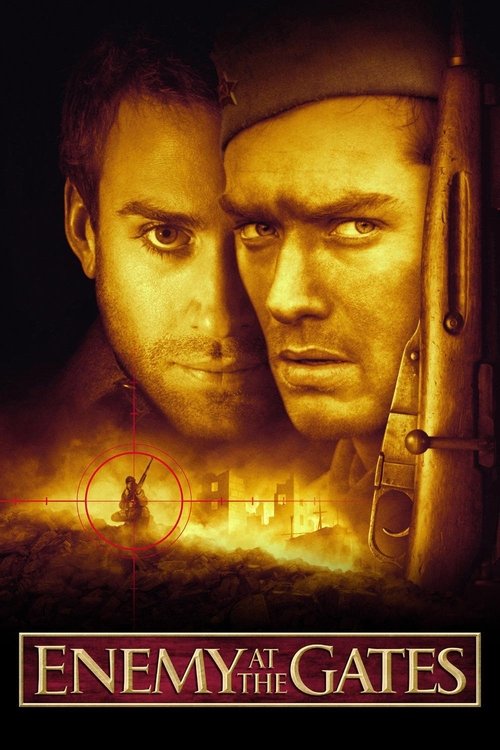
Set against the frozen ruins of Stalingrad in 1942, this film turns the brutal reality of World War II into a tense psychological duel between two elite marksmen. Jean-Jacques Annaud directs Enemy at the Gates, a production that blends historical drama with the suspense of a thriller. The story follows Vassili Zaitsev, played by Jude Law, a Soviet soldier thrust into the role of a national hero to boost morale. His opponent is Major König, portrayed by Ed Harris, a German sniper sent specifically to eliminate him.
Supporting roles include Joseph Fiennes as the political commissar Danilov and Rachel Weisz as Tania Chernova, a woman caught between propaganda and love. The narrative shifts from a general war epic to a cat-and-mouse game where survival depends on outthinking an enemy who knows your tactics better than you do. The film explores themes of individuality versus the collective, the dehumanizing nature of war, and the cost of being made a hero against one's will.
Stream
Rent
Availability and pricing can change. Confirm on the provider's site before purchasing.
The autumn of 1942 finds the city of Stalingrad reduced to rubble as the Soviet Red Army fights a desperate defense against the encroaching German Wehrmacht. In the chaos of the ruined warehouse district, a young Siberian hunter named Vassili Zaitsev accidentally kills a German officer while hiding. This accidental feat quickly becomes a weapon for the Soviet political apparatus. Commissar Danilov, a cynical officer struggling to maintain crumbling morale, sees an opportunity to turn this "accidental hero" into a propaganda icon. He promotes Zaitsev to the rank of Hero of the Soviet Union, intending to use his image to inspire the Russian lines, though Zaitsev himself remains deeply traumatized and uncomfortable with the adulation.
To help the reluctant sharpshooter adjust to his new status, Danilov pairs him with Tania Chernova, a former theater actress and widow who has lost her husband in the battle. Tania becomes Zaitsev's mentor in the ways of the public eye, guiding him through interviews and speeches. A romantic tension begins to develop between them, complicating their professional arrangement and adding a personal stake to the unfolding conflict. The narrative focus narrows as intelligence reports reveal the presence of a highly skilled German sniper known only as "Major König." König is not merely a soldier but a specific asset sent by the German high command to hunt down and eliminate the Soviet legend.
The Germans believe that killing Zaitsev will break the spirit of the entire Red Army defending Stalingrad. König operates with cold precision, using the rubble of the city as a fortress and employing psychological warfare to draw Zaitsev out. As the conflict escalates, Zaitsev must navigate the treacherous politics of his own side. Danilov, fearing that Zaitsev's growing independence might threaten his own position or the official narrative, begins to suspect Zaitsev of cowardice or treason if he fails to kill König. Meanwhile, Zaitsev struggles with the moral weight of his actions, realizing that every shot he takes costs another life.
The story builds toward a confrontation where the battlefield is no longer just about territory, but about the survival of the soul. Zaitsev must rely on his instincts, the support of his friend Koulikov, and his love for Tania to survive a hunter who knows his tactics better than he does himself. The film explores themes of individuality versus the collective, the dehumanizing nature of war, and the cost of being made a hero against one's will, culminating in a final showdown that will determine the fate of millions. The tension mounts as both men prepare for a duel that will define the legacy of the battle.
Enemy At The Gates - Official Trailer
Critical Consensus
While visually stunning and anchored by powerful performances from Jude Law and Ed Harris, Enemy at the Gates suffers from a script that prioritizes melodrama over historical accuracy. The film succeeds as a tense psychological thriller but occasionally falters under the weight of its own myth-making, resulting in a solid but flawed war epic.
“Annaud has created a visual spectacle that is both beautiful and terrifying, capturing the horror of war without losing sight of the human spirit.”
Roger Ebert
Chicago Sun-Times
“A gripping tale of survival and betrayal, driven by the intense chemistry between Law and Harris, though the plot occasionally feels too contrived.”
Janet Maslin
The New York Times
“Jude Law delivers a career-defining performance, bringing depth and vulnerability to a character that could have easily been a one-dimensional hero.”
Peter Travers
Rolling Stone
Jude Law
Vassili Zaitsev
Ed Harris
Major Martin König
Rachel Weisz
Tania Chernova
Joseph Fiennes
Commissar Danilov
Bob Hoskins
Nikita Khrushchev
Ron Perlman
Koulikov
Director
Jean-Jacques Annaud
Writers
Jean-Jacques Annaud, Alain Godard
Composer
James Horner
Cinematographer
Robert Fraisse
Producers
Jean-Jacques Annaud, John D. Schofield
BAFTA Awards (2002)
Best Cinematography: Nominated
BAFTA Awards (2002)
Best Sound: Nominated
Saturn Awards (2002)
Best Action/Adventure/Thriller Film: Nominated
Golden Globe Awards (2002)
Best Actor - Drama: Nominated
Empire Awards (2002)
Best British Actor: Won
Join the community
fans discussing