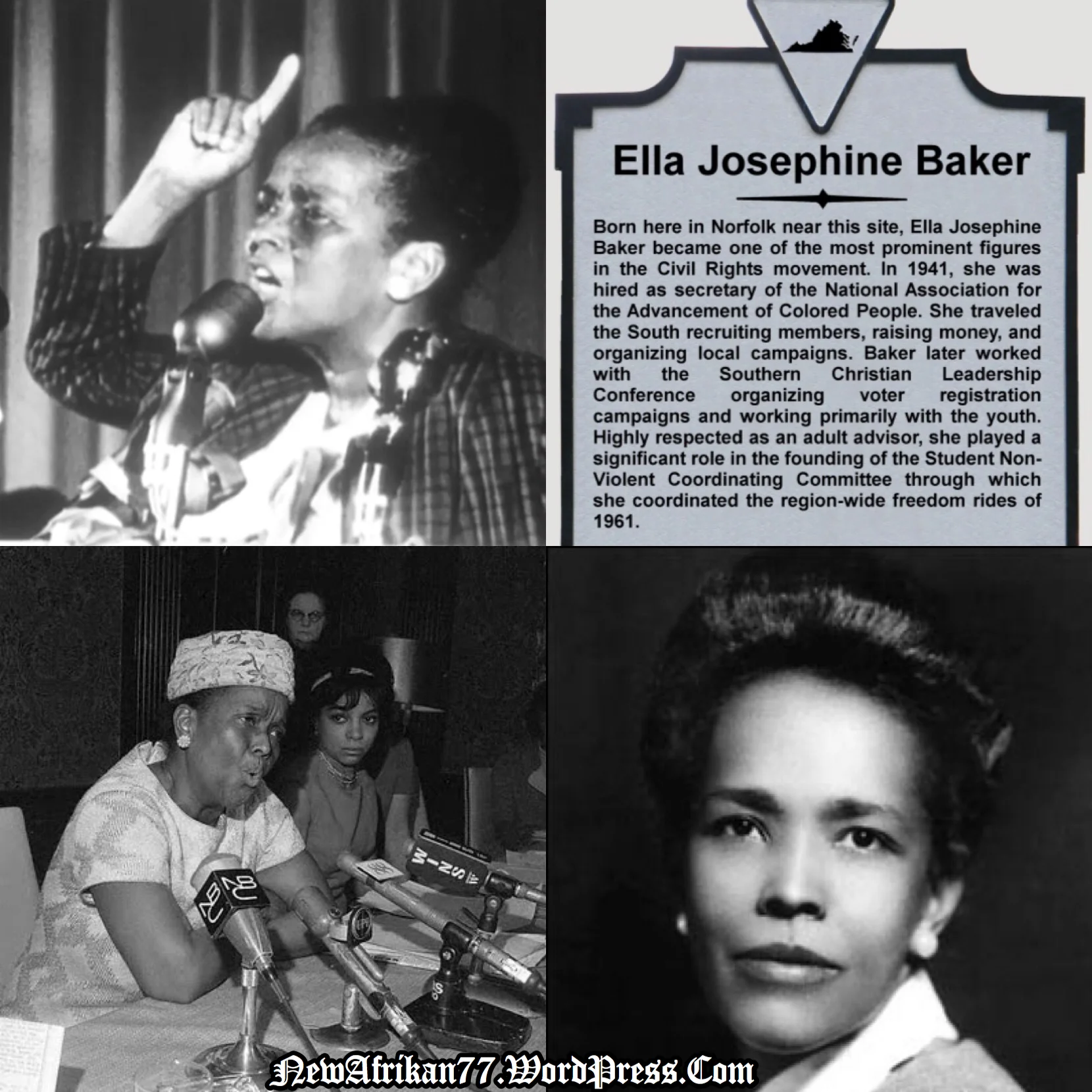
Ella Josephine Baker
 Norfolk Island
civil rights activist•organizer•and women's rights advocate
Also known as: Ella J. Baker, The Backbone of the Civil Rights Movement
Birthday
December 13, 1903
Birth Sign
Sagittarius
Birthplace
Norfolk, Virginia
Age
Died at 83
About
Ella Josephine Baker was an African-American civil rights and human rights activist whose career spanned over five decades. Born in Norfolk, Virginia, she is widely revered as the "Backbone of the Civil Rights Movement" and by Duke University historian William Chafe as its "mother." Unlike many contemporaries who sought the spotlight, Baker operated almost exclusively behind the scenes, prioritizing grassroots organization and "group-centered leadership" over individual celebrity.
She collaborated with giants such as W. E. B. Du Bois, Thurgood Marshall, A. Philip Randolph, and Martin Luther King Jr., yet her most enduring legacy lies in her mentorship of the next generation of activists, including Diane Nash, Stokely Carmichael, and Julian Bond. Her work focused on empowering ordinary people to effect change rather than relying on charismatic leaders.
Early Life & Background
Ella Josephine Baker was born on December 13, 1903, in Norfolk, Virginia, to Emily Elizabeth Donnell and Willie Baker. Her father worked as a carpenter and preacher, while her mother served as a domestic worker. In 1909, when Ella was just six years old, the family relocated to Littleton, North Carolina, where she spent the majority of her childhood. This move placed her in a rural environment that would deeply influence her understanding of the struggles facing Black Americans in the South.
Raised in a household that valued education and self-reliance, Baker learned independence from her grandmother. She attended Shaw University in Raleigh, North Carolina, graduating in 1927 with a degree in sociology. During her time at Shaw, she was influenced by the campus's progressive environment and the frequent visits of W. E. B. Du Bois. These formative years instilled in her a deep sense of agency and a belief in the power of collective action. Before entering full-time organizational work, she briefly worked as a teacher and librarian, but her passion for social justice quickly drew her into the NAACP while she was still a student.
Career Growth
Baker's professional timeline began in earnest during the 1930s when she joined the NAACP in New York City as a field secretary. She traveled extensively through the South to organize local branches and fight against lynching and segregation. By 1940, she had been appointed the first national director of branches for the NAACP, a role in which she significantly expanded the organization's reach and membership. Her strategic organizing skills were instrumental in the 1940s when she worked closely with A. Philip Randolph on the March on Washington Movement, helping to pressure President Franklin D. Roosevelt to issue Executive Order 8802, which banned discrimination in the defense industry.
In the 1950s, Baker played a pivotal role in the founding of the Southern Christian Leadership Conference (SCLC) in 1957. Although she was instrumental in its creation, she declined a position within the new organization due to disagreements with the male-dominated leadership structure and its reliance on charismatic figures like Dr. King. Her most significant impact came in 1960 when she advised and mentored the student activists who formed the Student Nonviolent Coordinating Committee (SNCC). She famously urged them to adopt "group-centered leadership," ensuring they remained independent of established adult organizations. She continued to work with SNCC and other groups through the 1960s, focusing on voter registration drives and community empowerment in the Deep South, including being a key figure in the Freedom Summer of 1964. She remained active in various civil rights causes until her death in 1986.
Career Timeline
Public Image & Style
Ella Baker is portrayed in media and history as the ultimate behind-the-scenes organizer. Her public image is one of humility, intelligence, and unwavering commitment to justice. She is often depicted as a wise, maternal figure who listened more than she spoke, embodying the principle that "strong people don't need strong leaders." Her aesthetic was simple and practical, reflecting her focus on substance over style. Historians and scholars universally rank her as one of the most effective organizers of the 20th century, with William Chafe's description of her as the "mother of the civil rights movement" serving as a definitive assessment.
Fame & Fandom (iFAMOUS Rankings)
iFANN has not yet collected fame data for this person. While there is no official "fandom" in the pop-culture sense, Baker has a dedicated following of historians, activists, and students who study her life and methods. These individuals often refer to themselves as "Baker scholars" or "activists inspired by Ella Baker." Notable fan-like activities include annual tributes on December 13 involving social media campaigns sharing her quotes and photos. Schools and universities often organize essay contests and lectures in her name, such as the Victorville Civil Rights Memorial Essay Contest won by Ashley Barahona in 2026. The 2015 unveiling of her statue at Shaw University was a major event attended by thousands of supporters and historians.
Interesting Facts and Legends
Ella Baker was known by those who worked with her as "The Whirlwind" due to her relentless energy and ability to move quickly between cities and campaigns. Despite being asked to lead the SCLC, she refused, believing that the movement should be led by the people it served rather than a single charismatic figure. She was a master of voter registration drives, often traveling to remote areas in the South to register Black voters despite the risks of violence and intimidation. Many prominent figures in the civil rights movement, including John Lewis and Diane Nash, credit her as their primary mentor and guide. One of the most retold stories about Baker is her refusal to take credit for successes; she often disappeared after organizing victories, allowing the young activists she mentored to take the spotlight.
Notable Quotes
“Give light and people will find the way.”
“Strong people don't need strong leaders.”
“We who believe in freedom cannot rest until it comes.”
“The role of the leader is to get people where they want to go.”
Family & Personal Life
Ella Baker never married and had no children. She dedicated her entire life to the civil rights movement and her community, viewing her work as her primary relationship and purpose. There are no records of romantic partners, engagements, or marriages in any credible historical source. She lived independently in New York City for much of her adult life, maintaining a close circle of friends and colleagues within the movement. Her lack of a traditional family structure was often cited by contemporaries as a testament to her total devotion to the struggle for justice. As of her death in 1986, she was unmarried and childless.
Notable Connections
W. E. B. Du Bois, Thurgood Marshall, A. Philip Randolph, Martin Luther King Jr., Diane Nash, Stokely Carmichael, Julian Bond
Relationships & Dating History
Ella Baker never married and had no children. She dedicated her entire life to the civil rights movement and her community, viewing her work as her primary relationship and purpose. There are no records of romantic partners, engagements, or marriages in any credible historical source. She lived independently in New York City for much of her adult life, maintaining a close circle of friends and colleagues within the movement. Her lack of a traditional family structure was often cited by contemporaries as a testament to her total devotion to the struggle for justice. At the time of her death in 1986, she was unmarried and childless.
Death & Aftermath
Died
December 13, 1986 (aged 83)
Death Place
Unknown
Cause of Death
Unknown
Net Worth (Estate Value)
$5,000
iFANN Editorial Team estimate
As a civil rights activist who lived a modest life and did not pursue commercial ventures, Ella Baker did not accumulate significant personal wealth. iFANN currently estimates Baker's net worth at approximately $5,000, reflecting her lifestyle of frugality and dedication to the cause rather than financial accumulation. She died with a net worth of less than $10,000, which aligns with her choice to live simply throughout her life. There is no publicly reported estate value managed by a trust or foundation in the manner of celebrity estates. The "Ella Baker Center for Human and Social Rights" operates as an independent non-profit organization founded by others in her name, not as an estate managing her assets. While her name and likeness are used in educational materials, books, and documentaries, these funds go directly to the respective non-profits, not to heirs.
Awards Won (1)
While Baker received few formal awards during her lifetime, partly because she avoided the spotlight and often rejected honors that might elevate her above the collective effort, her posthumous recognition has been profound. She received the NAACP Spingarn Medal in 1979, one of the highest honors bestowed by the organization. She also received several honorary doctorates from universities including Howard University and Fisk University in recognition of her contributions to civil rights.
1979 · Lifetime Achievement
Civil Rights Activism
Known For
Civil Rights Movement
1940-1986 · Organizer and Mentor
Student Nonviolent Coordinating Committee (SNCC)
1960 · Advisor
Southern Christian Leadership Conference (SCLC)
1957 · Founding Member
Keywords
Sources
Quick Facts
- Profession
- women's rights activist, civil rights advocate, public figure
- Born
- December 13, 1903
- Birthplace
- Norfolk, Virginia
- Died
- December 13, 1986
- Death Place
- Manhattan, New York
- Gender
- Female
- Birth Sign
- Sagittarius
Personal Details
- Full Name
- Ella Josephine Baker
- Children
- Education
- Shaw University (B.S. in Sociology, 1927)
Frequently Asked Questions
What was Ella Baker's profession?
Did Ella Baker ever get married?
Why is Ella Baker called the Mother of the Civil Rights Movement?
When did Ella Baker die?
What was Ella Baker's most famous contribution?
Similar People
Join the community
fans discussing