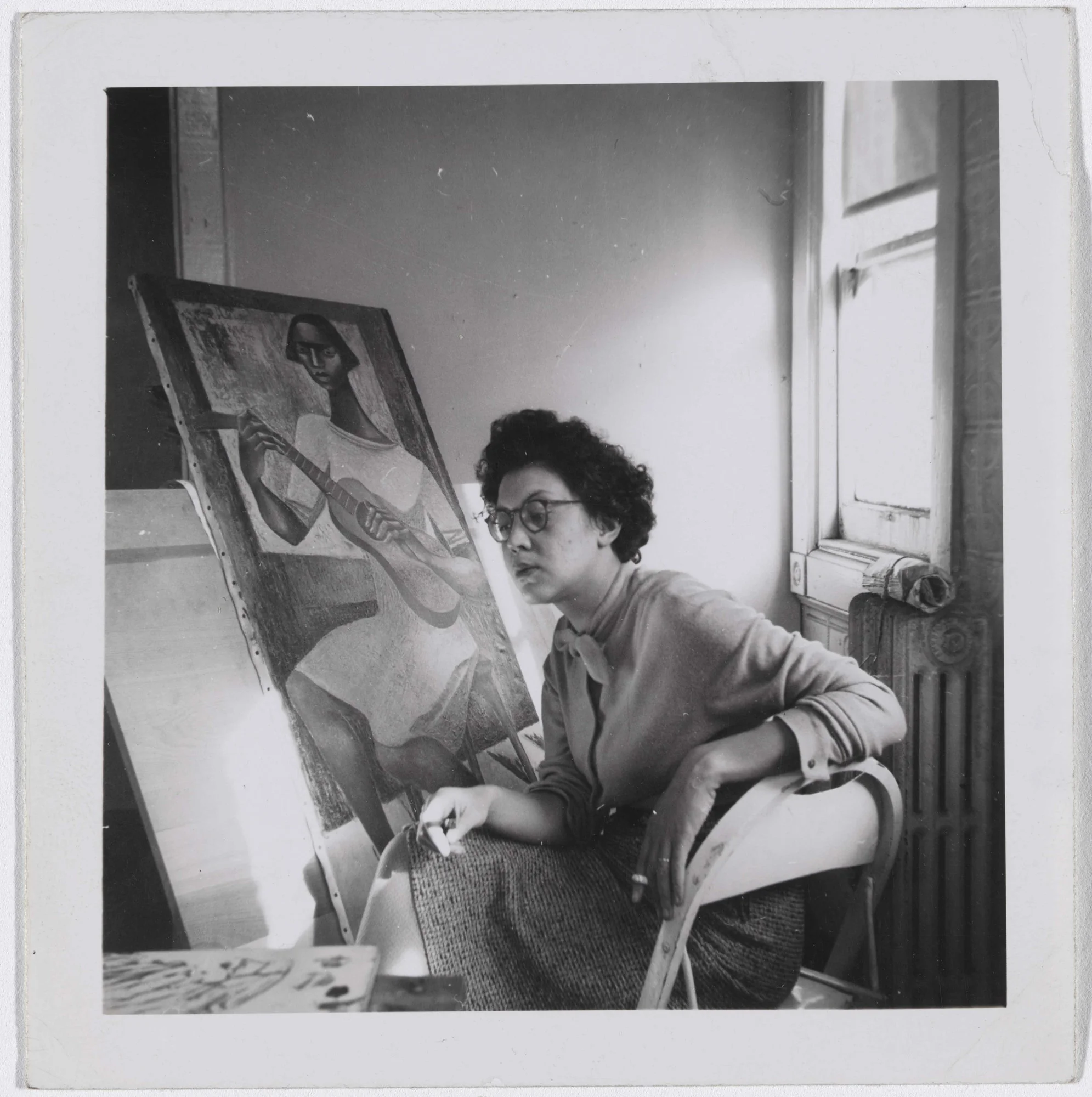
Elizabeth Catlett
 Mexico
Also known as: Elizabeth Mora–Catlett, Alice Elizabeth Catlett, Elizabeth Catlett Mora, Elizabeth Catlett–Mora, Elizabeth Catlett White
Birthday
April 15, 1915
Birth Sign
Aries
Birthplace
Washington, D.C.
Age
Died at 96
About
Elizabeth Catlett was an American and Mexican sculptor, printmaker, and painter whose art carried the weight of history and the urgency of social change. Born Alice Elizabeth Catlett in Washington, D.C., she became one of the most powerful artistic voices for Black experience in the 20th century, with a particular focus on women. Her work, spanning over six decades, blended modernist abstraction with figuration drawn from African and Mexican traditions, always aiming to convey messages about race, gender, and class rather than mere aesthetics. Catlett's pieces are held in major museums worldwide, and her influence endures through the artists she taught and the generations she inspired. She passed away on April 2, 2012, in Cuernavaca, Mexico, at the age of 96, leaving behind a legacy of art that continues to speak to contemporary audiences.
Early Life & Background
Elizabeth Catlett grew up in Washington, D.C., in a family that valued education deeply. Her mother was a truant officer, and her father, who died when she was young, worked in education. She was the grandchild of formerly enslaved individuals, a heritage that shaped her worldview and later infused her art with a sense of resilience and resistance. Catlett showed early artistic promise and went on to study at Howard University, where she was mentored by the painter Lois Mailou Jones. She earned her bachelor's degree in art in 1935, then pursued graduate studies at the University of Iowa, where she studied under the influential American painter Grant Wood. In 1940, she became the first person to earn a Master of Fine Arts degree in sculpture from the University of Iowa. Her early work already reflected her commitment to social themes, and she later taught at the George Washington Carver School in Harlem, where she encountered the vibrant cultural and political currents of the era. A pivotal moment came in 1946 when a fellowship from the Rosenwald Fund allowed her to travel to Mexico City, a trip that would redirect her artistic path and lead her to settle there permanently.
Career Growth
Catlett's arrival in Mexico City in 1946 marked the beginning of a new chapter. She became deeply involved with the Taller de Gráfica Popular, a renowned graphic arts workshop, where she collaborated with Mexican artists and honed her printmaking skills. For two decades, she created powerful linocuts and lithographs that addressed issues of racial injustice, labor, and motherhood. In the 1950s, she shifted her primary focus toward sculpture, producing works in wood, stone, and bronze that celebrated the strength and dignity of Black women. She also headed the sculpture department at the Escuela Nacional de Artes Plásticas, influencing a new generation of Mexican artists. Despite facing political persecution in the U.S. during the McCarthy era, Catlett continued to work and exhibit internationally. Her art was widely shown, and she received numerous honors, including membership in the Salón de la Plástica Mexicana and the International Sculpture Center's Lifetime Achievement Award. In 2025, the Art Institute of Chicago presented a major retrospective of her work, and in 2026, a documentary titled "ELIZABETH SPEAKS" was released, directed by her granddaughter Naima Mora.
Public Image & Style
Catlett was widely regarded as a revolutionary artist, an ardent feminist, and a lifelong social activist. Her public image was that of a trailblazer who used her art to challenge systemic racism and sexism. She was celebrated for her bold, expressive sculptures and prints that depicted Black women with dignity and strength. Critics and scholars praised her ability to merge modernist techniques with social realism, creating works that were both aesthetically striking and politically charged. Catlett's persona was one of quiet determination; she was known for her humility despite her many accolades. She was also a mentor to many younger artists, and her commitment to teaching was as strong as her artistic output. In the media, she was often portrayed as a bridge between American and Mexican art scenes, and her work has been the subject of numerous retrospectives, cementing her status as a key figure in 20th-century art.
Fame & Fandom (iFAMOUS Rankings)
Elizabeth Catlett's admirers form a reverent community of art historians, curators, students, activists, and collectors who celebrate her through institutional channels rather than grassroots fan culture. There is no documented formal fandom name; her following is better described as a devoted audience that engages with her legacy through exhibitions, scholarship, and tribute events. Recent years have seen a wave of major retrospectives, including the landmark 'Elizabeth Catlett: A Black Revolutionary Artist and All That It Implies' at the Art Institute of Chicago and the Brooklyn Museum, alongside a new documentary announced in April 2026. Her granddaughter, Naima Mora, a model and winner of America's Next Top Model, has spoken publicly about Catlett's revolutionary spirit, serving as a living link to younger generations. Fans honor Catlett by preserving her story and ensuring her art reaches new audiences, with no formal rituals or organized campaigns, the interaction happens through her powerful prints and sculptures.
In the realm of global fame, iFANN's Global Fame Engine has evaluated Elizabeth Catlett, but as of August 2026, she does not hold a placement in the published rankings, either in the Global Top 1,000 or any Top-100 scope list. This reflects the nature of her fame, profound within art and cultural circles, yet not measured by the broad, mainstream metrics that define global celebrity. Her legacy, however, continues to grow through posthumous recognition, ensuring her name remains prominent in the art world and beyond.
Interesting Facts and Legends
Catlett was known for her strong personality and her commitment to art as a tool for social change. She once said, "I have always wanted my art to service my people... to reflect us, to relate to us, to stimulate us, to make us aware of our potential." She was an avid gardener and found inspiration in the natural world. Catlett also collected pre-Columbian art, which influenced her sculptural forms. She was a lifelong supporter of civil rights and often used her art to protest against racial violence. In her later years, she continued to create and teach, and she was known to work in her studio every day until her health declined. She also held a deep love for music, particularly jazz, which she said influenced the rhythm and movement in her sculptures.
One of the most iconic aspects of Catlett's legend is her self-description as a "Black Revolutionary Artist," a phrase that became the title of a major retrospective and encapsulates her belief that art and activism were inseparable. Another legendary chapter is her move to Mexico in 1946, where she found artistic freedom and worked with the Taller de Gráfica Popular, creating prints for social causes. This period is often retold as a heroic time when Catlett made art for the people, not for the elite. Additionally, the narrative that Catlett never received her due during her lifetime has become a central part of her story, with recent exhibitions framed as a long-overdue recognition of her genius.
Family & Personal Life
Catlett was married twice. Her first husband was the painter Charles Wilbert White, whom she married in 1941; the couple divorced in 1946. She then married the Mexican artist Francisco Mora in 1947, and they remained together until his death in 2002. Catlett and Mora had three children: Francisco Mora Catlett, who became a musician, and two daughters, Juanita and Elizabeth. The family lived in Cuernavaca, Mexico, where Catlett maintained a studio and a home filled with art and plants. Her granddaughter, Naima Mora, is an actress and model who has worked to preserve Catlett's legacy, directing the documentary "ELIZABETH SPEAKS" and participating in tribute events. Catlett's family often spoke of her warmth and her dedication to her craft, and she was a beloved matriarch who instilled in her children a sense of social responsibility and artistic appreciation.
Relationships & Dating History
Catlett's personal life included two significant marriages. Her first marriage was to the artist Charles Wilbert White, whom she married in 1941. The couple divorced in 1946, amid Catlett's growing involvement in her own career and her move to Mexico. Shortly after, she met Francisco Mora, a Mexican artist and member of the Taller de Gráfica Popular. They married in 1947 and remained together for over five decades until Mora's death in 2002. Their partnership was both personal and professional, as they shared artistic and political ideals. Catlett and Mora had three children together, and their home in Cuernavaca was a hub of creative activity. After Mora's death, Catlett continued to live in Cuernavaca until her own passing in 2012. She was reportedly single during her final years, having been widowed a decade earlier.
- MarriedCharles Wilbert White1941 - 1946First marriage, ended in divorce.
- MarriedFrancisco Mora1947 - 2002Second marriage, lasted until his death.
Death & Aftermath
Died
April 2, 2012 (aged 96)
Death Place
Mexico
Cause of Death
reported natural causes
Elizabeth Catlett spent her final years in Mexico, maintaining the studio and home she had shared with her husband Francisco Mora until his passing. She passed away in 2012, ending a life dedicated to social justice and artistic innovation. Tributes flowed from the art world, with institutions like the National Gallery of Art recognizing her as a pivotal figure who bridged Black American and Mexican modernist traditions. Her granddaughter Naima Mora later directed the documentary Elizabeth Speaks, which served as a profound reflection of her voice and legacy. A major retrospective titled A Black Revolutionary Artist and All That It Implies opened at the Art Institute of Chicago, further cementing her status in the canon of American art. While estate matters were handled privately by her heirs, the focus remained on preserving her vast body of prints and sculptures for future generations.
Net Worth (Estate Value)
$5 Million
iFANN Editorial Team estimate
iFANN's editorial analysis currently estimates Elizabeth Catlett's net worth at the time of her death in 2012 to be around $5 Million, a figure that has grown through posthumous sales and exhibitions. Her estate has continued to earn revenue through the sale of her prints and sculptures, which are highly sought after by collectors. Major exhibitions, such as the 2025 retrospective at the Art Institute of Chicago, have boosted interest in her work. The estate is managed by her family, who have also licensed her images for use in documentaries and other media. In 2026, the estate continues to benefit from royalties and licensing fees, ensuring that Catlett's financial legacy remains robust. While she was not known for accumulating vast wealth during her lifetime, the enduring appeal of her art has made her estate a valuable asset.
Awards Won (2)
Throughout her career, Elizabeth Catlett received numerous accolades, including the International Sculpture Center's Lifetime Achievement Award and membership in the Salón de la Plástica Mexicana. Her work has been celebrated in major retrospectives, and she was honored with the Women's Caucus for Art Lifetime Achievement Award in 1985.
2005 · Lifetime Achievement
Lifetime achievement
1985 · Lifetime Achievement
Lifetime achievement
Known For
The Black Woman
1968 · Sculptor
Sharecropper
1952 · Printmaker
Invisible Man
1952 · Sculptor
Homage to My Young Black Sister
1968 · Sculptor
Keywords
Sources
Quick Facts
- Profession
- sculptor, printmaker, painter
- Born
- April 15, 1915
- Birthplace
- Washington, D.C.
- Died
- April 2, 2012
- Death Place
- Cuernavaca, Mexico
- Gender
- Female
- Spouse
- Francisco Mora, Charles Wilbert White
- Birth Sign
- Aries
Personal Details
- Full Name
- Alice Elizabeth Catlett
- Spouse
- Francisco Mora, Charles Wilbert White
- Children
- Three children
Frequently Asked Questions
Who was Elizabeth Catlett?
What is Elizabeth Catlett known for?
When and where was Elizabeth Catlett born and when did she die?
What were Elizabeth Catlett's major artistic influences?
What is Elizabeth Catlett's legacy?
Similar People
Join the community
fans discussing