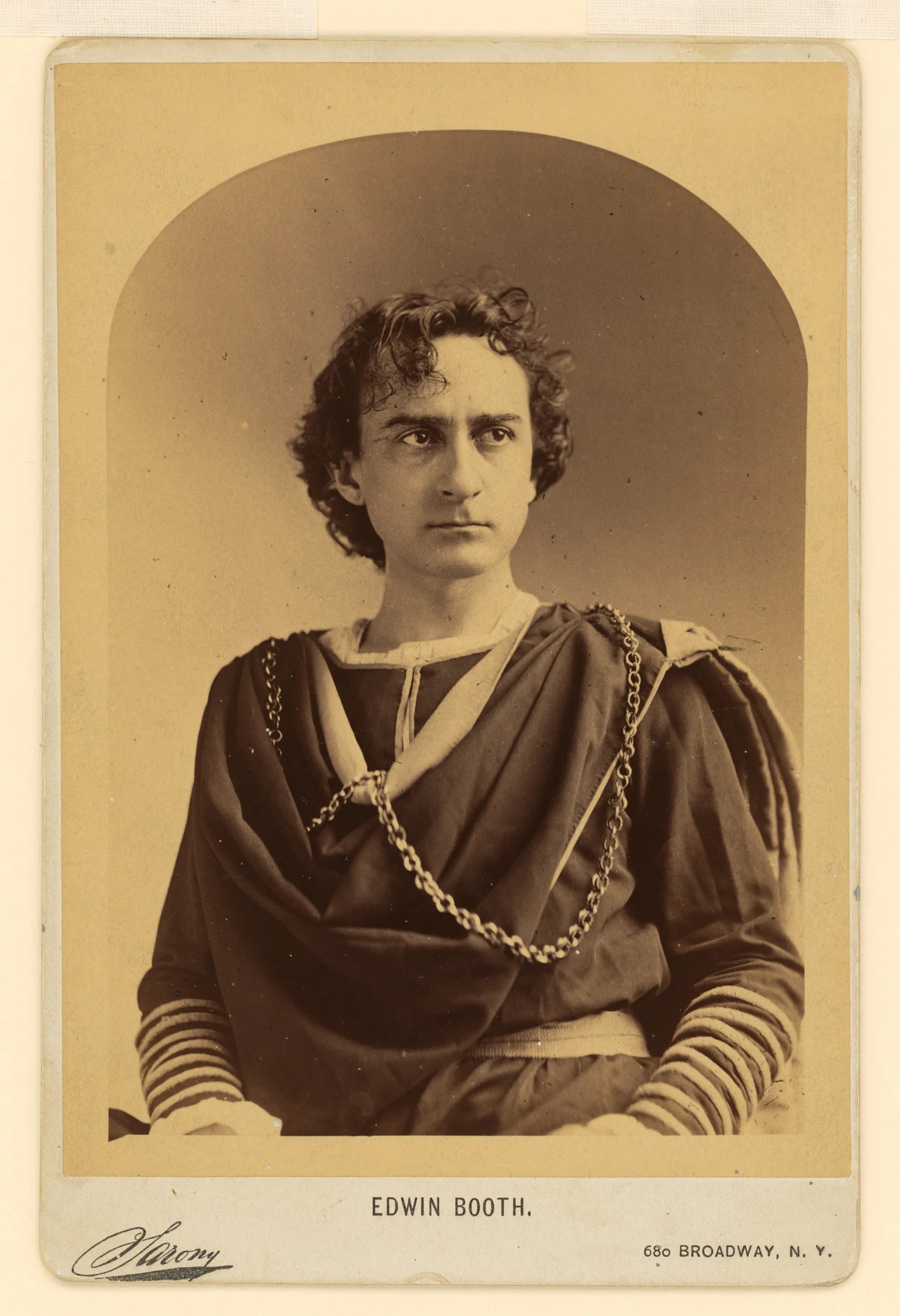
Edwin Booth
 Belgium
Also known as: Edwin Thomas Booth, The Master
Birthday
November 13, 1833
Birth Sign
Scorpio
Birthplace
Bel Air, Maryland, United States
Age
Died at 59
About
Edwin Thomas Booth was an American stage actor and theatrical manager, widely regarded as the greatest American Shakespearean actor of the 19th century. Born into a theatrical dynasty, Booth rose to fame through his nuanced portrayals of complex characters, particularly Hamlet, which he performed more often than any actor before or since. His record-setting 100-consecutive-night run of Hamlet in 1864-65 remains unmatched. Booth founded Booth's Theatre in New York City in 1869, a state-of-the-art venue that showcased his artistic vision. Despite his immense professional success, his legacy is often intertwined with that of his younger brother, John Wilkes Booth, who assassinated President Abraham Lincoln. Today, Booth is remembered as a transformative figure in American theater, whose reserved, introspective style revolutionized Shakespearean performance. He was short, slim, dark, and sensitive in appearance, with a pale and mobile face marked by melancholy. His stage presence was described as having a strange magnetic quality, drawing crowds wherever he performed. Booth's personal integrity and dedication to his craft earned him admirers even as his brother's infamy threatened to overshadow his achievements. He remains a subject of historical scholarship and biography, with his life depicted in the 1955 film Prince of Players starring Richard Burton.
Early Life & Background
Edwin Booth was born on November 13, 1833, in Bel Air, Maryland, in the family's log cabin. He was named after Edwin Forrest and Thomas Flynn, two of his father's colleagues. His childhood was shaped by his father's growing alcoholism and instability. Junius Brutus Booth, considered the preeminent American actor of his day, began drinking heavily and suffered bouts of rage after three of his children died in a short span. At age 13, Edwin was sent to accompany his father on tour, tasked with keeping him sober and sane. Biographer Eleanor Ruggles wrote that Edwin's quiet, solicitous presence could 'recall the father when Booth was wound about in melancholy or lost in frenzy.' This experience gave him an early education in the bombastic acting style of the era. Edwin received limited formal education but demonstrated remarkable intelligence and determination. He made his stage debut on September 10, 1849, at the Boston Museum, playing the minor role of Tressel to his father's Richard III. Two years later in New York City, when his father refused to perform, Edwin replaced him as Richard III, delivering an imitative but creditable performance that marked his first major step toward stardom.
Career Growth
After his father's death in 1852, Edwin Booth became a star on the stock circuit, performing in snowbound mining camps, living briefly in a hut outside San Francisco, touring the Pacific islands, and eventually returning east in 1854 to take on his father's most famous role, Richard III. In 1862, he became manager of the Winter Garden Theatre in New York, where he staged acclaimed Shakespearean productions. His 100-consecutive-night run of Hamlet from 1864 to 1865 remains a record. He portrayed Hamlet more often than any other actor in history. In 1869, he founded Booth's Theatre, a modern venue with advanced stage machinery, considered one of the most spectacular theatres of its time. He toured Europe from 1880 to 1882, performing in London and other capitals to great acclaim. Booth continued acting until his death in 1893, cementing his reputation as the preeminent American actor of his century.
Career Timeline
Public Image & Style
Edwin Booth possessed a strange magnetic quality that drew crowds wherever he performed. Onstage, he was transcendent and magnetic, known for his refined, introspective style that contrasted sharply with his father's bombastic approach. Offstage, he was described as grave, thoughtful, and reticent. His pale, mobile face and melancholy eyes became his trademark. Fans would block the stage door just to catch a glimpse of him. Booth's reserved persona and dedication to his craft earned him the nickname 'The Master' among theatrical circles. He was a Union supporter during the Civil War, and his personal integrity won him admirers even as his brother's infamy threatened to overshadow his achievements. When he walked the streets, people stopped to gaze at him. His stage presence was characterized as having 'an admiration that no word can adequately describe.' Booth's signature style was refined and reserved, setting him apart from his contemporaries.
Fame & Fandom (iFAMOUS Rankings)
For a man who never knew the frenzy of a modern fan base, Edwin Booth commanded a devotion that bordered on the religious. Audiences didn't just watch him; they waited by the stage door for hours, hoping to catch a glimpse of those melancholy eyes. His Hamlet, a role he performed more than any actor before or since, was the performance of a lifetime, a psychological revelation that left playgoers stunned into silence before the applause erupted. The 100-night consecutive run in 1864-65 was not merely a record, it was a phenomenon that made his name synonymous with theatrical greatness.
Yet Booth's following was not a fandom in the modern sense. There was no official name for his admirers, no organized clubs, no coordinated campaigns. His fans were the theatergoers of his era, bound by word of mouth and the shared experience of live performance. Their devotion was expressed in the packed houses and the fervent reviews, in the way they elevated him to the status of a cultural icon. Even after his death, his legacy was preserved not by fan groups but by institutions like The Players Club, which he founded, and the archives that keep his memory alive.
In the annals of fame, Edwin Booth's place is secure, though iFANN's Global Fame Engine has evaluated his standing and found that he currently does not hold a placement in the published rankings, not in the Global Top 1,000, nor in any Top-100 scope list. This is a reflection of the era in which he lived, a time before the global media landscape that fuels modern fame. Yet, in the annals of theatrical history, his name remains a touchstone, a legend that continues to resonate.
Interesting Facts and Legends
Edwin Booth's life was marked by extraordinary coincidences and quiet acts of kindness. He once saved the life of Robert Todd Lincoln, pulling the president's son from a train platform gap in Jersey City, a story that gains tragic irony when one recalls that Edwin's brother, John Wilkes, would assassinate the president a year later. This tale is often the first told to newcomers, a reflection of the strange hand of fate that linked the Booth family to the Lincolns.
During the Civil War, Booth hung a Union flag over his infant daughter's bed, a quiet declaration of loyalty that contrasted sharply with his brother's actions. He also contributed to a fund that purchased a horse and buggy for the poet Walt Whitman, who had become lame, a gesture of kindness that spoke to his character. Booth urged his daughter to learn ice-skating, lamenting that he had no childhood opportunities for play, and he lived a Bohemian lifestyle in his early career, with casual encounters he boasted about in letters to his brother Junius.
The Folger Shakespeare Library holds extensive materials on the Booth family, ensuring his legacy is preserved. His support for President Lincoln made his brother's assassination particularly devastating, and he withdrew from the stage briefly in the public backlash. He is interred at Mount Auburn Cemetery in Cambridge, Massachusetts, where his grave remains a site of pilgrimage for theater lovers.
Notable Quotes
“My youth began with my marriage.”
“Starring around the country is sad work.”
“I have never known a happy day since I left the stage.”
“The actor must be a student of human nature.”
“The stage is a world within a world.”
Family & Personal Life
Edwin Booth was the seventh of ten children born to Junius Brutus Booth, a renowned English-born actor, and Mary Ann Holmes, his mistress who later became his wife. His older brother was Junius Brutus Booth Jr., a theatre manager. His younger siblings included Asia Booth Clarke and John Wilkes Booth, the actor who assassinated President Lincoln. Edwin had one surviving child, a daughter named Edwina Booth Grossman, from his first marriage. He lived in New York City and later in life became a recluse. He had no pets documented. After Lincoln's assassination, Edwin was not imprisoned like other family members because he had friends in high places.
Notable Connections
Edwin Booth was the son of Junius Brutus Booth, a famous actor, and the brother of John Wilkes Booth, who assassinated Abraham Lincoln. He was also brother to Junius Brutus Booth Jr., a theatre manager, and Asia Booth Clarke. His first wife, Mary Devlin, was an actress, and his second wife, Mary McVicker, also an actress. His daughter Edwina Booth Grossman compiled his letters. He contributed to a fund for poet Walt Whitman.
Relationships & Dating History
Edwin Booth was married twice. His first wife was Mary Devlin, an actress who performed Juliet to his Romeo in Richmond, Virginia. They married in 1860, and Mary gave up the stage to become his wife. They had one daughter, Edwina, born in 1861. Mary died in 1863, shortly after Edwina's first birthday. Booth said of her, 'My youth began with my marriage.' In 1869, he married Mary McVicker, also an actress. That marriage lasted until her death in 1881. No children survived from the second marriage. Booth also had casual relationships earlier in his career, as documented in letters to his brother. At the time of his death in 1893, Booth was widowed, having outlived both wives.
- MarriedMary Devlin Booth1860 - 1863Mary Devlin was an actress who married Booth in 1860 and gave birth to their daughter Edwina in 1861. She died in 1863.
- MarriedMary McVicker Booth1869 - 1881Mary McVicker was an actress. The marriage lasted until her death in 1881. No surviving children.
Death & Aftermath
Died
June 7, 1893 (aged 59)
Death Place
New York City
Cause of Death
Apoplexy
The official announcement regarding Edwin Thomas Booth's passing came from his attending physicians, who certified the cause as apoplexy following a sudden collapse at his New York City residence. The celebrated actor, born in 1833, succumbed to what was understood to be a cerebral hemorrhage on June 7, 1893, at the age of fifty-nine. His final days had been marked by a decline in health attributed to chronic heart issues and the physical toll of years spent touring, though he had already retired from active stage management before his last hours.
The theatrical community and the public reacted with immediate and profound mourning, recognizing the loss of the man who had worked tirelessly to restore the family name after the tragedy involving his brother. Tributes poured in from institutions across the United States and Europe, honoring the actor whose record-breaking performances of Hamlet had defined a generation of American theater. Booth's funeral was conducted shortly after his death as a private affair attended by family and close friends, reflecting both the sensitivity of his history and his high standing within the profession.
He was laid to rest at Mount Auburn Cemetery in Cambridge, Massachusetts, where his grave has since become a site of interest for those studying American theater history. Posthumous recognition continued to grow, notably through the dedication of a statue in Gramercy Park, which commemorates his character and his famous rescue of Robert Todd Lincoln. His legacy was further cemented by publications such as an article in The Century Magazine, which helped distinguish his heroic narrative from the infamy of his sibling.
Net Worth (Estate Value)
$5 Million
iFANN Editorial Team estimate
iFANN currently estimates the estate of Edwin Booth at approximately $5 million. During his lifetime, Booth earned substantial sums from his tours and theatre management, often commanding thousands of dollars per performance. However, he also spent heavily on his theatrical ventures, particularly Booth's Theatre, which proved a financial burden. After his death in 1893, his estate was managed by his daughter, Edwina Booth Grossman, who compiled and published his letters in 1902. Revenue sources for the estate include royalties from published works, licensing of his name and image for historical publications, and ongoing performances of Shakespearean productions associated with his legacy. The estate has grown modestly over the years through careful management and historical interest. Specific estate valuation figures from his death are not readily available, but his earnings from starring tours and theatre management were significant, though offset by the costs of his ambitious theatrical projects.
Awards & Accolades
View 5 records, honours and achievementsKnown For
Hamlet
1864 · Hamlet
Richard III
1851 · Richard III
Booth's Theatre
1869 · Founder
Keywords
Sources
Quick Facts
- Profession
- stage actor, theatre manager
- Born
- +1833-11-13
- Birthplace
- Bel Air, Maryland, United States
- Died
- +1893-06-07
- Death Place
- New York City, New York, United States
- Gender
- Male
- Spouse
- Mary Devlin Booth, Mary McVicker Booth
- Birth Sign
- Scorpio
Personal Details
- Full Name
- Edwin Thomas Booth
- Spouse
- Mary Devlin Booth, Mary McVicker Booth
- Children
- Edwina Booth Grossman
Frequently Asked Questions
What is Edwin Booth best known for?
How did Edwin Booth react to his brother killing Lincoln?
Did Edwin Booth have children?
How many times was Edwin Booth married?
What theatre did Edwin Booth build?
Similar People
Join the community
fans discussing