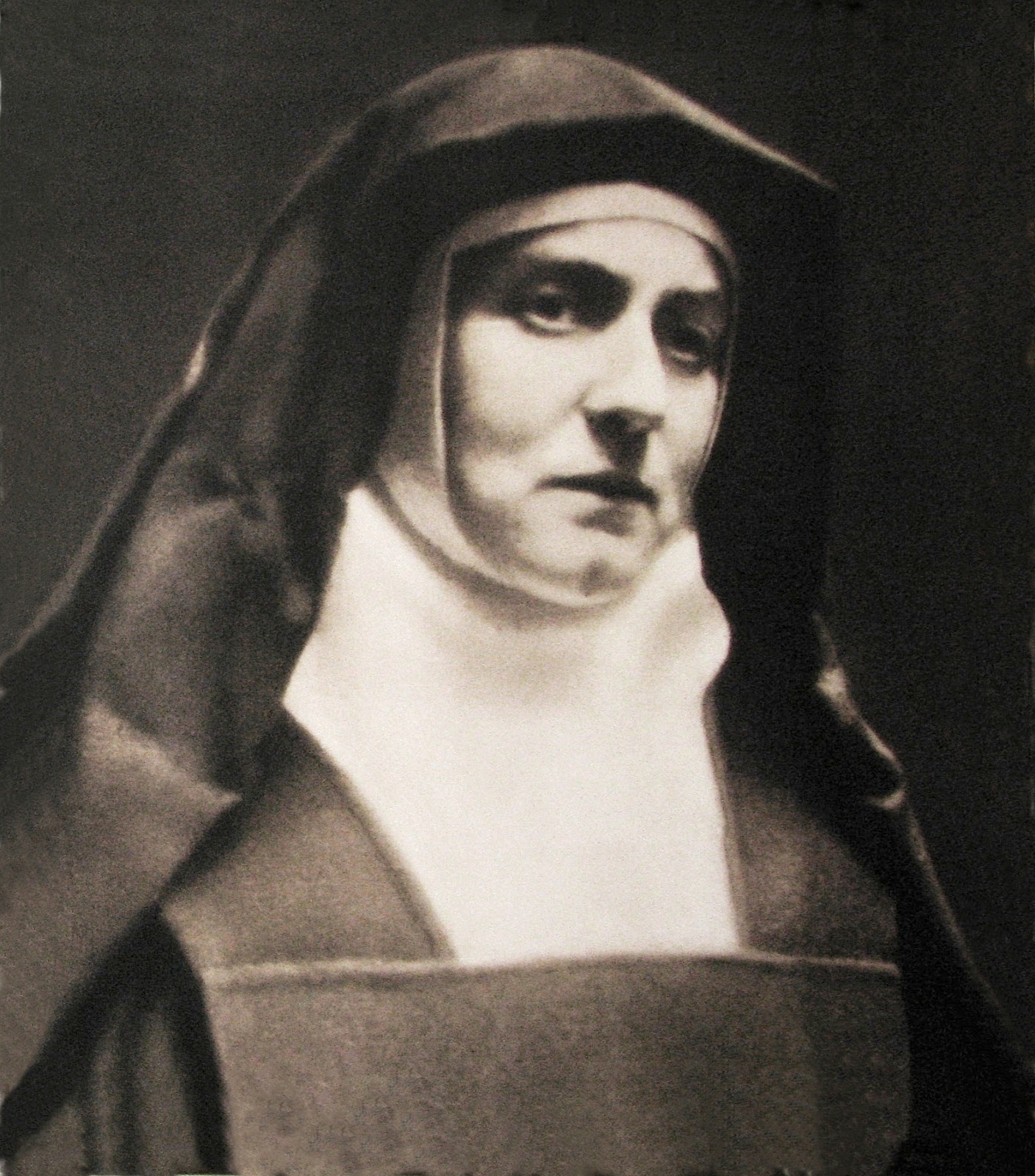
Edith Stein
 Germany
Birthday
+1891-10-12
Birth Sign
Libra
Birthplace
Wrocław
Age
Died at 50
About
Edith Stein, born on October 12, 1891, in Wrocław (then Breslau, Germany), was a German philosopher, translator, and writer who converted to Catholicism and became a Discalced Carmelite nun. She is best known for her philosophical works, her spiritual writings, and her tragic death at Auschwitz. Stein was canonized as a martyr by the Catholic Church in 1998 and is one of six patron saints of Europe. Stein grew up in an observant Jewish family but became an agnostic as a teenager. She pursued philosophy at the University of Freiburg, where she completed her doctoral thesis in 1916 under the supervision of Edmund Husserl, the founder of phenomenology. She then worked as his assistant, contributing to his research and editing his manuscripts. Her academic career was interrupted by World War I, during which she served as a nursing assistant at an infectious diseases hospital. Her experiences during the war, combined with her intellectual exploration, led her to a deep spiritual crisis. Reading the autobiography of Teresa of Ávila, the Carmelite reformer, sparked her conversion to Catholicism. She was baptized on January 1, 1922. After her conversion, Stein taught at a Catholic girls' school in Speyer and continued to write on philosophy and theology. Her notable works include 'Finite and Eternal Being' and 'The Science of the Cross,' a study of John of the Cross. In 1933, the Nazi government's Law for the Restoration of the Professional Civil Service required an 'Aryan certificate,' forcing her to resign from her teaching post. She entered the Discalced Carmelite monastery in Cologne in 1934, taking the religious name Teresa Benedicta of the Cross. She made her perpetual vows in 1938. In 1938, Stein and her sister Rosa, also a convert, were transferred to the Carmelite convent in Echt, Netherlands, for safety. However, after the Dutch bishops publicly condemned Nazi treatment of Jews in 1942, the Gestapo arrested all baptized Catholics of Jewish origin, including Edith and Rosa. They were deported to Auschwitz and murdered in the gas chambers on August 9, 1942. Stein was beatified in 1987 and canonized in 1998, recognized as a martyr who gave her life for her faith and her people.
Fame & Fandom
Edith Stein's fame is of a unique kind: not the fame of celebrity, but of veneration. Her admirers are not a fandom with a name; they are devotees, pilgrims, and scholars, drawn to her as a philosopher, a Carmelite nun, and a martyr. The community that surrounds her is organized through Catholic institutions, Carmelite monasteries, and academic circles, with her feast day on August 9 observed by the Church each year. Her canonization in 1998 and her designation as one of the patron saints of Europe have cemented her place in the hagiographical landscape, and her legacy is kept alive through projects like the Edith Stein Collection at the Graduate Theological Union and ongoing media productions by EWTN and the National Catholic Register.
As of August 2026, iFANN's Global Fame Engine has evaluated Edith Stein, but she does not currently hold a placement in the published rankings, whether the Global Top 1,000 or any Top-100 scope list. This absence from the rankings is a reflection of the nature of her fame, which is rooted in religious and intellectual spheres rather than in the global popular consciousness that the rankings measure. Yet her impact is undeniable: she is a figure who stands between two worlds, Jewish and Catholic, and her story of conversion, intellectual pursuit, and martyrdom continues to resonate with those who seek a model of faith and courage.
Interesting Facts and Legends
Edith Stein's life is rich with stories that have become part of her legend. The most iconic is her martyrdom at Auschwitz, where she was killed on August 9, 1942, after being arrested by the Gestapo. The story of her conversion is also widely told: while staying with friends, she read the autobiography of St. Teresa of Ávila in one sitting and declared, 'This is the truth.' She was baptized on January 1, 1922. Another cherished narrative is her journey from a prominent secular philosopher, a student of Edmund Husserl, to a Carmelite nun, a transformation that continues to inspire. The Vatican's description of her as 'an outstanding daughter of Israel and at the same time a daughter of the Carmelite Order' encapsulates her dual identity. Her writings on women and spirituality remain influential, and her poetry has been explored by publications like Plough. These stories and works form the fabric of her enduring legacy.
Death & Aftermath
Died
+1942-08-09 (aged 50)
Death Place
Unknown
Cause of Death
Unknown
Awards & Accolades
Keywords
Quick Facts
- Profession
- translator, philosopher, writer
- Born
- +1891-10-12
- Birthplace
- Wrocław
- Died
- +1942-08-09
- Death Place
- Auschwitz II-Birkenau concentration camp
- Gender
- Female
- Birth Sign
- Libra
Join the community
fans discussing