“A beautiful, moving, funny, and ultimately thrilling movie that speaks directly to the child in all of us.”
Roger Ebert
Chicago Sun-Times
 United States
"He is afraid. He is totally alone. He is 3,000,000 light years from home."
User Score
12,015 votes
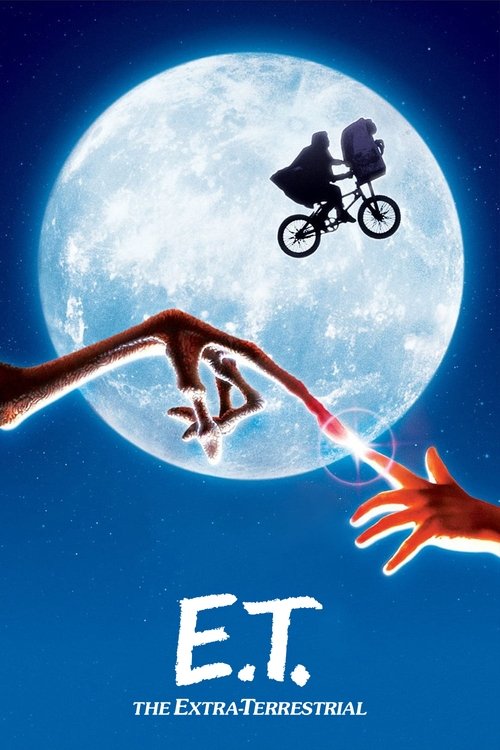
Steven Spielberg's most personal film began not with a script but with a vivid image: a young boy pedaling his bicycle across a full moon, an alien friend in his basket. That image, born from Spielberg's own childhood loneliness after his parents' divorce, became the seed for a story that would touch millions. Released in June 1982, E.T. the Extra-Terrestrial arrived at a time when audiences were hungry for wonder, and it delivered something far deeper than anyone expected, a quiet, intimate drama about a lonely boy and a stranded alien that happened to be wrapped in science fiction.
At its core, the film is a meditation on separation and the ache of wanting to belong. Spielberg shot it in chronological order, a rare approach that let his young cast, Henry Thomas, Drew Barrymore, and Robert MacNaughton, build genuine emotional bonds with the intricate animatronic puppet operated by twelve puppeteers. Melissa Mathison's screenplay, which she wrote in just eight weeks, stripped away all the typical alien-invasion tropes. There are no ray guns, no battles, no world-saving heroics. Just a frightened creature who wants to go home and a boy who needs him.
The film's production was famously secretive. Spielberg shot under the working title "A Boy's Life" to keep the project hidden. John Williams composed one of his most beloved scores, conducting the iconic flying theme in a single take. The result was a film that spent eleven years as the highest-grossing movie of all time, won four Oscars, and earned a place in the National Film Registry. But more than the records, E.T. became a shared emotional experience, a story told so simply and so honestly that it feels less like watching a movie and more like remembering something you'd forgotten.
Availability and pricing can change. Confirm on the provider's site before purchasing.
A spaceship lands in a remote California forest under cover of night. Gentle alien botanists emerge to collect plant specimens, their long fingers brushing against redwood bark. Suddenly, headlights cut through the trees. Government vehicles approach. The aliens scramble back to their ship, but in the chaos, one small creature is left behind, stranded, frightened, three million light-years from home.
The story settles in the San Fernando Valley suburb where ten-year-old Elliott lives with his older brother Michael, his younger sister Gertie, and their mother Mary, who is struggling to keep the family together after a recent divorce. Elliott is the kind of kid who notices things other people miss. When he goes to the backyard tool shed one evening and finds a strange, wrinkled creature with a glowing heart hiding among the rakes and shovels, he doesn't run. He stares. Then he drops a piece of candy.
Over the next few days, Elliott earns the alien's trust one Reese's Pieces at a time. He introduces E.T. to his siblings, and the three children discover that their guest has abilities that defy everything they know. He can heal a cut with a touch of his glowing finger. He can make dead chrysanthemums bloom again. He can levitate balls and send them floating across the room. And he can speak, or at least, he can mimic. When Elliott shows him a Speak & Spell toy, E.T. repeats the words, his voice a raspy echo. "E.T. phone home," he says, and those three words become the mission.
The connection between Elliott and E.T. goes beyond friendship. When E.T. feels joy, Elliott laughs. When E.T. is scared, Elliott's heart races. When E.T. drinks beer, Elliott gets dizzy at school. This psychic bond is the film's most ingenious device, it externalizes empathy, making the audience feel the alien's emotions through Elliott's body. The children work together to build a communication device from spare parts: a coat hanger, a circular saw blade, an umbrella. On Halloween night, they dress E.T. as a ghost and bike through the neighborhood, then ride into the forest where the device finally sends a signal into the stars.
But the government agents have been closing in. Led by a man named Keys, who seems to understand the alien's importance, they trace E.T.'s presence to the Taylor home. When they arrive, they find both E.T. and Elliott gravely ill, their bond has made them physically dependent on each other, and E.T.'s weakening connection to Earth is pulling them both toward death. The agents quarantine the house, turning it into a sterile medical facility. Scientists in hazmat suits surround the boy and the alien, monitoring their vital signs as E.T.'s heart grows dimmer.
2022 40th Anniversary IMAX Release
Original Theatrical Trailer #2
Original Theatrical Teaser
Critical Consensus
E.T. the Extra-Terrestrial remains a masterpiece of emotional storytelling, blending science fiction with profound human warmth. Its technical brilliance serves a simple, universal tale of friendship and loss that resonates across generations.
“A beautiful, moving, funny, and ultimately thrilling movie that speaks directly to the child in all of us.”
Roger Ebert
Chicago Sun-Times
“Spielberg has made a film that is not just a triumph of special effects but a triumph of the heart.”
Janet Maslin
The New York Times
“The film is a miracle of balancing the fantastic and the mundane, the cosmic and the intimate.”
Richard Corliss
Time Magazine
“E.T. is the best family film ever made, and one of the best films, period.”
Peter Bradshaw
The Guardian
Henry Thomas
Elliott
Drew Barrymore
Gertie
Robert MacNaughton
Michael
Peter Coyote
Keys
Dee Wallace
Mary
Erika Eleniak
Pretty Girl
C. Thomas Howell
Tyler
Director
Steven Spielberg
Writer
Melissa Mathison
Composer
John Williams
Cinematographer
Allen Daviau
Producers
Kathleen Kennedy, Steven Spielberg
Academy Awards (1983)
Best Original Score: Won
Academy Awards (1983)
Best Visual Effects: Won
Academy Awards (1983)
Best Sound: Won
Academy Awards (1983)
Best Sound Effects Editing: Won
Academy Awards (1983)
Best Picture: Nominated
Academy Awards (1983)
Best Director: Nominated
Academy Awards (1983)
Best Original Screenplay: Nominated
Academy Awards (1983)
Best Cinematography: Nominated
Academy Awards (1983)
Best Film Editing: Nominated
Golden Globes (1983)
Best Motion Picture – Drama: Won
Golden Globes (1983)
Best Original Score: Won
BAFTA Awards (1983)
Best Original Music: Won
BAFTA Awards (1983)
Best Film: Nominated
Saturn Awards (1983)
Best Science Fiction Film: Won
Join the community
fans discussing