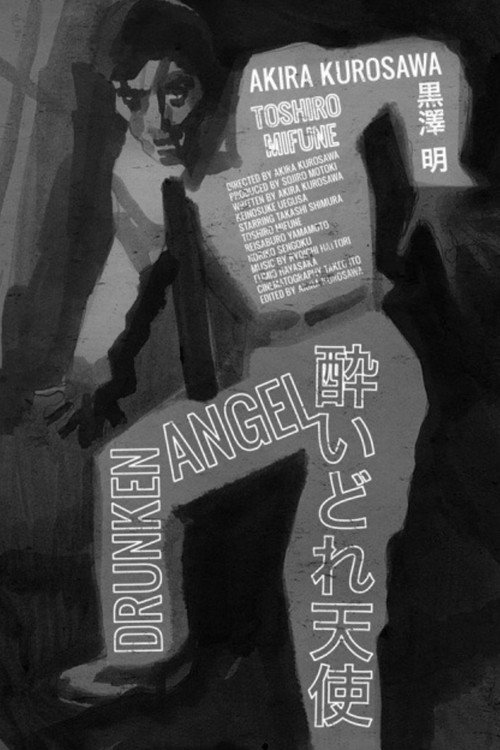
 Japan
Japan“A masterpiece of visual storytelling. Kurosawa's direction is flawless, capturing the grit and despair of post-war Tokyo with a visual poetry that is both haunting and beautiful.”
Roger Ebert
Chicago Sun-Times
Post-war Tokyo in 1948 feels like a character itself, a muddy swamp of rubble and despair where survival is the only law. Dr. Sanada operates a dilapidated clinic that doubles as a bar for his drinking buddies, a man whose own license is lost to alcoholism even as he tries to heal others. His world shifts when Matsunaga, a swaggering young gangster with a face full of bravado, stumbles through the door seeking treatment for injuries inflicted by rival yakuza.
Matsunaga carries an arrogance that masks deep vulnerability, but Sanada finds something far more deadly beneath the bruises: advanced tuberculosis. The diagnosis creates a tense dynamic between the dying criminal and the broken doctor. Sanada attempts to enforce a regimen of rest and medication, hoping to pull Matsunaga away from the violent underworld that claims its victims quickly. This struggle becomes a microcosm for the nation's own battle against decay, poverty, and the futility of fighting one's nature.
Availability and pricing can change. Confirm on the provider's site before purchasing.
The story unfolds in the shadowed alleys and flooded lots of post-war Japan, where the air hangs heavy with smoke and the smell of rot. Dr. Sanada spends his days drowning his sorrows in cheap sake and his nights patching up the city's most desperate souls. He lives in a state of constant intoxication, surrounded by misfits who reflect the hopelessness of an era defined by loss. When Matsunaga arrives at his clinic, the atmosphere shifts instantly. The young gangster projects strength while hiding a deep-seated fear, a "tough guy" archetype trying to survive in a world that has already discarded him.
Upon examining Matsunaga, Sanada discovers the terrifying truth: the gangster suffers from advanced tuberculosis, a disease considered a death sentence in the overcrowded slums of Tokyo. Sanada confronts Matsunaga with the diagnosis, warning him that without immediate rest and treatment, he will die within a year. This moment creates an uneasy alliance between two broken men. Despite his own moral failings, Sanada takes it upon himself to save Matsunaga, seeing a glimmer of humanity in the young criminal. He enforces a strict regimen of bed rest and medication, trying to pull Matsunaga away from the violent underworld that claims its victims quickly.
The central conflict arises from the clash between Sanada's desperate attempt to impose order and health through medicine and Matsunaga's chaotic descent into violence and denial. As Matsunaga's condition worsens, he becomes increasingly erratic and aggressive. He is drawn back into the orbit of the local crime syndicate, specifically the influence of his old boss, Takahama, who represents the old guard of the yakuza world. The tension escalates as Matsunaga struggles with the physical pain of his illness and the psychological pressure of his environment. He begins to hallucinate and acts out violently, creating a volatile situation that threatens everyone around him.
Sanada finds himself caught in the middle, trying to mediate between the dying gangster and the criminal elements that want to use him or eliminate him. The film explores themes of redemption, the futility of fighting one's nature, and the social decay of post-war Japan. The supporting characters, including Matsunaga's girlfriend Gin and the various members of the gang, add layers of complexity to the narrative, highlighting how the struggle for survival permeates every aspect of life in this broken city. The story builds toward a climax where the boundaries between life and death, sanity and madness, become increasingly blurred, leaving the audience to wonder whether Matsunaga can be saved or if he is destined to be consumed by the very forces he tries to resist.
Drunken Angel 1948 Trailer
Critical Consensus
Drunken Angel stands as a masterful blend of film noir and social realism, showcasing Akira Kurosawa's early genius. The film's raw energy, coupled with unforgettable performances from Takashi Shimura and Toshirō Mifune, creates a haunting portrait of post-war Japan. Its visual style and thematic depth remain as relevant today as they were in 1948.
“A masterpiece of visual storytelling. Kurosawa's direction is flawless, capturing the grit and despair of post-war Tokyo with a visual poetry that is both haunting and beautiful.”
Roger Ebert
Chicago Sun-Times
“Toshiro Mifune bursts onto the screen with a raw, untamed energy that immediately establishes him as a star. His portrayal of the doomed gangster is both terrifying and tragic.”
Variety Staff
Variety
“Akira Kurosawa's 'Drunken Angel' is a gripping tale of redemption and despair, set against the backdrop of a city in ruins. The film's atmospheric cinematography and powerful performances make it a must-see.”
The New York Times
The New York Times
“This film is a profound meditation on the human condition, exploring themes of addiction, disease, and the search for meaning in a chaotic world. Kurosawa's vision is both dark and hopeful.”
Peter Bradshaw
The Guardian
Takashi Shimura
Dr. Sanada
Toshirō Mifune
Matsunaga
Reizaburo Yamamoto
Okada
Michiyo Kogure
Nanae
Chieko Nakakita
Miyo
Noriko Sengoku
Gin
Shizuko Kasagi
Singer
Eitarō Shindō
Takahama
Director
Akira Kurosawa
Writers
Akira Kurosawa, Keinosuke Uekusa
Composer
Fumio Hayasaka
Cinematographer
Takeo Itō
Producer
Sōjirō Motoki
Mainichi Film Concours (1948)
Best Film: Won
Kinema Junpo Awards (1948)
Best Director: Won
Kinema Junpo Awards (1948)
Best Actor: Won
Blue Ribbon Awards (1949)
Best Film: Won
Venice International Film Festival (1950)
Golden Lion: Nominated
Join the community
fans discussing