“The movie's satire is broad and undisciplined, but its rage is genuine and its despair is earned. It's a comedy about the end of the world that is also a tragedy about the end of sense.”
A.O. Scott
The New York Times
 United States
"Based on truly possible events."
User Score
9,366 votes
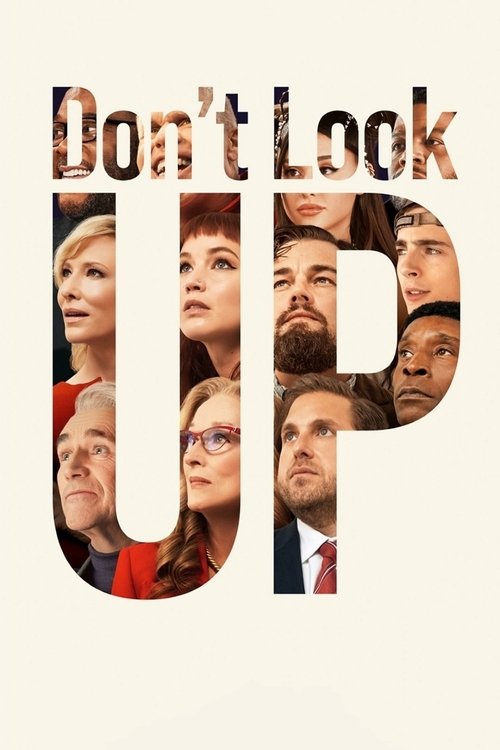
In December 2021, Netflix dropped a comet on the world. Adam McKay's Don't Look Up arrived with a cast so stacked it felt like a Hollywood emergency meeting: Leonardo DiCaprio, Jennifer Lawrence, Meryl Streep, Cate Blanchett, Jonah Hill, Mark Rylance. The premise was simple and terrifying: two astronomers discover a planet-killing comet heading straight for Earth, and nobody cares.
McKay, who turned the 2008 financial crisis into a dark comedy with The Big Short, here took aim at climate change denial, media trivialization, and political dysfunction. The comet is an allegory, but the film is anything but subtle. It lampoons cable news, tech billionaires, and spineless politicians with a sledgehammer, earning both cheers and jeers. Critics called it preachy; audiences made it one of Netflix's most-watched films ever, with over 152 million hours streamed in its first month.
The film sparked real-world debate, screened at climate conferences and cited by scientists. Its title became shorthand for willful ignorance. Love it or hate it, Don't Look Up captured something raw about the early 2020s: the feeling of shouting into a void while the world burns.
Availability and pricing can change. Confirm on the provider's site before purchasing.
Kate Dibiasky, a PhD candidate in astronomy at Michigan State University, is analyzing data when she spots something unusual: a comet, roughly 5 to 10 kilometers wide, on a direct collision course with Earth. She brings the finding to her professor, Dr. Randall Mindy, a mild-mannered scientist who initially dismisses it as an error. But further calculations confirm the trajectory. The comet will impact in about six months. Extinction-level event. All life gone.
Randall and Kate, along with Dr. Teddy Oglethorpe from NASA's Planetary Defense Coordination Office, fly to Washington D.C. to alert the White House. President Janie Orlean, played by Meryl Streep as a bored, narcissistic politician, barely listens. Her son and chief of staff, Jason Orlean (Jonah Hill), is more interested in optics and midterm elections. The administration tells the scientists to sit tight and not go public.
Frustrated, the trio leaks the story to the media. They appear on The Daily Rip, a morning show hosted by Brie Evantee (Cate Blanchett) and Jack Bremmer (Tyler Perry). The hosts treat the apocalypse like celebrity gossip, asking Randall about his awkward body language and cutting to a segment on a pop star's breakup. The comet becomes a meme. Conspiracy theorists claim it's a hoax. The slogan "Don't Look Up" spreads online, embraced by denialists who accuse scientists of fearmongering.
Tech billionaire Peter Isherwell (Mark Rylance), whose company BASH Cellular has developed advanced AI and mining technology, swoops in with an alternative plan. Instead of nuking the comet, his team will land on it and extract valuable rare-earth minerals. President Orlean, seeing a political and financial win, endorses the BASH mission. Randall, seduced by fame and Brie's attention, becomes a media darling, rationalizing the mining plan. Kate grows increasingly radical, smashing a TV on live air and retreating to her hometown, where she meets Yule (Timothée Chalamet), a skater-punk who becomes an unlikely ally.
As the comet looms larger, society fractures. Some people party. Some pray. Some look up. The BASH mission launches amid great fanfare. Randall, Kate, and Teddy watch from the ground, knowing the science doesn't support the plan. The film builds toward a single question: will humanity act, or will it look away?
Official Trailer
Official Teaser Trailer
Critical Consensus
Don't Look Up's ambitious satire lands with a thud as often as it hits its target, but its star-studded cast and well-intentioned message may be enough for some viewers. The film is a blunt, divisive allegory that splits critics and audiences sharply.
“The movie's satire is broad and undisciplined, but its rage is genuine and its despair is earned. It's a comedy about the end of the world that is also a tragedy about the end of sense.”
A.O. Scott
The New York Times
“McKay's satire is as blunt as a sledgehammer, but its targets are so deserving that the lack of subtlety almost becomes a virtue.”
David Rooney
The Hollywood Reporter
“A wildly uneven but frequently funny mess that's too smug and self-satisfied for its own good.”
Peter Bradshaw
The Guardian
“It's a passionate, provocative and very funny film that earns its dark ending.”
Richard Roeper
Chicago Sun-Times
“The film is a satire of the way we process information, and it's so on the nose that it's almost a documentary.”
Owen Gleiberman
Variety
Leonardo DiCaprio
Dr. Randall Mindy
Jennifer Lawrence
Kate Dibiasky
Meryl Streep
President Orlean
Cate Blanchett
Brie Evantee
Rob Morgan
Dr. Teddy Oglethorpe
Jonah Hill
Jason Orlean
Mark Rylance
Peter Isherwell
Tyler Perry
Jack Bremmer
Timothée Chalamet
Yule
Ron Perlman
Benedict Drask
Ariana Grande
Riley Bina
Kid Cudi
DJ Chello
Himesh Patel
Phillip
Melanie Lynskey
June Mindy
Sarah Silverman
Sarah Benterman
Director
Adam McKay
Writers
Adam McKay, David Sirota
Composer
Nicholas Britell
Cinematographer
Linus Sandgren
Producers
Adam McKay, Kevin J. Messick
Academy Awards (2022)
Best Picture: Nominated
Academy Awards (2022)
Best Original Screenplay: Nominated
Academy Awards (2022)
Best Original Score: Nominated
Academy Awards (2022)
Best Film Editing: Nominated
Golden Globe Awards (2022)
Best Motion Picture – Musical or Comedy: Nominated
Golden Globe Awards (2022)
Best Actor – Motion Picture Musical or Comedy: Nominated
Golden Globe Awards (2022)
Best Actress – Motion Picture Musical or Comedy: Nominated
Golden Globe Awards (2022)
Best Screenplay: Nominated
Golden Globe Awards (2022)
Best Original Score: Nominated
BAFTA Awards (2022)
Best Original Screenplay: Nominated
BAFTA Awards (2022)
Best Special Visual Effects: Nominated
Writers Guild of America Awards (2022)
Best Original Screenplay: Won
Join the community
fans discussing