“A masterpiece of atmospheric horror that lingers in the mind long after the final frame.”
Roger Ebert
Chicago Sun-Times
 United Kingdom
"Pass the warning."
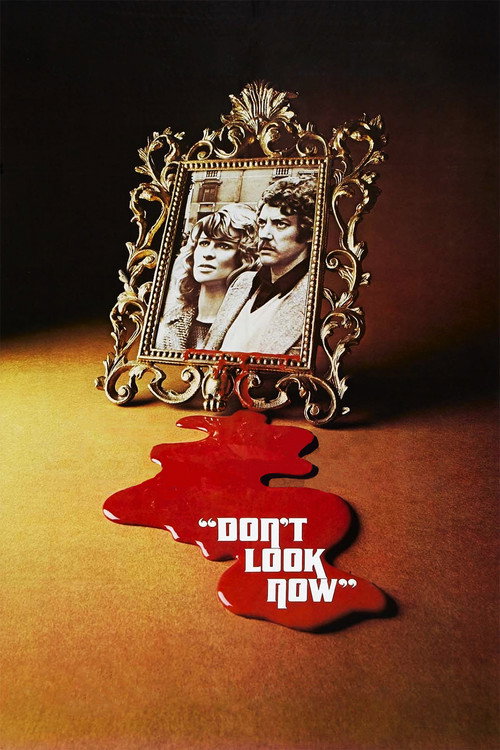
Donald Sutherland and Julie Christie lead this 1973 psychological horror film as a British couple navigating the foggy canals of Venice while reeling from the accidental drowning of their young daughter. Director Nicolas Roeg constructs a narrative that refuses to distinguish clearly between supernatural phenomena and the characters' fractured mental states. The story unfolds through a non-linear structure, utilizing split screens and rapid cuts to mirror the disorientation of grief.
The film stands apart from typical genre entries by focusing less on jump scares and more on the slow erosion of a marriage under pressure. Production values were high for its budget, with cinematographer Anthony B. Richmond capturing the city's decay and beauty in stark contrast to the muted tones of the protagonists' lives. Critics noted the boldness of the script adaptation from Daphne du Maurier's short story, which expanded the source material into a complex meditation on denial and loss.
Availability and pricing can change. Confirm on the provider's site before purchasing.
John and Laura Baxter arrive in Venice during the autumn of 1973 to work on restoring a church, seeking distraction from the recent death of their six-year-old daughter Christine. The tragedy occurred back home when she fell through ice while playing near a pond. John tries to maintain his composure through architectural work and rational thought, but Laura retreats into a desperate need for spiritual connection. Their hotel overlooks the Grand Canal, placing them in close proximity to two elderly sisters who claim to be mediums. Heather warns the family that a figure dressed in red represents a grave danger, a message that deeply unsettles Laura.
Laura begins experiencing vivid visions of a small child wearing a bright red raincoat. She interprets these sightings as her deceased daughter attempting to communicate from beyond the grave. John dismisses these claims as hallucinations born of exhaustion and sorrow. The tension between the couple escalates as Laura becomes increasingly obsessed with tracking the red figure through the city streets. John finds himself drawn into the mystery despite his skepticism, particularly after noticing a dwarf maintenance worker at the church site who wears a matching red hooded cloak.
Venice serves as a character in itself, with its labyrinthine alleys and perpetual mist creating an atmosphere of isolation. The film shifts between linear progression and fragmented memories, blurring the timeline of events. John continues his restoration work while simultaneously trying to keep Laura safe from her own delusions. The narrative builds tension through visual cues and sound design rather than traditional dialogue-heavy scenes. The presence of the red figure grows more frequent and intrusive, symbolizing both a potential sign from the afterlife and a tangible threat lurking in the shadows.
Laura's conviction deepens until she decides to follow the red-cloaked figure alone one night. John realizes the gravity of her obsession and rushes to intercept her before it is too late. The film utilizes disjointed editing techniques to heighten the sense of dread, cutting between different perspectives and moments in time. The audience watches as the couple navigates the dangerous interplay between their grief and the reality of their surroundings. The climax approaches as the distinction between the supernatural and the mundane dissolves completely.
The final sequence takes place in a narrow alleyway near the church where John works. Laura follows the red figure, calling out to what she believes is her daughter. The figure turns, revealing not a ghost but a dwarf maintenance worker. The confrontation ends violently as the man attacks Laura. John arrives moments later to find his wife dying in the arms of the attacker. The dwarf flees into the darkness, leaving John to confront the brutal reality that the red figure was never a spirit but a real person posing a lethal threat.
The film concludes with John staring directly into the camera, breaking the fourth wall. This final shot forces the viewer to acknowledge the harsh truth of the situation: the supernatural elements were manifestations of psychological trauma rather than actual ghosts. The ending leaves no room for comfort, emphasizing the destructive power of grief and the human tendency to project meaning onto random events. The ambiguity of the earlier scenes now resolves into a clear, tragic narrative about the failure to accept reality.
Official Re-Release Trailer
Don't Look Now (1973) Trailer #1 | Movieclips Classic Trailers
Critical Consensus
A masterclass in psychological horror, Don't Look Now blends grief, guilt, and the supernatural into a haunting tale of a couple unraveling in Venice. Its non-linear storytelling, stunning visuals, and powerful performances make it a timeless classic that challenges viewers to question the nature of reality and loss.
“A masterpiece of atmospheric horror that lingers in the mind long after the final frame.”
Roger Ebert
Chicago Sun-Times
“Roeg's visual language is as haunting as the story itself, creating a nightmare that feels all too real.”
Peter Travers
Variety
“Julie Christie delivers a performance of devastating emotional depth, anchoring the film's surreal elements with raw humanity.”
Peter Bradshaw
The Guardian
“A film that redefines the boundaries of horror, blending psychological drama with supernatural terror in a way few have ever achieved.”
A.O. Scott
IndieWire
“The red cloak becomes a symbol of fear itself, a visual motif that haunts the viewer with its simplicity and power.”
Todd McCarthy
The Hollywood Reporter
Donald Sutherland
John Baxter
Julie Christie
Laura Baxter
Hilary Mason
Heather
Giorgio Trestini
Workman (Dwarf)
Director
Nicolas Roeg
Writers
Allan Scott, Chris Bryant, Daphne du Maurier
Composer
Pino Donaggio
Cinematographer
Anthony B. Richmond
Producer
Peter Katz
Venice Film Festival (1973)
Golden Lion: Won
Saturn Awards (1974)
Best Horror Film: Won
Edgar Allan Poe Awards (1974)
Best Motion Picture Screenplay: Won
BAFTA Awards (1974)
Best Cinematography: Nominated
BAFTA Awards (1974)
Best Editing: Nominated
Golden Globe Awards (1974)
Best Foreign Language Film: Nominated
Join the community
fans discussing