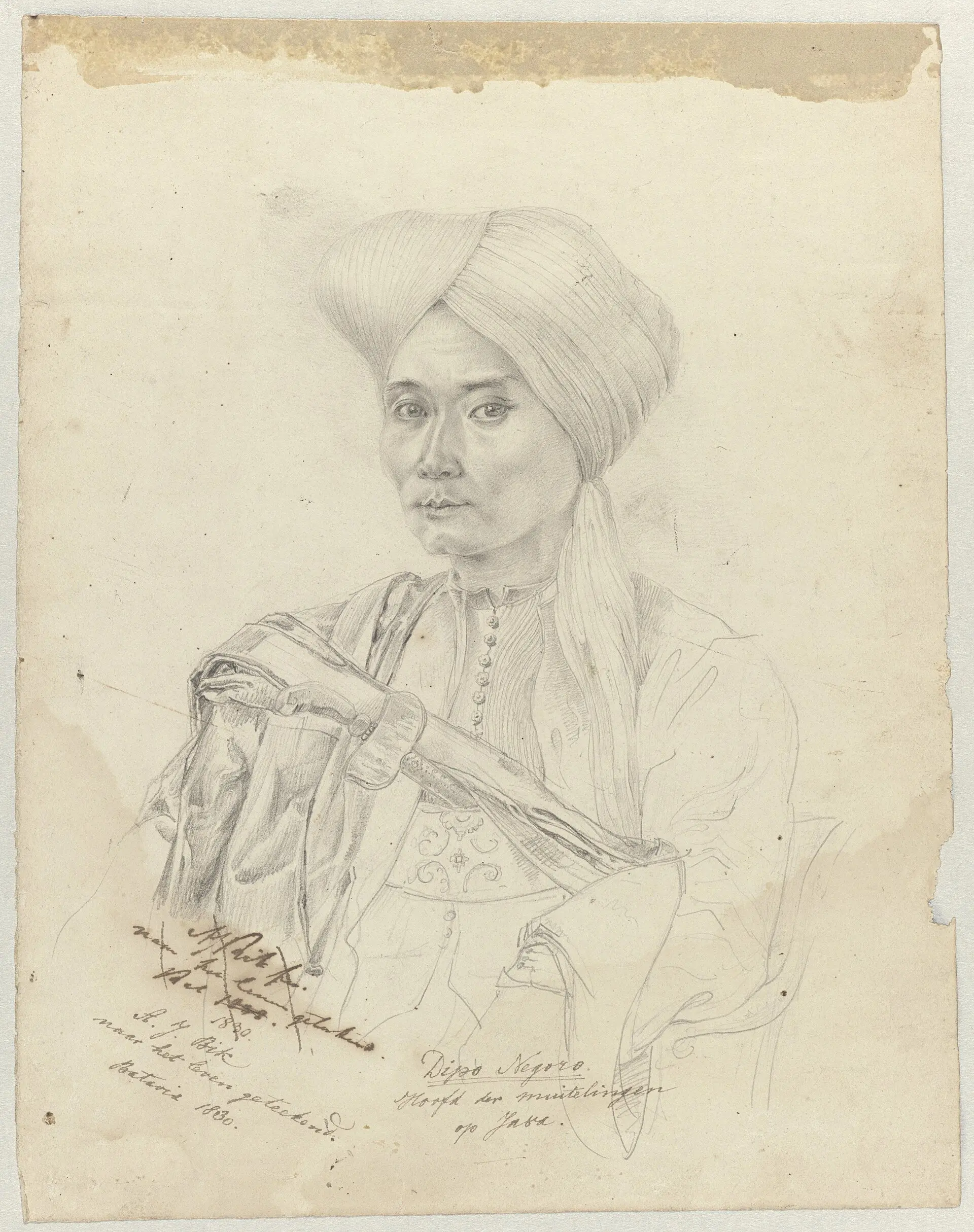
Diponegoro
 Indonesia
Javanese prince•military leader•resistance fighter
Also known as: Pangeran Diponegoro, Raden Mas Ontowiryo, Dipanegara
Birthday
November 11, 1785
Birth Sign
Scorpio
Birthplace
Yogyakarta Sultanate
Age
Died at 69
About
Prince Diponegoro was a Javanese prince and military leader who led one of the largest anti-colonial uprisings in Southeast Asian history. Born Bendara Raden Mas Mustahar on 11 November 1785 in the Yogyakarta Sultanate, he was the eldest son of Sultan Hamengkubuwono III. He is revered in Indonesia as a national hero and a symbol of resistance against Dutch colonial rule.
Diponegoro is best known for leading the Java War from 1825 to 1830, a five-year guerrilla conflict that devastated central Java and became a defining moment in Indonesian history. His blend of Islamic piety and Javanese mysticism gave him a unique authority that transcended the royal court. Despite his eventual capture and exile, his legacy endures through monuments, universities, and the UNESCO-recognized chronicle of his life.
Early Life & Background
Diponegoro's childhood unfolded within the walls of the Yogyakarta kraton, where he was educated in Javanese court traditions, Islamic scholarship, and martial arts. As the son of a concubine, his path to succession was complicated, but his status as the eldest son gave him considerable standing. He grew increasingly troubled by the corruption and accommodation of Dutch colonial influence that he saw among the court nobles.
His early years were marked by deep religious devotion and mystical practice. He spent long hours in meditation and contemplation, earning a reputation as a spiritual leader. The immediate catalyst for his rebellion came when the Dutch ordered a road built through his ancestral land, a project that desecrated sacred ground and symbolized the erosion of Javanese sovereignty.
Career Growth
Diponegoro launched his rebellion in 1825, igniting the Java War, a five-year conflict that engulfed much of central Java. His guerrilla tactics and intimate knowledge of the terrain made him a formidable adversary. The war caused enormous casualties, with an estimated 200,000 Javanese and 8,000 Dutch soldiers losing their lives.
Despite early successes, the Dutch overwhelmed his forces with superior numbers and technology. In 1830, he was lured to peace negotiations under a flag of truce and captured. He was exiled first to Manado, then to Makassar, where he died on 8 January 1855. His struggle, though ultimately unsuccessful, inspired generations of Indonesian nationalists and secured his place as a national hero.
Career Timeline
Public Image & Style
Diponegoro is revered in Indonesia as a national hero and a symbol of anti-colonial resistance. He is portrayed in textbooks, monuments, and cultural works as a pious, principled prince who sacrificed royal privilege for the sake of his people's freedom. His image in art typically features traditional Javanese royal attire with Islamic elements, reflecting his dual identity as prince and religious leader. The media and cultural institutions depict him as a tragic hero, a brilliant military leader ultimately betrayed by Dutch deception.
Fame & Fandom
In the quiet corridors of Javanese history, a single figure commands attention that outlasts empires. Diponegoro stands as a monumental symbol of resistance, his legacy woven into the national identity of Indonesia with threads of steel and spirit. His influence transcends mere biography to become a living mythos for millions. According to the iFANN Global Fame Rankings, he is currently the 18th most famous person in Indonesia, holding steady from the previous cycle. This dominance extends beyond borders; he ranks as the 35th most famous person from Indonesia and holds the spot of the 56th most famous person in Southeast Asia, both holding steady. These placements reflect a deep, enduring resonance across media coverage and cultural consumption signals worldwide. Unlike modern pop stars, Diponegoro does not have a formal fandom name or organized fanbase engaging in digital campaigns. The Indonesian public venerates him as a National Hero rather than an idol. There are no subreddits dedicated to his birthday or fan clubs organizing charity drives. Instead, his audience consists of students, historians, and citizens who revere his story of sacrifice. Institutions like Universitas Diponegoro keep his memory alive through academic excellence, while state-sponsored exhibitions ensure his narrative remains central to the national consciousness. The absence of a specific fandom label underscores the unique nature of his fame: it is a collective, patriotic devotion rather than a commercial following.
Interesting Facts and Legends
Diponegoro's autobiographical chronicle, the Babad Diponegoro, stands as a pillar of Javanese literature and was inscribed on UNESCO's Memory of the World Register in 2018. He viewed his resistance as a pan-Islamist struggle, blending nationalist and religious motivations. The famous 1857 painting by Raden Saleh depicting his capture contains hidden symbolic messages that art historians still decode today. The war he led cost the Dutch colonial government enormous sums, contributing to significant financial pressures on the administration. Beyond these documented facts, the arrest of Prince Diponegoro remains the defining legend of his life. During peace negotiations, he was betrayed by Lieutenant General De Kock despite promises of safe conduct, an event that cemented the narrative of Dutch treachery versus Javanese honor. This moment is so iconic that every Indonesian student learns the details of this betrayal first. Another legendary chapter involves his exile to Manado and later Makassar, where he lived until his death in 1855. Even in captivity, stories emphasize his refusal to acknowledge Dutch authority, maintaining his dignity as a sovereign prince. These verified historical events have evolved into foundational myths that define Indonesian patriotism.
Family & Personal Life
Diponegoro was the eldest son of Sultan Hamengkubuwono III and Raden Ayu Mangkarawati, one of the sultan's concubines. In accordance with Javanese royal customs, he had multiple wives and children, though detailed records are sparse. His religious devotion and mystical practices were central to his personal identity, setting him apart from more secular courtiers.
Notable Connections
Diponegoro's father was Sultan Hamengkubuwono III of Yogyakarta, and his mother was Raden Ayu Mangkarawati. The Javanese painter Raden Saleh created a famous 1857 painting depicting Diponegoro's capture, which contains hidden symbolic messages. His adversaries were the Dutch colonial authorities, who ultimately defeated and exiled him.
Relationships & Dating History
Historical records from the early 19th century Javanese court do not provide detailed documentation of Diponegoro's romantic relationships. As a Javanese prince, he would have had multiple marriages and concubines per royal tradition, but specific chronological details are not well-documented. His most significant personal relationships noted in historical accounts were with his father, Sultan Hamengkubuwono III, and his mother, Raden Ayu Mangkarawati. The Babad Diponegoro contains autobiographical reflections on his life, including some personal matters, but detailed romantic histories are not accessible in available sources.
Death & Aftermath
Died
January 8, 1855 (aged 69)
Death Place
Magelang, Central Java, Dutch East Indies
Cause of Death
Natural causes after prolonged illness
Inside the stone walls of Fort de Vries in Magelang, Prince Diponegoro spent his final twenty-five years under Dutch house arrest. On January 8, 1855, at the age of sixty-nine, he passed away while still confined by colonial guards. Historical records do not preserve an autopsy or medical ruling as such procedures were absent for political prisoners in the mid-19th century Dutch East Indies; his death was simply noted by administrators. The immediate reaction was muted by censorship, with open mourning suppressed within the Javanese community under strict colonial control. His remains lay buried in Magelang for decades until 1992, when Indonesian officials and descendants exhumed his body to reinter him in a mausoleum in Kotagede, Yogyakarta, near the royal palace. This repatriation transformed a forgotten grave into a national shrine, attended by high-ranking government figures and members of the Sultanate family. Today, his legacy is cemented through institutions like Universitas Diponegoro in Semarang and statues that dot the landscape.
Net Worth (Estate Value)
$0
iFANN Editorial Team estimate
As a historical figure who died in 1855, Diponegoro's personal net worth is not applicable in the modern sense. He was a prince of the Yogyakarta Sultanate who was stripped of his wealth and position upon his capture and exile. Per iFANN's editorial analysis, the total value attributed to his estate at death is $0. However, his legacy has been monetized indirectly through naming rights. The Diponegoro name is used on universities, hotels, streets, and businesses across Indonesia, including the DoubleTree by Hilton Jakarta – Diponegoro and Universitas Diponegoro. The Babad Diponegoro manuscript is a UNESCO-recognized cultural treasure, and commemorative events, such as the 200th anniversary of the Java War in 2025, have generated significant cultural and tourism activity.
Awards Won (2)
Diponegoro received no awards during his lifetime, but posthumously he has been honored as a National Hero of Indonesia. His autobiographical chronicle, the Babad Diponegoro, was inscribed on UNESCO's Memory of the World Register in 2018, a prestigious international recognition of its documentary heritage value.
20th century · National honor
Leadership in the anti-colonial struggle
2018 · Documentary heritage
Babad Diponegoro
Known For
Java War
1825-1830 · Leader
Keywords
Sources
Quick Facts
- Profession
- Javanese prince, military leader, resistance fighter
- Born
- November 11, 1785
- Birthplace
- Yogyakarta Sultanate
- Died
- January 8, 1855
- Death Place
- Makassar
- Gender
- Male
- Birth Sign
- Scorpio
Personal Details
- Full Name
- Bendara Raden Mas Mustahar
Frequently Asked Questions
Who was Prince Diponegoro?
Why did Diponegoro start the Java War?
How did Diponegoro die?
Was Diponegoro a national hero?
What is the Babad Diponegoro?
Join the community
fans discussing