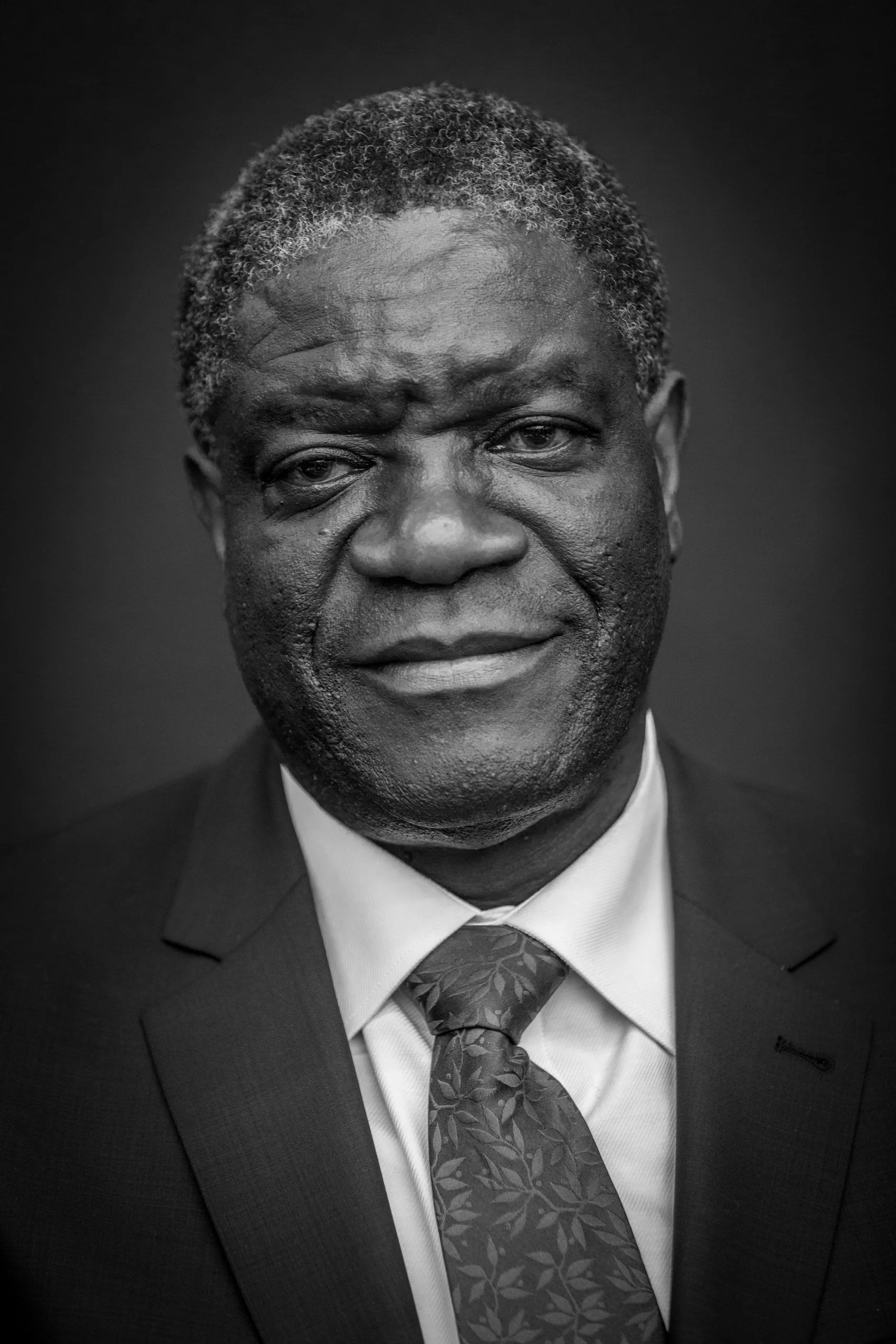
Denis Mukwege
 DR Congo
human rights defender•gynecologist•obstetrician
Also known as: Denis Mukengere Mukwege, Denis M. Mukwege
Birthday
March 1, 1955
Birth Sign
Pisces
Birthplace
Bukavu, South Kivu, Democratic Republic of Congo
Age
71 years old
About
Denis Mukwege is a Congolese gynecologist, obstetrician, human rights defender and Pentecostal pastor who has spent more than three decades treating women and girls brutalized by sexual violence in eastern Democratic Republic of Congo. He founded and still directs Panzi Hospital in Bukavu, where his surgical team has cared for tens of thousands of survivors of rape used as a weapon of war, repairing fistulas and other catastrophic internal injuries that most surgeons never learn to treat.
His testimony about the scale of that violence, delivered in front of governments, courts and the United Nations, helped push the International Criminal Court toward its first conviction for rape as a war crime. In 2018 he shared the Nobel Peace Prize with Nadia Murad for their work to end the use of sexual violence in armed conflict. He remains one of the most quoted moral voices on the Congo crisis, speaking out in 2026 against predatory mining deals, university closures and the impunity that follows massacres.
Early Life & Background
Denis Mukengere Mukwege grew up in Bukavu, a lakeside town in South Kivu, in a household shaped by his father's work as a Pentecostal pastor. The family belonged to a community where prayer and practical service were inseparable, and Mukwege absorbed both early. He attended local Catholic schools before enrolling at the University of Kinshasa, where he earned his medical degree in 1984.
His decision to specialize in gynecology came from watching women arrive at mission clinics with injuries nobody around him could repair. He went to France for training, taking a doctorate in gynecology and obstetrics from the University of Lyon in 1986, then added further study in reconstructive surgery for fistulas in Paris and London. By the late 1980s he was one of a small number of surgeons worldwide with the skills to reconstruct the internal damage caused by gang rape.
He returned to Bukavu in 1990 to practice, expecting a quiet career in a regional hospital. The First Congo War broke out in 1996, and the patients who came through the doors changed everything. Soldiers and militias were using rape systematically, and Mukwege realized that patching up individual women while the violence continued was not enough. He began keeping records, documenting patterns, and preparing for something larger than a surgical practice.
Career Growth
Panzi Hospital opened in Bukavu in 1999, named after Mukwege's wife at the time, and it quickly became something no other clinic in the region offered: a place where a survivor could receive surgery, psychological counseling, legal help and job training under one roof. The model drew attention from international health organizations and, over the following decade, from the world's press.
Mukwege's public turn came in the early 2000s, when he started testifying about what he was seeing. He co-founded the Congolese Organization for Human Rights and Development in 2004 and became a persistent critic of both the Congolese government and foreign powers he accused of tolerating the violence. His documentation fed into international legal efforts, and in 2012 the ICC handed down its first conviction for rape as a tool of war. That same year he survived a shooting at his home in Bukavu, a bullet passing through his chest without killing him.
Awards followed: the Right Livelihood Award in 2013, Fortune's list of the world's greatest leaders in 2016, and the Nobel Peace Prize in 2018, shared with Nadia Murad. He used the Nobel platform to press for justice rather than to celebrate, and he has kept doing the same work since. In 2026 he features prominently in the documentary Muganga: The One Who Treats, produced by Angelina Jolie, which follows his hospital and the wider crisis in eastern Congo.
Career Timeline
Public Image & Style
Media coverage of Mukwege tends toward the reverent. He is routinely described as a saint, a moral compass, a man who fixes broken women, labels he has spent years politely refusing. In interviews he redirects the attention to his surgical team, to the nurses and counselors at Panzi, and to the survivors themselves, insisting that the story is theirs.
His public voice is calm, precise and unsparing. He speaks in complete paragraphs, cites dates and casualty figures, and rarely raises his voice even when describing atrocities. That evenness is part of why he is trusted: he does not perform outrage, he documents it.
His appearance is deliberately unglamorous. He wears dark suits and clerical collars to formal events and clinical whites at the hospital, and he has never cultivated a personal brand beyond the work. The effect is a public image built almost entirely on credibility rather than charisma.
Fame & Fandom
There is no fandom name attached to Denis Mukwege, and no organized fan culture in the usual sense. His supporters are survivors he has treated, human rights lawyers, medical colleagues, church networks and donors to the Mukwege Foundation, and they express loyalty through fundraising, advocacy campaigns and legal pressure rather than through fan projects or birthday billboards. If the community has a label at all, it is simply allies.
What that coalition has built is measurable reach. In the September 2026 iFANN Global Fame Rankings, he holds the 9th most famous person in Pastors, a placement that has held steady from the previous cycle. It is a striking position for a surgeon who has never sought celebrity, and it reflects how far his name travels through humanitarian, religious and policy circles worldwide.
The engagement runs both ways. Mukwege takes questions from students and activists directly, and his foundation channels supporter energy into concrete programs at Panzi, from survivor scholarships to legal clinics. Fans of his work tend to measure their devotion in donations and signatures rather than in merchandise.
Interesting Facts and Legends
Mukwege is one of very few people alive who is both a fully ordained Pentecostal pastor and a world-class surgeon. He prays with patients before operating, treating the body and the spirit as one problem.
He speaks French, Swahili, Lingala, English and Dutch, a practical necessity for a man who moves between Bukavu clinics, European capitals and UN chambers.
In Mashi, the language of his home region, muganga means healer. The 2026 documentary took that word as its title, and Mukwege has said the label belongs to the whole team at Panzi rather than to him.
He has lived through stretches of exile in Belgium and the Netherlands when threats made staying in Congo too dangerous, and each time he returned as soon as he judged it safe enough to operate again.
Fans of his work still retell the 2012 shooting as the moment that proved his nerve: he was back at the hospital within weeks, and when asked why he did not flee permanently, he said the women had nowhere else to go.
Notable Quotes
“The women of Congo have been raped by armies and militias, and the world has watched.”
“I have seen too much suffering to be silent.”
“Justice is the only way to break the cycle of violence.”
“I am not a saint. I am a doctor doing my job.”
“The international community must stop looking away from Congo.”
Family & Personal Life
Mukwege's father was a Pentecostal pastor in Bukavu, a calling that shaped both the household's daily rhythm and Mukwege's own decision to be ordained. He grew up in a family where religious service and community obligation were the same thing.
He has been married twice. His first wife, Alexandra, was the namesake of Panzi Hospital when it opened in 1999. They divorced in the mid-2000s, and she later moved abroad. His second wife, Marie-Louise Mukwege, has managed the household through years of threats and periods of exile, and the couple splits their time between Bukavu and The Hague, where the Mukwege Foundation is headquartered.
His children have largely stayed out of the public eye, a deliberate choice given the family's history of surviving assassination attempts. One son, Jean-Pierre, trained as a physician.
Notable Connections
Mukwege's closest public allies include Nadia Murad, his Nobel co-laureate and a Yazidi survivor advocate, and Angelina Jolie, who produced the 2026 documentary Muganga: The One Who Treats. He works alongside chef José Andrés on crisis relief and with the Mukwege Foundation team in The Hague. Actors David Oyelowo and Danai Gurira have championed his story at film festivals.
Relationships & Dating History
Mukwege married his first wife, Alexandra Mulema, in the late 1980s, around the time he returned from Europe to begin practicing in Bukavu. She was well known in the community, and when he opened Panzi Hospital in 1999, he named it after her. The marriage produced several children, but the pressures of his activism, the threats against the family and the long absences took a toll. They divorced in the mid-2000s, and Alexandra later moved abroad while continuing to speak supportively about his work.
He married Marie-Louise Mukwege in the mid-2000s, and she has been his partner through the most dangerous years of his career, including the 2012 assassination attempt and the periods of exile that followed. She manages the household and has accompanied him to international events, though she keeps a lower public profile than her husband. The couple has children together.
As of 2026, Denis Mukwege remains married to Marie-Louise Mukwege. There have been no public reports of separation, divorce or new relationships since their marriage, and the couple divides their time between Bukavu and The Hague.
- MarriedAlexandra Mulema1988 - 2005First wife; Panzi Hospital was named after her when it opened in 1999. They divorced in the mid-2000s amid the pressures of his activism.
- MarriedMarie-Louise Mukwege2005 - presentCurrentSecond wife; has supported him through assassination attempts and periods of exile. The couple lives between Bukavu and The Hague.
Salary, Net Worth In 2026
$9 Million
iFANN Editorial Team estimate
Denis Mukwege is not a wealthy man in the way his international profile might suggest. Most of the money that flows through his name belongs to the Mukwege Foundation and Panzi Hospital, whose combined annual budgets run into the tens of millions of dollars and are spent on salaries, surgeries, legal aid and survivor programs rather than on him.
His personal income comes from a handful of sources. International speaking engagements, from the World Economic Forum to university lectureships, typically pay between $20,000 and $50,000 per appearance. Book royalties from his memoirs and advocacy writing add a smaller, steadier stream. A modest administrative stipend from the foundation and limited fees tied to humanitarian causes round out the picture.
iFANN currently estimates his net worth at approximately $9 million, a figure that reflects decades of speaking fees, royalties and conservative personal investments rather than any accumulation of corporate wealth. He has said repeatedly that his real assets are the survivors who walk out of Panzi Hospital, and his lifestyle, a small home in Bukavu and a modest apartment near the foundation's Hague office, is consistent with that claim.
Looking ahead, the financial trajectory is unlikely to change much. Mukwege has never pursued commercial endorsements, and the bulk of his earning capacity is tied to a speaking circuit that he uses as an advocacy platform first and a paycheck second. Any growth in his personal fortune over the next few years would come from continued lecture fees and book projects, not from investments or business ventures.
Awards Won (9)
Mukwege's awards record centers on the 2018 Nobel Peace Prize, which he shared with Nadia Murad for their work against wartime sexual violence. Earlier honors include the 2013 Right Livelihood Award, the 2012 Chatham House Prize, the 2008 International Women of Courage Award and the 2018 Pacem in Terris Award. France named him a Chevalier of the Legion d'honneur and Belgium made him a Commander of the Order of Leopold II.
2018 · Peace
Efforts to end the use of sexual violence as a weapon of war
2018 · Peace
Humanitarian and peace work in the DRC
Known For
Founding Panzi Hospital
1999 · Founder and Director
Nobel Peace Prize
2018 · Co-laureate with Nadia Murad
Muganga: The One Who Treats
2026 · Documentary subject
Keywords
Sources
Quick Facts
- Profession
- human rights defender, gynecologist, obstetrician
- Born
- March 1, 1955
- Birthplace
- Bukavu, South Kivu, Democratic Republic of Congo
- Gender
- Male
- Birth Sign
- Pisces
- Education
- University of Kinshasa (MD, 1984); University of Lyon (Doctorate, 1986)
- Spouse
- Marie-Louise Mukwege
- Net Worth
- $9 Million
Personal Details
- Full Name
- Denis Mukengere Mukwege
- Spouse
- Marie-Louise Mukwege
- Education
- University of Kinshasa (MD, 1984); University of Lyon (Doctorate in Gynecology and Obstetrics, 1986)
Filmography
1
Total
1
Film
0
TV
Frequently Asked Questions
What is Denis Mukwege known for?
How old is Denis Mukwege in 2026?
What is Denis Mukwege's net worth in 2026?
Is Denis Mukwege still married?
Why did Denis Mukwege win the Nobel Peace Prize?
Social Media
Similar People
Join the community
fans discussing