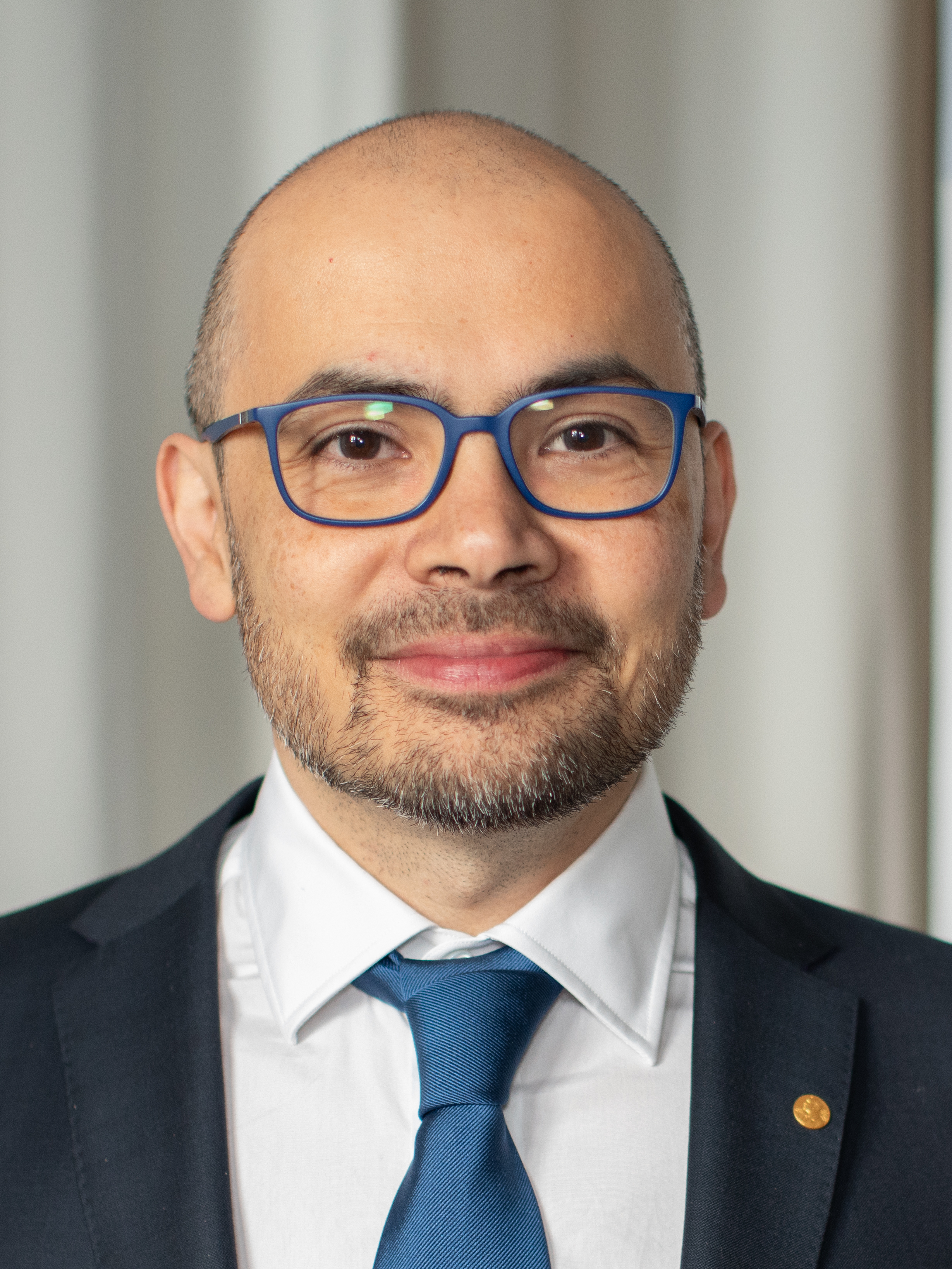
Demis Hassabis
 United Kingdom
artificial intelligence researcher•computer scientist•entrepreneur•chess player•former video game designer
Birthday
July 27, 1976
Birth Sign
Leo
Birthplace
London, England
Age
50 years old
About
Sir Demis Hassabis is a British artificial intelligence researcher, entrepreneur and former chess prodigy. He is the chief executive officer and co-founder of Google DeepMind and Isomorphic Labs, and a UK Government AI Adviser. In 2024, Hassabis and John M. Jumper were jointly awarded the Nobel Prize in Chemistry for developing AlphaFold2, an AI that solved the 50-year grand challenge of predicting protein structures.
Hassabis bridges neuroscience, AI and entrepreneurship. His work at DeepMind produced AlphaGo, which defeated world champion Lee Sedol in 2016, and AlphaFold, which predicted structures for over 200 million proteins. He was knighted in 2024 for services to AI, named to the Time 100 in 2017 and 2025, and was one of the Architects of AI collectively chosen as Time's 2025 Person of the Year. He is a Fellow of the Royal Society and has won the Breakthrough Prize, Canada Gairdner International Award and Lasker Award.
Early Life & Background
Hassabis was born on 27 July 1976 in London, England. He grew up in North London as the eldest son of a Greek Cypriot father and a Chinese Singaporean mother. He began playing chess at age four and became a chess master by 13 with an Elo rating of 2300, captaining the England junior chess team.
At eight, he received a ZX Spectrum computer and taught himself programming from books. His first program was a version of Othello that could beat his younger brother. He attended Queen Elizabeth's School, Barnet, was homeschooled for a year, then finished A-levels two years early at Christ's College, Finchley. At 16, he joined Bullfrog Productions, working on Syndicate, and at 17 co-designed and programmed Theme Park, a multi-million selling AI simulation game. Cambridge University asked him to take a gap year because he was too young, which he spent at Bullfrog. He graduated from Queens' College, Cambridge in 1997 with double First-Class honours in Computer Science.
Career Growth
After Cambridge, Hassabis founded Elixir Studios in 1998, producing award-winning games with advanced AI. He then shifted to academia, completing a PhD in Cognitive Neuroscience at UCL in 2009, where his work on memory and imagination was named a Top Ten Scientific Breakthrough of 2007 by Science. After a postdoc at MIT and Harvard, he co-founded DeepMind in 2010 with Shane Legg and Mustafa Suleyman. Google acquired DeepMind in 2014 for approximately £400 million, its largest European acquisition at the time.
In 2016, DeepMind's AlphaGo defeated world champion Lee Sedol at Go, a watershed moment for AI. In 2020, AlphaFold2 solved protein structure prediction, and in 2021 DeepMind released predictions for over 200 million proteins free through the AlphaFold database. In 2024, Hassabis and Jumper won the Nobel Prize in Chemistry. He now leads DeepMind's push toward AGI and runs Isomorphic Labs, aiming to use AI for drug discovery.
Career Timeline
Public Image & Style
Hassabis is portrayed in media as a visionary, interdisciplinary genius who bridges neuroscience, AI and entrepreneurship. His public image emphasizes ethical AI development and the pursuit of AGI for humanity's benefit. In interviews, he speaks in a measured, thoughtful style focused on long-term scientific questions. He is described as fervently advocating for responsible AGI. No official fandom name or fan-culture rituals are documented.
Fame & Fandom
The enduring allure of Demis Hassabis lies not in celebrity spectacle but in the profound, almost mythic weight of his scientific contributions. While he lacks a traditional fanbase with rituals or organized campaigns, his audience consists of a global community of scientists, engineers, and futurists who revere his work as a defining chapter in human history. This is a fandom built on intellectual awe rather than pop culture adoration, where the 'legend' is measured in solved protein structures and chess grandmaster victories. His journey from a child prodigy coding Othello to leading the charge in AGI has created a unique cultural footprint where admiration is expressed through citation and emulation rather than merchandise or fan fiction.
His standing in the digital ecosystem reflects this specialized reverence. According to the iFANN Global Fame Rankings, Hassabis holds a position of significant influence within his field. He is currently recognized as the 8th most famous person in AI, a placement that has held steady through recent cycles of intense technological evolution. This ranking captures his status as a pivotal figure whose work bridges the gap between theoretical neuroscience and practical, world-changing applications.
Interesting Facts and Legends
Before becoming a titan of artificial intelligence, Demis was a formidable force in the chess world, earning half-blue distinctions for Cambridge University in both 1996 and 1997 while serving as a five-time World Games Champion. His precocious nature was evident early on; he completed his A-levels at age 16 and wrote his first computer program, a version of Othello capable of defeating his younger brother, when he was just eight years old. Even his academic path was unconventional, as Cambridge University requested a gap year due to his young age before he could officially enroll. Outside of science, he remains a lifelong supporter of Liverpool FC and spent a year being homeschooled between grammar and comprehensive school.
The narrative of his life has evolved into modern legend, anchored by the moment he coded the multi-million-selling simulation game Theme Park at age 17, showcasing an early dexterity in software engineering that would later define his career. The story of AlphaFold 2 stands as the central pillar of his legacy, solving a fifty-year-old biological grand challenge and earning him the 2024 Nobel Prize in Chemistry alongside John M. Jumper. More recently, the tech world watched closely as August 2026 brought a major shift in his role, with Hassabis stepping back from day-to-day CEO duties at Google DeepMind to become Chair and Chief Scientist of Alphabet, a move that sparked intense debate regarding the future identity of the organization.
Notable Quotes
“I remember thinking, 'This is amazing, that you can create a program that can carry on number crunching while you sleep.'”
“AlphaGo was a big watershed moment... it actually started the starting gun for the modern AI era.”
“I've always been interested in the big questions like consciousness and cosmology.”
“We want to solve all disease with AI.”
“The Nobel Prize was a huge honor, but the real reward is seeing AlphaFold help scientists every day.”
Family & Personal Life
Hassabis's father is a Greek Cypriot who worked as an aspiring singer-songwriter and toy seller; his mother is Chinese Singaporean and worked as a retail clerk and cleaner. He has a younger brother. The family lived in North London. He has described being proud of his Greek heritage, understands some Greek, and visits Greece regularly.
Notable Connections
Relationships & Dating History
Hassabis is married, though his spouse's name and the details of their relationship have not been publicly disclosed. He lives with his wife and children in North London. No other public romantic relationships, dating history, engagements, or divorces have been documented. Hassabis maintains significant privacy regarding his personal life.
- MarriedCurrentSpouse's identity not publicly disclosed; family lives in North London.
Salary, Net Worth In 2026
Unknown
iFANN Editorial Team estimate
As of 2026, iFANN's editorial analysis places Demis Hassabis's total net worth at Unknown. This assessment accounts for his substantial equity holdings stemming from the approximately £400 million acquisition of DeepMind by Google. As the co-founder and CEO of Isomorphic Labs, a spinout dedicated to AI-driven drug discovery using AlphaFold, he maintains significant financial stakes in the biotech sector. His compensation package as a senior executive within the Alphabet family further bolsters his wealth, alongside his share of the Nobel Prize winnings, which totaled approximately 11 million Swedish kronor.
Awards Won (7)
Hassabis has won the Nobel Prize in Chemistry (2024), the Breakthrough Prize, the Canada Gairdner International Award, the Lasker Award, the Dan David Prize (2020), the Pius XI Medal (2020), the VinFuture Prize (2022), the BBVA Foundation Frontiers of Knowledge Award (2022), the IRI Medal (2021), and the Global Swiss AI Award (2022). He was appointed CBE in 2017 and knighted in 2024.
2024 · Chemistry
AlphaFold2
2020 · Future
AlphaFold
Known For
AlphaGo
2016 · Co-founder of DeepMind
AlphaFold2
2020 · Lead researcher
Theme Park
1994 · Co-designer and lead programmer
Keywords
Sources
Quick Facts
- Profession
- artificial intelligence researcher, computer scientist, entrepreneur, chess player, former video game designer
- Born
- July 27, 1976
- Birthplace
- London, England
- Gender
- Male
- Birth Sign
- Leo
- Nationality
- British
- Education
- Queens' College, Cambridge (BA Computer Science, Double First); University College London (PhD Cognitive Neuroscience)
Personal Details
- Full Name
- Dimitrios Hassapis
- Children
- Yes (number not disclosed)
- Education
- Queens' College, Cambridge (BA Computer Science, Double First); University College London (PhD Cognitive Neuroscience)
Frequently Asked Questions
What is Demis Hassabis's net worth?
Is Demis Hassabis married?
How old is Demis Hassabis?
What did Demis Hassabis win the Nobel Prize for?
Does Demis Hassabis have kids?
Social Media
Similar People
Join the community
fans discussing