 United States
“Brooks has created a world that is both absurd and deeply moving, a place where the rules of life are turned upside down to reveal the truth about courage.”
Roger Ebert
Chicago Sun-Times
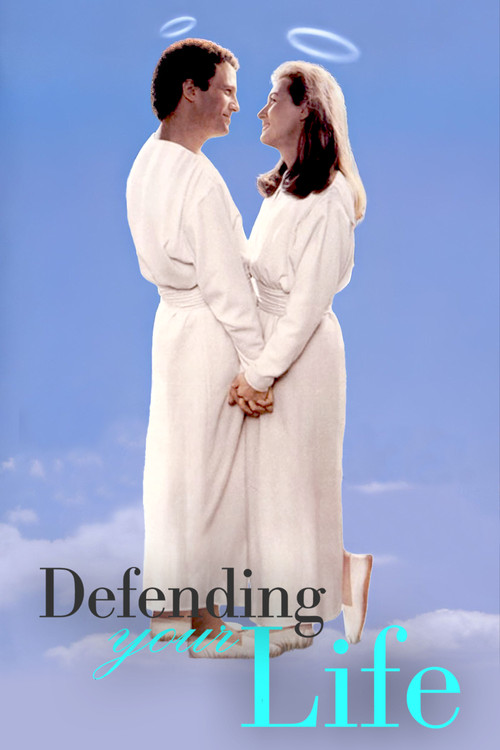
Albert Brooks steps behind the camera to craft a unique blend of romantic comedy and metaphysical drama with Defending Your Life. Released in March 1991, this film explores the afterlife not as a place of eternal judgment or reward, but as a bureaucratic waiting room where souls must prove they possessed enough courage to move forward. The story centers on Daniel Miller, played by Brooks himself, a nervous advertising executive who dies in a car accident and arrives in Judgment City. There he faces a trial led by his father, portrayed by Rip Torn, while navigating a strange new existence alongside Julia, a spirited woman played by Meryl Streep.
The production carried a budget of $20 million and grossed roughly $16.4 million at the box office, finding a niche audience rather than dominating the charts. Critics and viewers have responded positively over the years, with the film holding a solid rating that reflects its clever writing and emotional depth. Brooks weaves together satire about corporate culture and human anxiety with genuine warmth, creating a movie that feels both funny and deeply personal. While it does not launch a franchise, its exploration of fear and love remains distinct within the canon of 1990s cinema.
Stream
Availability and pricing can change. Confirm on the provider's site before purchasing.
Daniel Miller wakes up in a bustling metropolis that defies all logic, a place called Judgment City where time stands still and the architecture mimics a mid-century American cityscape mixed with futuristic elements. He has just died in a traffic collision on his way to work in Los Angeles, yet here he is, surrounded by other recently deceased individuals wandering through streets filled with neon signs and endless bureaucracy. The atmosphere is one of polite confusion, as people wait for instructions that never seem to arrive immediately. Daniel finds himself swept into a mandatory legal proceeding designed to determine whether a soul lived with sufficient courage to be allowed reincarnation.
The trial takes place in a high-tech courtroom that resembles a corporate boardroom more than a traditional court of law. Prosecutors present evidence from Daniel's past life, highlighting moments where he chose safety over risk. His father Bob Diamond sits on the bench, having been stuck in this limbo for decades because he never left his comfort zone on Earth. The prosecution argues that Daniel's career as an advertising executive and his relationship history were defined by a paralyzing fear of failure and rejection. Defense attorneys attempt to reframe these events, suggesting that Daniel's anxiety was a rational response to a chaotic world and that he did show bravery in small, often overlooked ways.
While waiting for his verdict, Daniel meets Julia, a woman who has already passed her own trial and is preparing to return to Earth. She is confident and free-spirited, contrasting sharply with Daniel's constant state of worry. Julia becomes his guide through the surreal landscape of Judgment City, showing him how others navigate their eternal waiting periods. Their interactions reveal a deepening connection as Daniel begins to question the nature of his own fears. He realizes that his greatest obstacle has always been internal, a self-imposed barrier created by his own insecurities rather than external circumstances.
The narrative follows Daniel as he struggles to reconcile his past failures with his desire to move forward. He encounters various characters who represent different archetypes of human behavior, including a man who never left his apartment and a woman who spent her life avoiding conflict. The film blends sharp satire of corporate culture and consumerism with genuine emotional depth, exploring how fear dictates our choices and limits our potential. Daniel's relationship with Julia deepens, creating a romantic subplot that challenges his belief that he is unworthy of happiness. The tension builds as the trial concludes, leaving Daniel and the audience wondering if he can overcome the weight of his past to embrace the possibility of a new beginning.
Defending Your Life (1991) | Official Trailer
Critical Consensus
Defending Your Life masterfully blends satire, romance, and metaphysical inquiry, anchored by Albert Brooks' sharp writing and Meryl Streep's charismatic performance. While its exploration of fear and the afterlife may seem abstract, the film grounds its themes in relatable human experiences, making it a timeless classic that balances humor with poignant emotional resonance.
“Brooks has created a world that is both absurd and deeply moving, a place where the rules of life are turned upside down to reveal the truth about courage.”
Roger Ebert
Chicago Sun-Times
“A witty and touching film that uses the afterlife as a mirror to reflect our fears and hopes, with Brooks and Streep delivering performances that are both funny and heartbreaking.”
Janet Maslin
The New York Times
“Albert Brooks has crafted a unique blend of comedy and drama that explores the human condition with intelligence and heart, making Defending Your Life a standout in the genre.”
Variety Staff
Variety
Albert Brooks
Daniel Miller
Meryl Streep
Julia
Rip Torn
Bob Diamond
Lee Grant
Lena Foster
Michael Durrell
Agency Head
Director
Albert Brooks
Writer
Albert Brooks
Composer
Michael Gore
Cinematographer
Allen Daviau
Producer
Michael Grillo
Academy Awards (1991)
Best Original Screenplay: Nominated
Golden Globe Awards (1991)
Best Motion Picture – Musical or Comedy: Nominated
Saturn Awards (1991)
Best Science Fiction Film: Won
National Society of Film Critics Awards (1991)
Best Screenplay: Won
Join the community
fans discussing