“The movie is a triumph of special effects, but the effects serve the story instead of overwhelming it. Streep and Hawn are game for anything, and the movie's dark humor is genuinely subversive.”
Roger Ebert
Chicago Sun-Times
 United States
"Eternal youth has a dark side. Drink wisely."
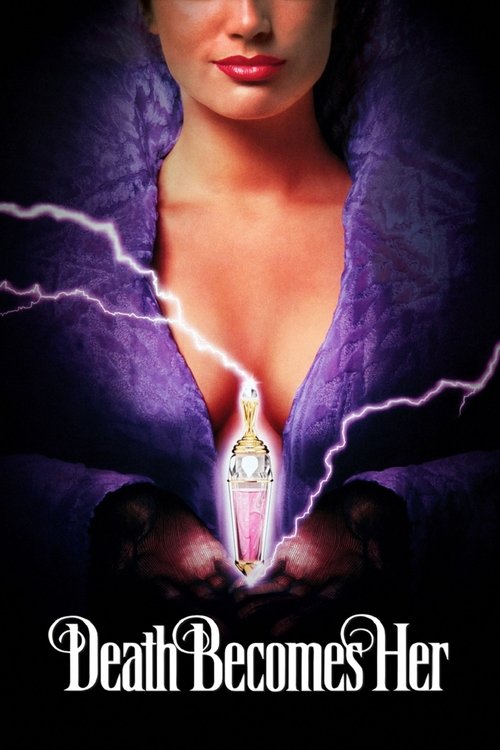
In 1992, director Robert Zemeckis took a sharp detour from the blockbuster spectacle of his Back to the Future franchise to craft a darkly comic fable about vanity, aging, and the lengths two women will go to stay beautiful. Death Becomes Her stars Meryl Streep as Madeline Ashton, a self-absorbed actress whose desperate grip on youth leads her to a mysterious potion that promises eternal life. Goldie Hawn plays Helen Sharp, Madeline's former friend turned bitter rival, and Bruce Willis is Ernest Menville, the hapless plastic surgeon caught between them. Isabella Rossellini appears as the enigmatic Lisle von Rhuman, who peddles the magical elixir with a knowing smirk. The film blends comedy, fantasy, and body horror, a combination that feels as fresh today as it did three decades ago.
Produced by Universal Pictures and Zemeckis's own South Side Amusement Company, the movie carried a hefty $55 million budget, a risk that paid off when it grossed $149 million worldwide. Critics were divided at the time, but audiences embraced its macabre humor and groundbreaking visual effects, which won the Academy Award for Best Visual Effects. The film's rating of 6.8 out of 10 from over 3,000 votes on one popular database suggests it remains a cult favorite rather than a universal classic, but its influence on later dark comedies is undeniable.
Availability and pricing can change. Confirm on the provider's site before purchasing.
In 1978, Madeline Ashton (Meryl Streep) and Helen Sharp (Goldie Hawn) are old acquaintances with a simmering rivalry. Madeline, a fading actress, attends a party at Helen's home and immediately sets her sights on Helen's fiancé, Dr. Ernest Menville (Bruce Willis), a successful but emotionally weak plastic surgeon. Within weeks, Madeline steals Ernest away, and the two marry. The betrayal shatters Helen, who spirals into a severe mental breakdown and is institutionalized for seven years, obsessing over revenge.
By 1985, Helen has transformed herself into a confident, successful author of a self-help book about overcoming adversity. Madeline, meanwhile, has aged poorly, her career and marriage in shambles. Ernest is an alcoholic whose shaking hands have ruined his medical practice. When Helen invites the couple to her book launch party, the confrontation is electric. Helen taunts Madeline about her aging, and Madeline retaliates by exposing Ernest's failures. The evening ends in chaos, with Ernest accidentally shooting Madeline in the arm and the couple slinking away in humiliation.
Desperate to reclaim her youth, Madeline seeks out the mysterious Lisle von Rhuman (Isabella Rossellini), who offers a magical potion granting eternal youth and beauty, with a warning about side effects. Madeline drinks it and awakens looking more radiant than ever. But when Ernest, in a fit of rage, pushes her down a grand staircase, she survives with her neck twisted completely backward, her body broken but her consciousness intact. The potion has made her immortal, but her body is now a damaged, decaying vessel.
Panicked, Madeline forces Ernest to help her. He discovers that the potion has made her functionally unkillable but left her with a grotesque, deteriorating body. Seeking a solution, Ernest approaches Lisle, who reveals that the only way to maintain the illusion of beauty is to keep drinking the potion, but the decay never truly stops. Helen, having learned what happened, decides she wants the same power. She confronts Madeline and Ernest, and a twisted three-way power struggle ensues. Helen drinks the potion herself, and the two immortal women, now locked in an eternal rivalry, begin a battle for Ernest's affection that will span decades, with Ernest caught between two women who can never truly die but can never truly live either.
Official Trailer
Critical Consensus
A delightfully macabre comedy that satirizes aging and vanity with gleeful dark humor, memorable visual effects, and an unforgettable performance from Meryl Streep. While some critics found the tonal shifts jarring, the sheer audacity of its premise and the committed performances won many over.
“The movie is a triumph of special effects, but the effects serve the story instead of overwhelming it. Streep and Hawn are game for anything, and the movie's dark humor is genuinely subversive.”
Roger Ebert
Chicago Sun-Times
“A gleefully nasty piece of work, a movie that takes the Hollywood obsession with youth and beauty and pushes it to gloriously grotesque extremes.”
Janet Maslin
The New York Times
“Zemeckis has created a technically dazzling black comedy that showcases Streep and Hawn at their most uninhibited, even if the script's satirical targets are sometimes too easy.”
Todd McCarthy
Variety
“The movie is a riot, a horror-comedy that gets its laughs from the most macabre places imaginable. Streep and Hawn have never been funnier, or more willing to look ridiculous.”
Peter Travers
Rolling Stone
“A witty, vicious satire of the eternal-youth industry, with visual effects so seamless they make the impossible look easy.”
Owen Gleiberman
Entertainment Weekly
Meryl Streep
Madeline Ashton Menville
Goldie Hawn
Helen Sharp
Bruce Willis
Dr. Ernest Menville
Isabella Rossellini
Lisle von Rhuman
Ian Ogilvy
Chagall
Adam Storke
Dakota
Alaina Reed Hall
Psychologist
Nancy Fish
Rose
Michelle Johnson
Anna
Mary Ellen Trainor
Vivian Adams
William Frankfather
Mr. Franklin
John Ingle
Eulogist
Director
Robert Zemeckis
Writers
David Koepp, Martin Donovan
Composer
Alan Silvestri
Cinematographer
Dean Cundey
Producers
Steve Starkey, Robert Zemeckis
Academy Award (1993)
Best Visual Effects: Won
Saturn Award (1993)
Best Makeup: Won
Saturn Award (1993)
Best Fantasy Film: Nominated
Saturn Award (1993)
Best Actress: Nominated
Saturn Award (1993)
Best Supporting Actress: Nominated
BAFTA Award (1993)
Best Special Visual Effects: Nominated
Hugo Award (1993)
Best Dramatic Presentation: Nominated
Join the community
fans discussing