“Deadwood is the best TV drama of the year, a show that combines the grit of a Western with the depth of a Shakespearean tragedy.”
Ken Tucker
Entertainment Weekly
 United States
"Gold rushes kill dreams in this brutal frontier"
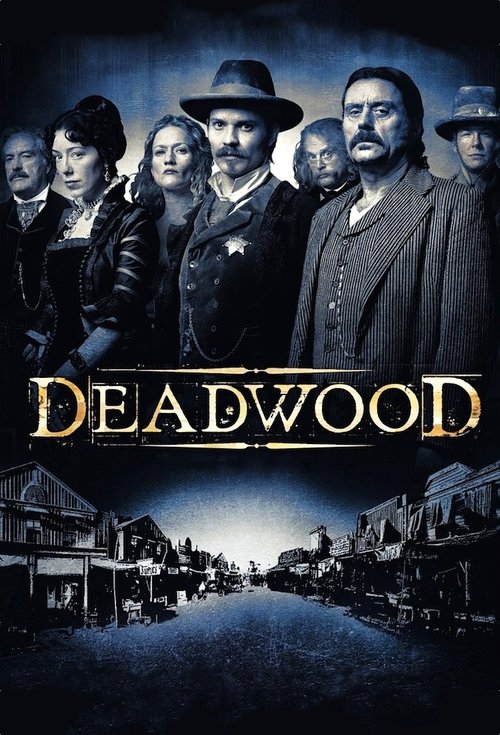
David Milch crafted a gritty Western for HBO that blends historical fact with fictional drama, set in the chaotic gold rush camp of Deadwood, South Dakota. The series ran from March 2004 to August 2006 across three seasons and thirty-six episodes. Timothy Olyphant stars as Sheriff Seth Bullock while Ian McShane leads the cast as Al Swearengen, the proprietor of the Gem Saloon and brothel. This crime drama tackles themes of greed, lawlessness, and civilization without pulling any punches.
Critics praised the show for its unique dialogue and moral complexity rather than standard genre tropes. Audiences responded strongly to the raw portrayal of human nature in a place where the rule of law was still being written. The series stands out for how it transforms a mining settlement into an organized town through conflict and negotiation.
Availability and pricing can change. Confirm on the provider's site before purchasing.
The story begins in May 1876, two weeks after the Battle of the Little Bighorn, when the Black Hills region is officially closed to white settlers by federal order. Despite this ban, hundreds of prospectors flood into the area, creating a makeshift camp on the banks of the Cheyenne River. This unincorporated settlement operates outside any legal jurisdiction, becoming a haven for gamblers, prostitutes, miners, and former soldiers who answer only to their own codes of conduct. The arrival of Seth Bullock, a Montana sheriff, disrupts the existing hierarchy. He brings his friend Calamity Jane and seeks to impose order on a community that respects nothing but strength and violence.
At the center of this chaos sits Al Swearengen, owner of the Gem Saloon and brothel. Swearengen maintains a twisted code of honor, protecting the women in his employ while ruthlessly eliminating threats to his empire. His power comes from manipulation, intelligence, and a willingness to use force when necessary. The narrative tension builds as Swearengen must navigate the arrival of wealthy widow Alma Garret, whose claims threaten his control over the local gold deposits. Season One focuses on the formation of a provisional government, pitting the settlers' desire for legitimacy against the entrenched interests of the camp's founders.
As the series progresses into Season Two, the town officially incorporates, bringing external authorities and the threat of federal intervention. The power dynamic shifts dramatically with the introduction of Cy Tolliver, a rival saloon owner backed by the railroad and the local elite. Swearengen finds himself in a direct conflict with Tolliver, forcing him to make difficult alliances to survive. Meanwhile, the women of Deadwood, including Trixie and Joanie Stubbs, begin to assert their independence within the patriarchal framework of the camp. The season explores the moral compromises required to build a civilized society, showing characters like Bullock and Swearengen navigating a complex web of politics and corruption.
Season Three introduces George Hearst, a wealthy mining magnate with immense wealth and connections to the federal government. Hearst represents the encroaching force of corporate capitalism and threatens the very existence of the town. As the first elections approach, the citizens must decide whether to submit to Hearst's demands or fight for their autonomy. The narrative arc concludes not with a tidy resolution, but with a somber reflection on the cost of progress and the enduring nature of human greed. The town survives, but the scars of the past remain visible, marking the end of the lawless era and the beginning of a new, more structured chapter.
Deadwood Trailer (HBO)
Critical Consensus
Deadwood stands as a masterclass in television writing, distinguished by its Shakespearean dialogue, complex moral ambiguity, and unflinching portrayal of the American frontier. The series transcends genre conventions to explore themes of civilization, greed, and redemption, anchored by powerhouse performances from Ian McShane and Timothy Olyphant. Its legacy lies in its ability to elevate the Western genre into high art, offering a nuanced examination of human nature in a lawless environment.
“Deadwood is the best TV drama of the year, a show that combines the grit of a Western with the depth of a Shakespearean tragedy.”
Ken Tucker
Entertainment Weekly
“David Milch has created something truly special here, a show that feels both timeless and utterly unique in its execution.”
Alan Sepinwall
HitFix
“Deadwood is a triumph of character development and storytelling, proving that television can be as profound as any great novel.”
David Bianculli
NPR
“The dialogue in Deadwood is unlike anything else on television, a poetic blend of profanity and philosophy that elevates the entire production.”
James Poniewozik
Time Magazine
“Deadwood is a rare beast, a show that manages to be both a period piece and a modern masterpiece, capturing the essence of the American experience.”
Matt Zoller Seitz
Vulture
Timothy Olyphant
Seth Bullock
Ian McShane
Al Swearengen
Molly Parker
Alma Garret
Jim Beaver
Whitney Ellsworth
W. Earl Brown
Dan Dority
Dayton Callie
Charlie Utter
Kim Dickens
Joanie Stubbs
Brad Dourif
Amos Cochran
Anna Gunn
Martha Bullock
John Hawkes
Sol Star
Paula Malcomson
Trixie
Leon Rippy
Tom Nuttall
Gary Basaraba
Jack McCall
Jeffrey DeMunn
Judge Isaac Parker
Michael J. Anderson
Mr. Smith
David Morse
George Hearst
Directors
Timothy Van Patten, Allen Coulter, Mick Jackson, Daniel Sackheim
Writers
David Milch, Harold Perrineau, William M. Finkelstein, David West Reynolds
Composer
Mark Isham
Cinematographers
Robert Elswit, Paul Cameron, Frank G. DeMarco
Producers
Mark Tinker, Gregg Fienberg, David Milch, Ronald L. Schwary
Emmy Awards (2004)
Outstanding Writing for a Drama Series: Won
Emmy Awards (2005)
Outstanding Lead Actor in a Drama Series: Nominated
Golden Globe Awards (2005)
Best Television Series – Drama: Nominated
Peabody Award (2004)
Excellence in Electronic Media: Won
Join the community
fans discussing