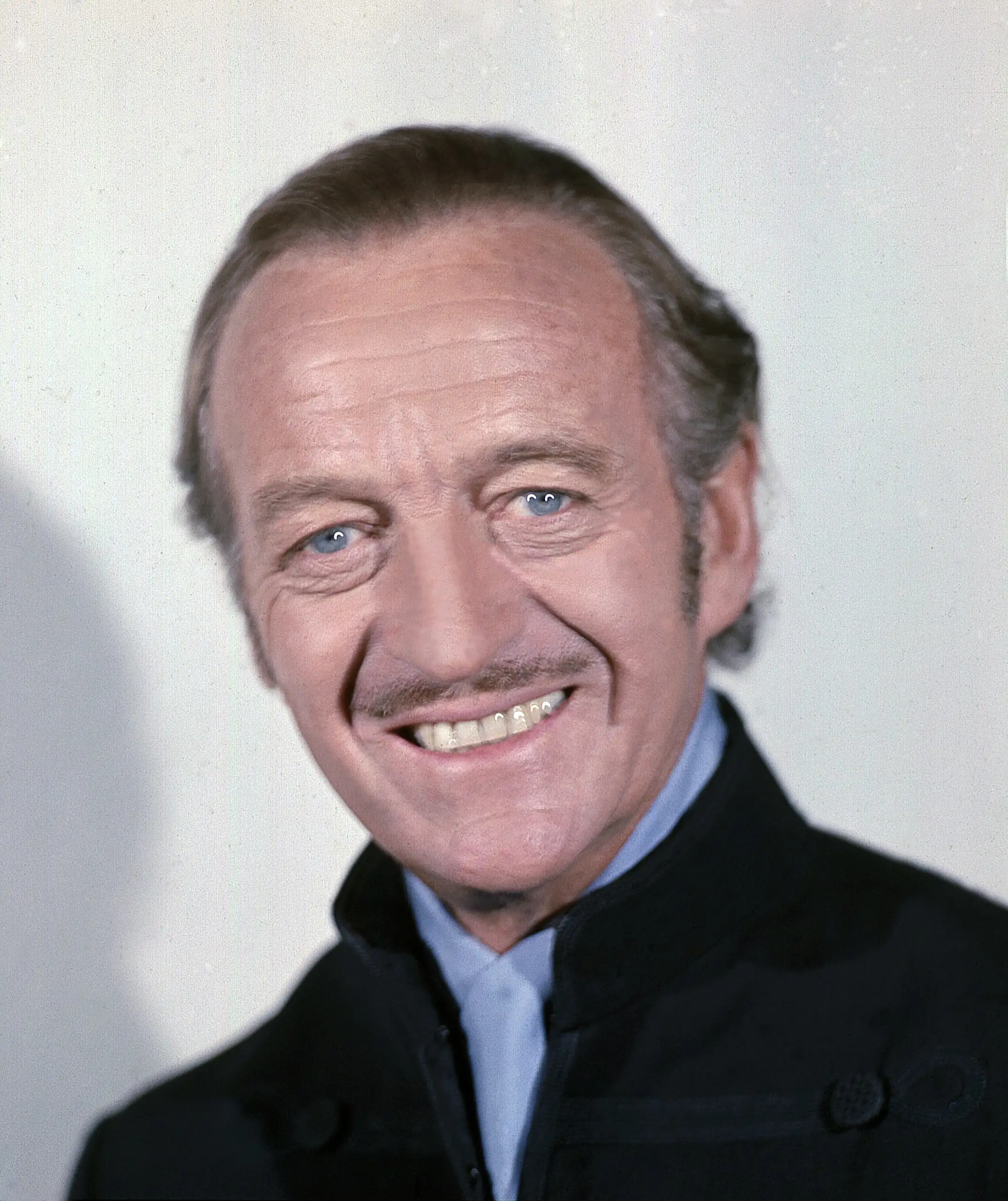
David Niven
 United Kingdom
Also known as: James David Graham Niven, Dave Niven
Birthday
March 1, 1910
Birth Sign
Pisces
Birthplace
London, England
Age
Died at 73
Height
5 ft 11 in (180 cm)
About
James David Graham Niven was an English actor, soldier, raconteur, memoirist, and novelist who became one of the most beloved leading men of Hollywood's Golden Age. Known for his debonair charm, wit, and military service, Niven embodied the archetype of the sophisticated British gentleman on screen. He passed away at age 73 from a heart attack in Beverly Hills, California, leaving behind a legacy that includes an Academy Award, two Golden Globe Awards, and a permanent place in film history as the first James Bond (in Casino Royale, 1967). His career spanned over four decades, during which he worked with top directors and co-stars across the globe. Even decades after his passing, his films continue to be watched by new generations, cementing his status as a timeless icon of style and substance.
Niven remains a defining figure of mid-20th-century cinema, celebrated for roles that ranged from dashing heroes to complex villains. His unique ability to blend comedy with dramatic depth allowed him to navigate diverse genres effortlessly. From the heights of stardom in the 1950s to character roles in the 1970s, he maintained a consistent presence in the industry. His contributions to film culture extend beyond acting, encompassing his work as an author and his significant role in World War II intelligence operations. This multifaceted career ensures his enduring relevance in discussions of classic Hollywood cinema.
Early Life & Background
Born on March 1, 1910, in London to James Henry Graham Niven and Mary Elizabeth Niven (née Hogg), he grew up in an upper-middle-class family with strong military ties. His father served as a captain in the Royal Army Service Corps, a profession that deeply influenced young James's early life. He attended Heatherdown Preparatory School in Ascot and later Stowe School, where he developed an early interest in acting and storytelling. The school environment fostered his love for performance, though his initial path seemed destined for the army.
In 1928, he entered the Royal Military College, Sandhurst, and was commissioned as a second lieutenant in the Highland Light Infantry. However, finding peacetime army life unfulfilling, he resigned his commission in 1933. After leaving the army, Niven moved to New York City before traveling to Hollywood in 1934. He initially struggled to find substantial work, taking small parts and even working as an extra. His breakthrough came when he was cast as an extra in the Metro-Goldwyn-Mayer production Mutiny on the Bounty (1935). This exposure led to a contract with producer Samuel Goldwyn. His early roles were minor, appearing in films like Dodsworth (1936) and The Charge of the Light Brigade (1936), but by 1937, he had secured a supporting role in The Prisoner of Zenda, establishing himself as a rising star. Before this success, he also spent time in England working as a horse trainer and jockey, further developing his physical skills.
Career Growth
Niven's career trajectory is defined by a series of iconic roles across decades. From 1937 to 1939, he gained prominence with The Prisoner of Zenda (1937) and Wuthering Heights (1939), where he played Heathcliff, proving his dramatic range beyond dashing leads. During World War II, he rejoined the British Army, serving in intelligence and special operations. He co-starred in the morale-boosting film The First of the Few (1942), playing Reginald Mitchell, the designer of the Spitfire.
Upon returning to Hollywood, he became a top-tier leading man. Notable films include A Matter of Life and Death (1946), The Bishop's Wife (1947), The Moon Is Blue (1953), and Around the World in 80 Days (1956). In 1958, he won the Academy Award for Best Actor for his role as Major Pollock in Separate Tables. His performance, lasting only 23 minutes and 39 seconds, remains the shortest winning performance in the category's history. The 1960s saw him become a global icon for his role as Sir Charles Lytton in The Pink Panther (1963) and starring as the original James Bond in the spoof Casino Royale (1967). He also headlined The Guns of Navarone (1961). In the 1970s, he transitioned into character roles and mystery films, including Murder by Death (1976) and Death on the Nile (1978). His extensive writing career included best-selling memoirs like Bring On the Empty Horses, which offered candid insights into Hollywood life.
Career Timeline
Public Image & Style
Niven was renowned for his impeccable style and sophisticated demeanor, often described as the epitome of the British gentleman. His fashion sense was characterized by tailored suits, crisp white shirts, and a signature pocket square. On screen, he projected an air of confidence and charm that made him a favorite among audiences worldwide. Off-screen, he was known for his wit and ability to entertain guests with his storytelling skills. His public persona was one of elegance and grace, which helped him maintain a long and successful career in Hollywood. He was frequently cited in magazines for his grooming and etiquette, setting trends for male fashion in the mid-20th century. His reputation as a 'gentleman' extended to his interactions with fans and colleagues, earning him widespread respect and admiration.
Fame & Fandom (iFAMOUS Rankings)
iFANN has not yet collected fame data for this person. As of November 2026, there is no published ranking for David Niven in the Global Fame Rankings. While he does not appear on the September 2026 iFAMOUS Rankings flagship list, his enduring popularity ensures that he remains a household name among classic film enthusiasts. Fans of his work often gather at film festivals and retrospectives to celebrate his contributions to cinema. Although there is no formal fandom name, his admirers are known for their deep appreciation of his performances and his unique blend of humor and sophistication. Specialized clubs dedicated to classic Hollywood stars often feature segments on Niven's films, highlighting his versatility and charm. His legacy continues to inspire new actors and filmmakers who seek to emulate his style and professionalism.
Interesting Facts and Legends
David Niven holds the record for the shortest performance to win an Academy Award for Best Actor. His winning role in Separate Tables lasted just 23 minutes and 39 seconds, a feat that has never been matched since. He was also known for his extensive writing career, penning several best-selling memoirs and novels that offered a candid look at Hollywood life. One of his most famous anecdotes involves his time as a spy during World War II, where he allegedly used his charm to extract information from high-ranking German officers.
Niven was also a skilled horseman and often performed his own stunts in action sequences. He was a close friend of many celebrities, including Cary Grant and Katharine Hepburn, and was known for his sharp wit and storytelling abilities at parties. His final years were spent writing and managing his estate, leaving behind a rich collection of personal papers and letters that provide insight into his life and career. He was also a keen golfer and enjoyed tennis, often playing with fellow stars. His home in Beverly Hills featured a library filled with rare books and memorabilia from his travels and career.
Notable Quotes
“I have always believed that the best way to predict the future is to create it.”
“The only thing I know for sure is that I don't know anything for sure.”
“A man is not old until regrets take the place of dreams.”
Family & Personal Life
David Niven's immediate family consisted of his parents, James Henry Graham Niven and Mary Elizabeth Niven, and his siblings, though details about them remain less publicized. He had three children with his first wife: Victoria Niven (born 1939), Giles Niven (born 1942), and Hugh Niven (born 1944). His son, Giles Niven, followed him into showbusiness as an actor and writer, continuing the family's artistic legacy. Niven also owned several pets throughout his life, including dogs that accompanied him on set and at his home. His household in Beverly Hills was known for its warmth and hospitality, often hosting friends and colleagues. The family story is marked by close bonds, particularly between Niven and his children, despite the challenges of his demanding career. His mother, Mary Elizabeth, remained a supportive figure until her death, influencing his values regarding family and duty.
Notable Connections
Cary Grant, Katharine Hepburn, Gregory Peck, Audrey Hepburn, Sean Connery.
Relationships & Dating History
David Niven was married twice. His romantic history is well-documented and marked by high-profile unions. He first married Primula Rollo in 1938. They met while she was a stage actress, and the couple had three children together: Victoria, Giles, and Hugh. The marriage ended in divorce in 1954 due to Niven's infidelity and the demands of his career. Shortly after his divorce, Niven met Swedish actress Hjördis Genberg. They married in 1954, and she remained his wife until his death in 1983. Their marriage lasted nearly 30 years, and they did not have children together. Following her husband's death, she managed his estate and charitable foundations. Prior to his marriages, Niven had various relationships in the UK and early Hollywood, though specific names of non-marital partners prior to 1938 are less documented in public records compared to his marriages.
- MarriedPrimula Rollo1938 - 1954Three children together; divorced due to infidelity and career demands.
- MarriedHjördis Genberg1954 - 1983Remained married until his death; managed his estate afterward.
Death & Aftermath
Died
July 29, 1983 (aged 73)
Death Place
Beverly Hills, California
Cause of Death
Heart attack
James David Graham Niven passed away on July 29, 1983, at the age of 73 inside his residence at 905 North Beverly Drive in Beverly Hills, California. He experienced chest pain while sitting in his study before being discovered unresponsive by his wife, Hjördis Genberg. The medical ruling was a natural heart attack resulting from myocardial infarction, consistent with his known history of heart disease. The news sent shockwaves through Hollywood and London, where he had been a beloved figure for decades. Tributes poured in from the Academy of Motion Picture Arts and Sciences, which held a moment of silence during its proceedings, while peers like Roger Moore and Sean Connery publicly praised his charm, wit, and professionalism.
A private ceremony took place on August 2, 1983, at Forest Lawn Memorial Park in Glendale, California. His widow Hjördis and close friends gathered to bury him in the Garden of Memory without public broadcast or formal eulogies. The film industry mourned one of the last remaining stars of Hollywood's Golden Age, with renewed interest appearing in television reruns and theatrical re-releases of his work in the months that followed. Following his death, Hjördis managed the estate and oversaw the licensing of his image alongside the publication of memoirs like Bring On the Empty Horses. In 1984, the David Niven Foundation was established to support charitable causes related to children and the arts, ensuring the preservation of his literary and cinematic legacy through posthumous releases such as The Man Who Haunted Himself. His death marked the end of an era, leaving a void in the world of classic cinema that has yet to be fully filled.
Net Worth (Estate Value)
$15 Million
iFANN Editorial Team estimate
As of 2026, research by the iFANN Editorial Team puts David Niven's estate value at around $15 million. This figure reflects the accumulated wealth from his extensive career in film, television, and literature, as well as ongoing royalties from his posthumous releases. His estate continues to generate income through licensing deals for his image, re-releases of his classic films, and sales of his books. The management of his estate by his widow, Hjördis Genberg, ensured that his financial interests were preserved and grew steadily over the years following his death in 1983. Additional income sources include merchandise featuring his likeness and digital streaming rights for his filmography. The careful stewardship of his assets by his family and executors has maintained the estate's value and integrity over decades.
Awards Won (6)
David Niven won the Academy Award for Best Actor for Separate Tables (1958). He also received two Golden Globe Awards, one for Best Actor in a Motion Picture Drama for Separate Tables (1958) and another for Best Supporting Actor in a Motion Picture for The Great Escape (1963). His accolades highlight his versatility and talent across different genres.
1958 · Best Actor
Separate Tables
1963 · Best Supporting Actor – Motion Picture
The Great Escape
1958 · Best Actor – Motion Picture Drama
Separate Tables
Known For
Separate Tables
1958 · Major Pollock
The Pink Panther
1963 · Sir Charles Lytton
Casino Royale
1967 · James Bond
Around the World in 80 Days
1956 · Phileas Fogg
The Guns of Navarone
1961 · Major John Andrews
Keywords
Sources
Quick Facts
- Profession
- film actor, actor, military personnel
- Born
- March 1, 1910
- Birthplace
- London, England
- Died
- July 29, 1983
- Death Place
- Beverly Hills, California
- Gender
- Male
- Spouse
- Primula Rollo, Hjördis Genberg
- Birth Sign
- Pisces
Personal Details
- Full Name
- James David Graham Niven
- Height
- 5 ft 11 in (180 cm)
- Spouse
- Primula Rollo, Hjördis Genberg
- Children
- Victoria Niven · Giles Niven · Hugh Niven
- Education
- Heatherdown Preparatory School; Stowe School; Royal Military College, Sandhurst
Filmography
85
Total
78
Film
7
TV
Frequently Asked Questions
How old was David Niven when he died?
What was David Niven's net worth?
Who was David Niven married to?
What is David Niven best known for?
Did David Niven serve in the military?
Similar People



Join the community
fans discussing