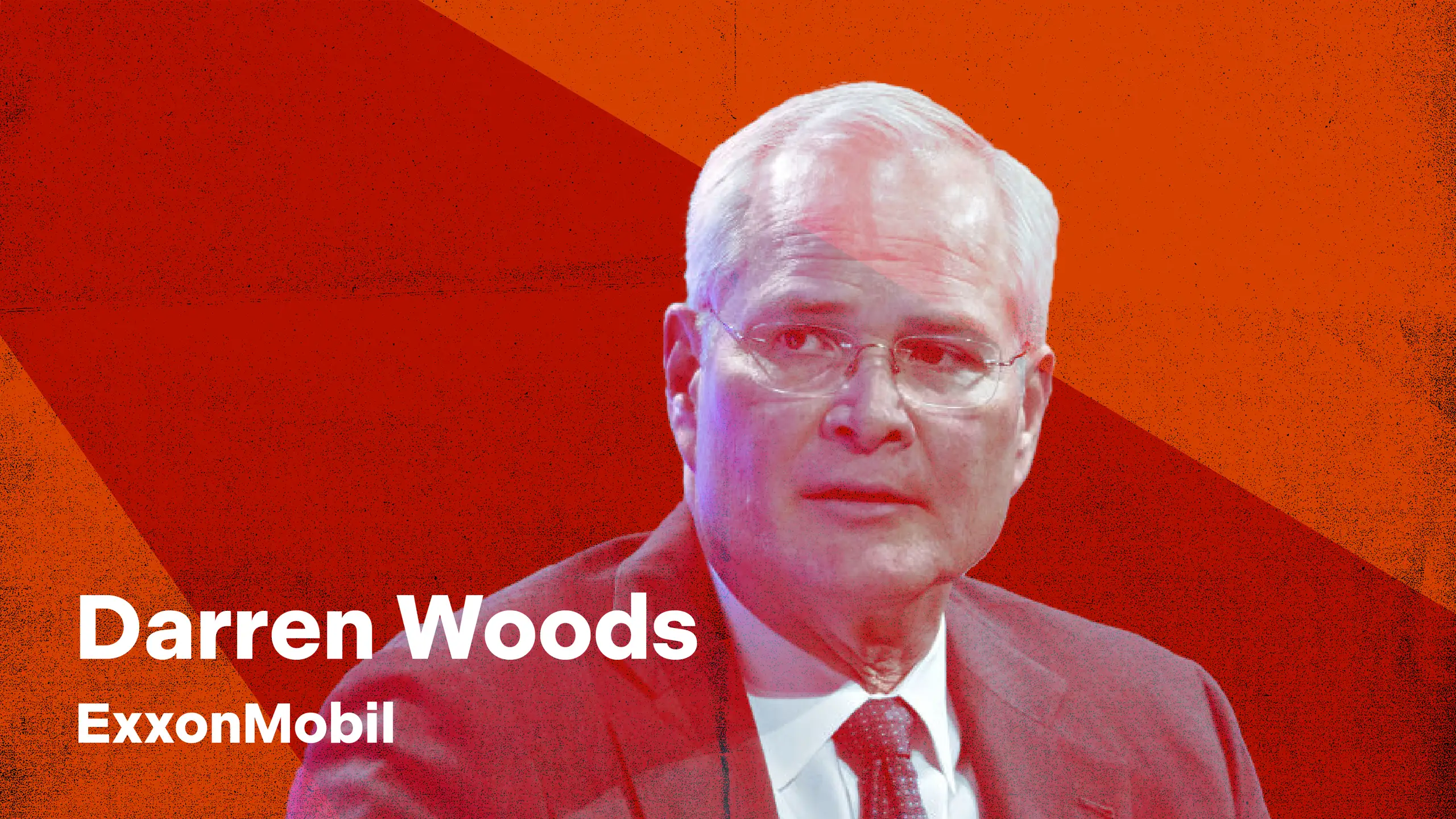
Darren Woods
 United States
Business executive•Chairman and CEO of ExxonMobil
Also known as: Darren W. Woods, The King of Big Oil
Birthday
December 16, 1965
Birth Sign
Sagittarius
Birthplace
Wichita, Kansas, United States
Age
60 years old
About
Darren Woods is an American business executive who has served as chairman and chief executive officer of ExxonMobil since January 2017. He is the company's top decision-maker at a moment when the oil major is both the most valuable energy firm in the United States and one of the loudest voices in the global debate over how much oil the world will still need.
Woods runs a company with operations on six continents and a market value in the hundreds of billions. Under his leadership ExxonMobil has cut operating costs sharply, restructured its refining and chemicals divisions, and pushed into carbon capture, hydrogen and lithium while still spending heavily on the core oil and gas business. He also chairs the American Petroleum Institute, the industry's main lobbying arm in Washington.
His reputation inside the industry is that of a low-drama operator who came up through the refinery floor rather than the boardroom. The Financial Times, profiling him in 2026, called him the King of Big Oil. He is not a celebrity chief executive in the Silicon Valley mold. He gives interviews about crude spreads and pump prices, not about himself.
Early Life & Background
Woods arrived in Fort Stockton, Texas, as a kid in an oil town in the Permian Basin, the flat stretch of West Texas where pump jacks outnumber traffic lights. He has repeatedly pointed to that upbringing when explaining why energy work felt like a natural fit. It was a place where the local economy rose and fell with the price of a barrel, and where the practical engineering of getting oil out of the ground was ordinary conversation.
He enrolled at Texas A&M University and graduated in 1987 with a bachelor's degree in engineering. The university's own engineering news page identifies him as a former student in electrical and computer engineering, while several corporate biographies describe his training as mechanical engineering. Either way, the degree was the launch pad. He did not go straight into oil. He spent five years elsewhere before ExxonMobil hired him in 1992 as a planning analyst, a modest entry-level post in a company where careers are measured in decades.
What followed was a long, unglamorous climb. Woods worked his way through refining and supply, the part of the business that turns crude into gasoline, diesel and jet fuel, and where a single miscalculated maintenance schedule can cost millions. He managed the Baytown refinery in Texas, ExxonMobil's largest, then served as president of ExxonMobil Refining & Supply, then ran the chemicals business. In 2001, roughly nine years into his ExxonMobil career, he picked up an MBA from Northwestern University's Kellogg School of Management, a credential that signaled he was being groomed for more than plant management.
By 2016 he had been named president of ExxonMobil and given a seat on the board. The top job came faster than almost anyone expected, and for a reason nobody inside the company would have predicted.
Career Growth
Rex Tillerson's departure for Washington in December 2016 opened the door. When Tillerson resigned as ExxonMobil CEO to become U.S. Secretary of State under Donald Trump, the board turned to Woods, then 51, and installed him as chairman and CEO in January 2017. He was the first ExxonMobil chief executive to come up entirely through the refining and chemicals side of the company rather than exploration.
The early years were defined by cost discipline. Woods cut spending, shed assets and reorganized the company's refining and chemicals segments into a single downstream business, a restructuring that drew criticism at the time and praise later when margins recovered. He also held the line on the core oil and gas business against shareholder resolutions demanding faster climate action, arguing that ExxonMobil could reduce its own emissions without shrinking production.
At the same time he built out the low-carbon side. ExxonMobil under Woods invested in carbon capture and storage, hydrogen production and, later, lithium extraction from brine in Arkansas, a bet on the electric vehicle supply chain built out of oilfield expertise. In 2023 the company agreed to buy Pioneer Natural Resources for roughly $60 billion, a deal that made ExxonMobil the dominant player in the Permian Basin, the same region where Woods grew up. The deal closed in 2024 and reshaped the company's production profile.
By 2026 his stated strategy was blunt: produce more oil for less money. ExxonMobil was preparing a roughly $30 billion Rovuma LNG development in Mozambique, and Woods was publicly warning that Europe would lose energy imports under a new climate law. In July 2026 he went on CNBC to explain what he called the disconnect between crude prices and pump prices. A shale tycoon publicly accused him that September of betraying him in a $60 billion deal, a fight that played out in the trade press.
Career Timeline
Public Image & Style
The public Darren Woods is a suit and a slide deck. He appears at earnings calls, industry conferences and the occasional cable news hit, and he speaks in the measured, numbers-first register of an engineer who spent decades inside refineries. He is not a showman and does not try to be. Where other oil chiefs cultivate a swagger, Woods tends to explain spreads, margins and maintenance schedules.
His media coverage splits sharply. Business outlets treat him as a disciplined operator, and Barron's put him among the top CEOs of 2026. Climate advocates and critics paint him as the face of an industry resisting the transition, and the National Legal and Policy Center published a piece in 2026 titled Dear Darren Woods and Exxon: Your Insecurity is Showing. He does not appear to mind either framing much. His public posture is that ExxonMobil's job is to supply energy reliably and profitably, and that the rest is politics.
Fame & Fandom (iFAMOUS Rankings)
Fame in the celebrity sense is not what Woods has. iFANN has not yet collected fame data for him, so there is no published placement to point to. His visibility runs through the business press, earnings calls and cable news bookings rather than through tabloids or social platforms. He is not on the September 2026 iFAMOUS Rankings flagship list, which tracks the names that dominate global attention rather than the executives who move markets.
What he has instead is an audience of a specific and influential kind. Energy traders, analysts, policymakers and investors parse his every public sentence for signals about production plans and capital spending. When he told CNBC in July 2026 that there was a disconnect between crude prices and pump prices, the clip circulated through trading desks within minutes. That is a form of attention, but it is not a fandom. There is no fanbase with a name, no streaming campaigns, no birthday billboards. The people who follow Woods closely are people with money or policy at stake, and they follow him because his words move share prices, not because they admire him.
Interesting Facts and Legends
Woods is one of the few ExxonMobil CEOs in modern history to have never run the exploration side of the business. His entire pre-CEO career was downstream, in refineries and chemicals plants.
He grew up in Fort Stockton, Texas, a Permian Basin town of roughly 8,000 people, and later led the company's push to dominate that same basin through the Pioneer acquisition.
His first job at ExxonMobil, in 1992, was as a planning analyst, a position far from the executive suite. Thirty-five years later he holds the corner office.
Search engines routinely confuse him with Darren Woodson, the former Dallas Cowboys safety, a mix-up that has produced a steady stream of wrong biographical details online, including an age of 26 and a birth year of 2000 that circulated in some databases.
He chairs the American Petroleum Institute, giving him a second podium beyond his corporate one, and sits on the National Petroleum Council.
Notable Quotes
“There's a disconnect between crude prices and pump prices.”
“Recent changes have made us more resilient to operational disruptions.”
Family & Personal Life
Woods keeps his family life almost entirely out of public view. No credible source names a spouse, and reports of a divorce or of children are unverified speculation that circulates mainly through search autocomplete rather than reporting. He lives in the Houston area, where ExxonMobil has its corporate headquarters in Spring, Texas, north of the city. Colleagues describe a private, low-key style at home that matches his public manner. He has spoken warmly about his Texas upbringing but has not turned it into a personal narrative the way many chief executives do.
Notable Connections
ExxonMobil, the American Petroleum Institute, the National Petroleum Council, the Oil and Gas Climate Initiative, the German Marshall Fund, and Texas A&M University. He succeeded Rex Tillerson as ExxonMobil CEO and has worked alongside the company's board and senior leadership through the Pioneer Natural Resources acquisition.
Relationships & Dating History
Almost nothing about Woods' romantic life is on the public record. He has never been the subject of a profile that names a spouse, and no credible outlet has confirmed a marriage, a divorce or children. What exists instead is search data: queries like who is Darren Woods' wife, Darren Woods ex wife and Darren Woods daughter show up as common searches, which tells you more about public curiosity than about his actual life. The ex wife phrasing in particular suggests speculation circulating in forums and autocomplete rather than reporting.
He lives in the Houston area and keeps his personal life separate from his corporate one, a discipline that has served him well in a job where every public statement is parsed for market signals. As of 2026, his relationship status cannot be confirmed from available sources, and any claim about a spouse or a former spouse should be treated as unverified.
Salary, Net Worth In 2026
$265 Million
iFANN Editorial Team estimate
Woods' fortune is a corporate fortune, built almost entirely inside one company. GuruFocus, which tracks insider holdings and trading data, put his net worth at no less than $221 million as of 2026, and that figure is driven by ExxonMobil equity accumulated over more than three decades plus the appreciation of those shares. iFANN's own editorial research, weighing that estimate against his long compensation history and the performance of the stock, points to a current figure of roughly $265 million.
The mechanics are straightforward. His annual package is set by the board and leans heavily on stock awards rather than base salary, which means his wealth rises and falls with ExxonMobil's share price. He has held the top job since January 2017, a stretch that includes the 2020 oil crash, the post-pandemic recovery and the Pioneer acquisition that added enormous production capacity. Each of those swings moved his holdings.
He has no significant outside business ventures, no endorsement deals and no production company. Unlike celebrity executives who monetize a personal brand, Woods' income is salary, bonus and equity, full stop. Readers searching how much the CEO of Exxon makes are asking about a compensation structure that is public in its broad outlines but dominated by performance-linked awards whose value depends on the year.
The Pioneer deal is the single largest financial event of his tenure, a roughly $60 billion transaction that reshaped the company's asset base and, by extension, the value of the equity tied to his compensation. ExxonMobil's Q1 2026 earnings, reported in October, kept the stock in the spotlight. As of 2026, his net worth sits in the low hundreds of millions, a figure that would look modest next to a tech founder and enormous next to almost anyone else.
Awards & Accolades
Known For
Chairman and CEO of ExxonMobil
2017 · Chief executive
Pioneer Natural Resources acquisition
2023 · Architect of the roughly $60 billion deal
Chairman of the American Petroleum Institute
· Industry leadership
Keywords
Sources
Quick Facts
- Profession
- Business executive, Chairman and CEO of ExxonMobil
- Born
- December 16, 1965
- Birthplace
- Wichita, Kansas, United States
- Gender
- Male
- Education
- Texas A&M University; Northwestern Kellogg School of Management
- Net Worth
- $265 Million
Personal Details
- Full Name
- Darren Wayne Woods
- Education
- Texas A&M University (BS, 1987); Northwestern University Kellogg School of Management (MBA, 2001)
Frequently Asked Questions
How old is Darren Woods?
How rich is Darren Woods?
Who is Darren Woods' wife?
Where does Exxon CEO Darren Woods live?
How much does the CEO of Exxon make?
Similar People

Join the community
fans discussing