“Dark City is a visual feast, a movie that looks like a painting come to life. It is a film that asks big questions about the nature of reality and the human soul.”
Roger Ebert
Chicago Sun-Times
 United States
"Last night, one of us went off."
User Score
340000 votes
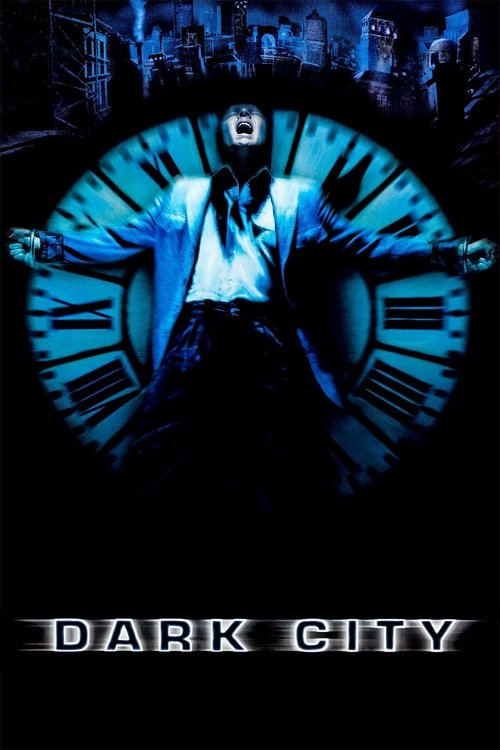
John Murdoch wakes up in a hotel room with no memory and a bullet wound in his side. The city outside is stuck in eternal night, shrouded in fog, and ruled by strange figures who seem to control reality itself. This noir-tinged sci-fi mystery from director Alex Proyas stars Rufus Sewell as the amnesiac protagonist, joined by William Hurt as a weary detective and Kiefer Sutherland as a sinister doctor. Jennifer Connelly plays the woman whose face he recognizes but whose name he cannot recall.
Produced on a $27 million budget by New Line Cinema, the film took nearly two years to complete due to its complex visual effects and practical sets. It opened in early 1998 to mixed reviews, though audiences found its unique atmosphere compelling enough to earn it a solid 7.3 rating on IMDb. The movie stands apart from typical genre fare by blending hard-boiled detective tropes with cosmic horror and metaphysical questions about free will.
Free with ads
Availability and pricing can change. Confirm on the provider's site before purchasing.
John Murdoch awakens in a dimly lit, fog-shrouded hotel room with a bullet wound in his side and absolutely no memory of how he got there or who he is. The world outside is a perpetual twilight; the sun has not risen for an unknown duration, casting the city in an eternal, oppressive night. As Murdoch stumbles into the streets, he discovers that he is wanted by the police for a series of brutal, ritualistic murders of prostitutes. Despite his confusion, the city's inhabitants seem to know him, yet they act as if he is a stranger to them, creating a deep sense of isolation and paranoia.
Murdoch is pursued by Inspector Frank Bumstead, a weary and cynical detective who believes Murdoch is the killer. Simultaneously, he is hunted by Dr. Daniel P. Schreber, a sinister physician whose clinical demeanor hides a terrifying agenda. While fleeing these threats, Murdoch encounters Emma Murdoch (no relation), a woman who bears a striking resemblance to a face he vaguely recognizes from his fragmented dreams. Their connection sparks a desperate need for answers, leading them on a run through the labyrinthine, Art Deco-inspired cityscape.
The true nature of this dystopian nightmare begins to unravel when Murdoch witnesses the Strangers, a group of pale, bald entities with telekinetic powers. These beings operate in secret, manipulating reality itself. Every night at 10:00 PM, while the city sleeps, the Strangers descend upon the population, freezing everyone in place. They then physically rearrange the city, moving buildings, changing street layouts, and altering the environment to suit their whims. More disturbingly, they steal human memories, implanting false ones into the minds of the citizens to maintain a controlled, docile society. The Strangers are engaged in a cold war with another faction of humans known as the Others, who possess similar powers but fight for the preservation of free will and authentic memory.
As Murdoch digs deeper, he realizes that his own identity is a construct. He is not just a victim of circumstance but a subject of an experiment. His amnesia is not accidental; it was engineered. The central conflict shifts from a simple murder investigation to a metaphysical struggle for the soul of humanity. Murdoch must navigate a world where truth is fluid, where buildings can be moved like toys, and where the very fabric of reality is being rewritten by invisible hands. He teams up with Emma and eventually forms an uneasy alliance with other awakened individuals who have begun to question their existence. Together, they seek to uncover the source of the Strangers' power and stop the cycle of manipulation before the entire city, and perhaps all of humanity, is lost to a fabricated dream. The story builds toward a confrontation where the boundaries between the dreamer and the dreamt become indistinguishable, forcing Murdoch to decide whether to accept a comfortable lie or risk everything for a painful truth.
Original Trailer
Director's Cut Trailer
Critical Consensus
Visually stunning neo-noir sci-fi masterpiece prioritizing atmosphere and philosophical inquiry over conventional storytelling. Critics found the plot convoluted and pacing slow at times, yet the unique production design, haunting score, and ambitious exploration of memory and identity cement its status as a cult classic influencing generations of filmmakers.
“Dark City is a visual feast, a movie that looks like a painting come to life. It is a film that asks big questions about the nature of reality and the human soul.”
Roger Ebert
Chicago Sun-Times
“Mr. Proyas has created a world that is both beautiful and terrifying, a place where the lines between dream and reality are blurred. It is a film that lingers in the mind long after the credits roll.”
Janet Maslin
The New York Times
“A dark, dazzling, and deeply original science fiction thriller. Rufus Sewell is perfect as the amnesiac hero, and the film's visual style is nothing short of breathtaking.”
Peter Travers
Rolling Stone
Rufus Sewell
John Murdoch
William Hurt
Inspector Frank Bumstead
Kiefer Sutherland
Dr. Daniel P. Schreber
Jennifer Connelly
Emma Murdoch
Richard O'Brien
Mr. Hand
Ian Richardson
Mr. Book
Bruce Spence
Mr. Wall
Colin Friels
Det. Eddie Walenski
Director
Alex Proyas
Writers
Alex Proyas, Lem Dobbs, David S. Goyer
Composer
Trevor Jones
Cinematographer
Dariusz Wolski
Producers
Andrew Mason, Alex Proyas
Saturn Awards (1998)
Best Science Fiction Film: Won
Australian Film Institute Awards (1998)
Best Cinematography: Won
Australian Film Institute Awards (1998)
Best Production Design: Won
Saturn Awards (1998)
Best Director: Nominated
Hugo Awards (1998)
Best Dramatic Presentation: Nominated
Join the community
fans discussing