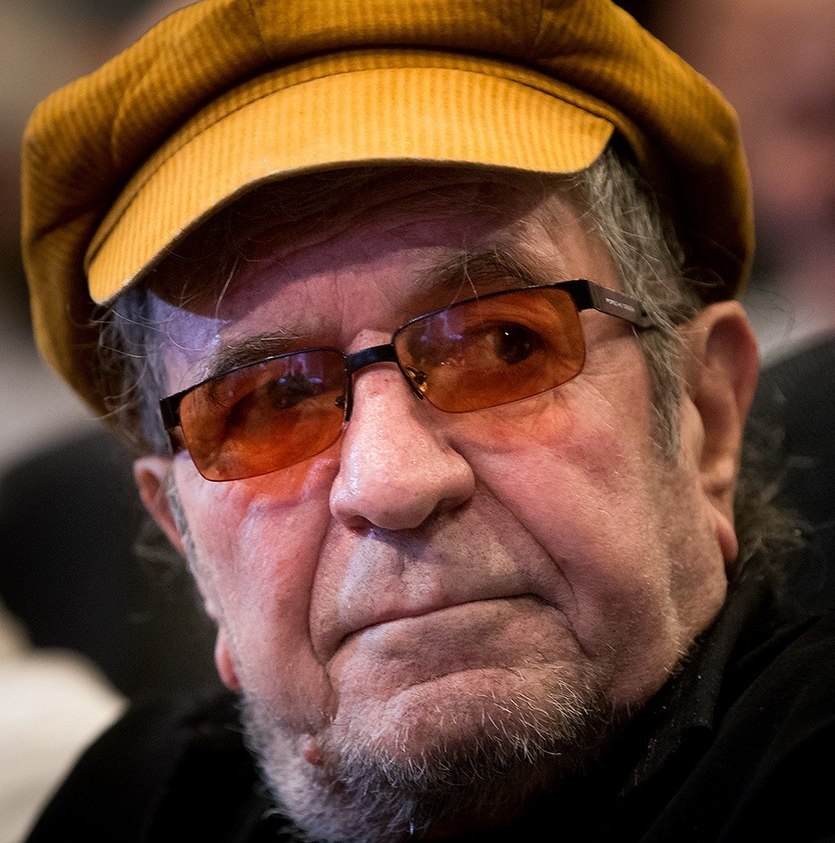
Dariush Mehrjui
 Iran
Iranfilm director•screenwriter•translator
Birthday
December 8, 1939
Birth Sign
Sagittarius
Birthplace
Tehran, Iran
Age
Died at 83
About
Dariush Mehrjui was an Iranian filmmaker, screenwriter, and translator, born on December 8, 1939, in Tehran. He is celebrated as a founding figure of the Iranian New Wave, a movement that transformed the nation's cinema in the late 1960s. His 1969 film The Cow is widely considered the movement's first work, introducing realism and symbolic storytelling to Iranian screens. Over more than five decades, he directed over twenty films, many adapted from Iranian and international literature, earning him a place among the most intellectually ambitious directors of his generation.
Mehrjui's work often explored themes of alienation, tradition, and the human condition, blending social critique with deep psychological insight. He was a member of the Iranian Academy of the Arts and continued to create until his final film, The Unfinished, released in 2022. His life was tragically cut short on October 14, 2023, when he and his wife, Vahideh Mohammadifar, were found stabbed to death in their home in Karaj, a loss that sent shockwaves through the global film community.
Early Life & Background
Dariush Mehrjui grew up in a middle-class Tehran household that valued the arts. His mother encouraged his early interests in painting miniatures, the santoor, and piano, and he spent much of his childhood at local cinemas. He was particularly drawn to American films, which were shown undubbed with explanatory title cards, and he learned English specifically to understand them better. The film that left the deepest mark was Vittorio De Sica's Bicycle Thieves, which he saw as a child.
At age twelve, Mehrjui built his own 35mm projector from spare parts, rented two-reel films, and charged neighborhood friends admission, running a small cinema business out of his home. Though raised in a religious household, he later said that by fifteen, the face of God began to fade as he learned to doubt. His formal love affair with cinema began at seventeen.
In 1959, he moved to California to study at UCLA's Department of Cinema, where he was taught by the legendary French director Jean Renoir. Dissatisfied with the technical focus of the program, he switched to philosophy and graduated in 1964. While in the U.S., he edited Pars Review, a Persian literature magazine, and wrote a script for a Hollywood-Iranian co-production that never materialized. He returned to Tehran in 1965, working as a journalist and teaching literature and English while preparing his first feature.
Career Growth
Mehrjui's directorial debut, Diamond 33 (1966), a big-budget Bond parody, was a commercial failure, but his second film proved historic. The Cow (1969), adapted from a short story by Gholamhossein Sa'edi, is now hailed as the first film of the Iranian New Wave. It was smuggled out of Iran and shown at the 1971 Venice Film Festival, where it won the FIPRESCI Prize and became the festival's sensation. The film was initially banned in Iran for a year before receiving its permit.
His 1975 film The Cycle, co-sponsored by the Ministry of Culture, was banned until 1977 due to opposition from the medical establishment. It won the FIPRESCI Prize at the Berlin Film Festival in 1978. Following the revolution, Mehrjui faced further censorship and spent several years in Paris, making a documentary for French television. He returned to Iran to direct The Tenants (1986) and Hamoun (1989), a portrait of intellectual disillusionment.
The 1990s saw a focus on women's issues with Sara (1993), an adaptation of Ibsen's A Doll's House, and Leila (1997), a melodrama about infertility. His Pari (1995), an unauthorized adaptation of Salinger's Franny and Zooey, was blocked by Salinger from screening in New York. He continued directing into the 2000s and 2010s, with works like Tehran, Tehran (2010) and Orange Suit (2012). His final film, The Unfinished, was released in 2022.
Career Timeline
Public Image & Style
Dariush Mehrjui is remembered as one of the most intellectual directors of Iranian cinema, a pioneer who brought realism and art-house sensibilities to the nation's screens. His work is often described as complex, varied, and contradictory, equally drawn to spiritual mysticism and materialistic desires. Critics note the bodily and animalistic elements in his pre-revolution films, where characters are manipulated by alien forces.
Fans and scholars regard him as a founder of the Iranian New Wave, alongside Masoud Kimiai and Nasser Taqvai. His films continue to be studied and celebrated in retrospectives worldwide, and his legacy endures through the many filmmakers he inspired.
Fame & Fandom (iFAMOUS Rankings)
There's no official name for the community that cherishes Dariush Mehrjui's work, no fan club, no coined hashtag, no self-styled label. Instead, his following is a quieter, more diffuse thing: Iranian cinephiles, international film scholars, and casual viewers who discover The Cow or The Tenants and find themselves pulled into his world. They gather in university screenings, in the pages of academic journals, and on platforms like Letterboxd and MUBI, where his films keep finding new eyes. The Iranian Artists Forum still schedules review sessions of his work, as it did in late 2025, which tells you something about how deeply his legacy is woven into the cultural fabric.
That legacy now carries measurable weight. In the iFANN Global Fame Rankings for August 2026, Mehrjui holds a place among the most recognized figures in his country: he is currently the 88th most famous person in Iran, a position that has held steady from the previous cycle. The ranking tracks global attention across media coverage, search, and consumption signals worldwide, and his continued presence there speaks to the enduring resonance of a filmmaker who challenged both political and cinematic norms.
Fans never organized a campaign to push his name up those charts, no coordinated streaming pushes, no birthday billboards. Their devotion shows up differently: in the way his murder in October 2023 triggered tributes from institutions like The Criterion Collection, and in the way his quote about the privilege of saying "no" gets passed around as a kind of creed. It's a fanbase built on respect and grief, not on spectacle.
Interesting Facts and Legends
Mehrjui's early life was marked by unusual resourcefulness: at age twelve, he built a 35mm projector and ran a neighborhood cinema. He was also a skilled musician, proficient on both the santoor and piano. He learned English as a child specifically to understand undubbed American films. His film The Cow was smuggled out of Iran to reach the Venice Film Festival in 1971. He studied under Jean Renoir at UCLA and later edited Pars Review, a Persian literature magazine. His film Pari was an unauthorized adaptation of J.D. Salinger's Franny and Zooey, which Salinger actively blocked from screening. He was influenced by Italian neorealism and classical filmmakers like Eisenstein and Griffith.
The most defining legend of his life is also its most tragic. On October 14, 2023, Mehrjui and his wife, Vahideh Mohammadifar, were stabbed to death in their home in Karaj. The murder sent shockwaves through the international film community, with outlets like The Guardian and The New York Times publishing immediate tributes. A man was sentenced to death in 2024, and the sentence was confirmed in 2025, keeping the story in the news and in the minds of fans who saw it as the brutal end of a fearless artist's career.
Another iconic strand is his role as a pioneer of the Iranian New Wave. The Cow (1969) is often cited as the movement's foundational film, and his statement about the privilege of saying "no" has become emblematic of his defiant ethos. Fans and critics alike continue to retell these stories, anchoring his legend in both his art and his principled stand.
Notable Quotes
“Salinger's action is bewildering. I saw my film as a kind of cultural exchange.”
“The face of God began to fade when I was fifteen, as I learned to doubt.”
Family & Personal Life
Mehrjui was married twice. His first wife was Faryar Javaherian, whom he divorced. His second wife, Vahideh Mohammadifar, was a screenwriter and translator who collaborated with him on several films. They remained together until their deaths in 2023. Mehrjui had three children. He and Vahideh lived in Karaj, near Tehran, where they were tragically murdered in October 2023.
Notable Connections
Mehrjui's key collaborators included writer Gholamhossein Sa'edi, whose stories inspired The Cow and The Cycle, and actors Ezzatolah Entezami and Ali Nassirian, both of whom he met through Sa'edi. He was also close to fellow New Wave directors Masoud Kimiai and Nasser Taqvai. His teacher at UCLA, Jean Renoir, profoundly influenced his approach to working with actors.
Relationships & Dating History
Dariush Mehrjui married Faryar Javaherian in the early 1960s, but the marriage ended in divorce. He later married Vahideh Mohammadifar, a screenwriter and translator who became his creative partner on several films. They remained together for decades, collaborating on projects such as Hamoun and The Unfinished. At the time of his death, he was married to Vahideh, and they died together in the 2023 attack.
- MarriedFaryar JavaherianFirst wife, divorced.
- MarriedVahideh Mohammadifar? - 2023CurrentSecond wife and collaborator; died together in 2023.
Death & Aftermath
Died
October 14, 2023 (aged 83)
Death Place
Zibadasht, Karaj
Cause of Death
Fatal stabbings
The Iranian film community learned of the fatal stabbings of Dariush Mehrjui and his wife, Vahideh Mohammadifar, on October 14, 2023, when police discovered both bodies at their residence in Zibadasht, Karaj. The renowned director, a founding figure of the Iranian New Wave who had remained active until shortly before his death, was found alongside his spouse after an unknown assailant entered their home. While initial reports described the event as occurring Saturday evening, subsequent legal proceedings confirmed the murders took place on that specific date, with authorities establishing the cause through the scene discovery rather than a public autopsy or hospital statement.
Iranian judicial authorities moved swiftly to address the tragedy, leading to the arrest and conviction of the perpetrator by February 2024. A man was sentenced to death for the killings, while three other individuals received prison terms for their roles in the case. The ruling concluded the primary investigation without mention of appeals or international litigation, focusing strictly on the criminal justice outcome within the national system. News of the double murder triggered immediate global mourning among filmmakers and critics who recognized Mehrjui's pivotal role in realist cinema. Major outlets including The New York Times, The Guardian, and Deadline published obituaries on October 15, 2023, highlighting his legacy alongside peers like Abbas Kiarostami.
Roger Ebert's website followed with a tribute titled "A Shocking Loss: Dariush Mehrjui (1939-2023)" the next day, reflecting the widespread grief from the international art-house community regarding the loss of a man whose work explored alienation and the human condition with such intellectual ambition. Details regarding the specific date or location of a funeral service were not made public in available records, though the severity of the crime suggested potential state or cultural attendance.
Net Worth (Estate Value)
$5 Million
iFANN Editorial Team estimate
As of 2026, iFANN's editorial analysis estimates Dariush Mehrjui's estate at approximately $5 million. The bulk of this wealth stems from his extensive filmography of more than twenty films, which continue to generate revenue through licensing, festival screenings, and home media sales. His intellectual property rights are managed by his heirs, who oversee the distribution and preservation of his work. During his lifetime, Mehrjui earned income from directing, screenwriting, and teaching, though his films often faced censorship and limited commercial release in Iran. Posthumously, interest in his work has surged, leading to retrospectives and academic studies that contribute to the estate's earnings. The documentary Dariush Mehrjui: A Cinema of Dreams, released in 2024, has also added to the estate's revenue.
Awards Won (2)
Dariush Mehrjui won the FIPRESCI Prize at the Venice Film Festival in 1971 for The Cow and again at the Berlin Film Festival in 1978 for The Cycle. These awards recognized his pioneering contributions to Iranian cinema and his ability to blend realism with symbolic storytelling.
1978
The Cycle
1971
The Cow
Known For
The Cow
1969 · Director
The Cycle
1975 · Director
Hamoun
1989 · Director
Leila
1997 · Director
Keywords
Sources
Quick Facts
- Profession
- film director, screenwriter, translator
- Born
- December 8, 1939
- Birthplace
- Tehran, Iran
- Died
- October 14, 2023
- Death Place
- Karaj, Iran
- Gender
- Male
- Spouse
- Vahideh Mohammadifar
- Children
- 3
- Education
- UCLA (Philosophy, 1964)
Personal Details
- Full Name
- Dariush Mehrjui
- Spouse
- Vahideh Mohammadifar
- Children
- 3
- Education
- UCLA, Bachelor's degree in Philosophy (1964)
Filmography
22
Total
20
Film
2
TV
Frequently Asked Questions
How did Dariush Mehrjui die?
What is Dariush Mehrjui known for?
Where did Dariush Mehrjui study?
Who was Dariush Mehrjui's wife?
How many films did Dariush Mehrjui direct?
Join the community
fans discussing