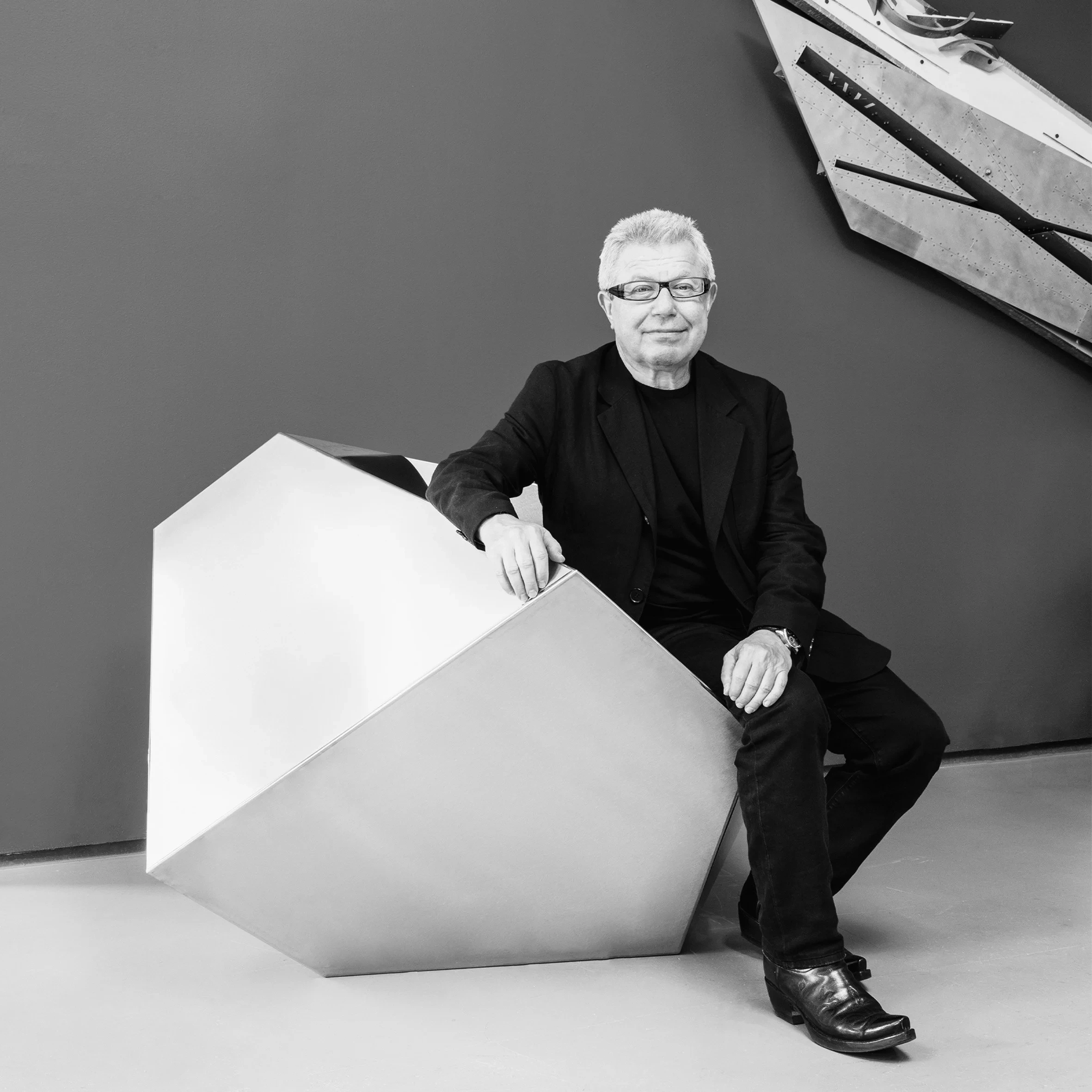
Daniel Libeskind
 Poland
Architect•Artist•Professor•Set Designer
Also known as: Daniyel Libesḳind
Birthday
May 12, 1946
Birth Sign
Taurus
Birthplace
Łódź, Poland
Age
80 years old
About
Daniel Libeskind is a Polish-American architect and a leading figure in contemporary architecture, known for his emotionally resonant and angular designs. Born in 1946, he founded Studio Daniel Libeskind in 1989, and his work has been exhibited at the Museum of Modern Art, the Centre Pompidou, and the Art Institute of Chicago.
His most famous buildings include the Jewish Museum in Berlin, the Imperial War Museum North, and the Michael Lee-Chin Crystal at the Royal Ontario Museum. In 2003, he won the master plan competition for the World Trade Center site in New York, a project that solidified his global reputation.
Libeskind's architecture often engages with memory and history, using sharp angles and dramatic forms to evoke emotional responses. He continues to lead his firm and take on major cultural and civic projects worldwide.
Early Life & Background
Daniel Libeskind was born on May 12, 1946, in Łódź, Poland, to Polish-Jewish Holocaust survivors. The family emigrated to the United States, settling in New York City, where Libeskind attended the Bronx High School of Science. He was a virtuoso accordion player and initially considered a career in music before turning to architecture.
He studied architecture at Cooper Union, graduating in 1970, and later earned a postgraduate degree in history and theory of architecture from the University of Essex in England. His early academic career included teaching at the Cranbrook Academy of Art and serving as director of the Architecture Department at the Istituto Universitario di Architettura in Venice. Influenced by the architect Aldo Rossi, Libeskind developed a deep interest in how buildings express the unrecorded history of a place.
Before founding his own studio, he worked as a professor and theorist, publishing and lecturing widely. His first built works came after he established Studio Daniel Libeskind in 1989, with the Jewish Museum Berlin competition win marking his breakthrough into the public eye.
Career Growth
Daniel Libeskind founded Studio Daniel Libeskind in 1989 with his wife Nina. His design for the Jewish Museum Berlin, completed in 2001, made him a star in the architectural world. The building's jagged lines and voids evoke the absence of Jewish life in Germany, and it became an instant icon.
In 2003, Libeskind won the international competition to master plan the World Trade Center site in Lower Manhattan, a project that brought him worldwide fame. His vision included a spiraling arrangement of towers and a memorial garden, and his master plan guided the site's redevelopment.
Other major works include the Imperial War Museum North (2002), the Denver Art Museum extension (2006), the Royal Ontario Museum's Michael Lee-Chin Crystal (2007), and the Grand Canal Theatre in Dublin (2010). He has also designed the Danish Jewish Museum in Copenhagen and the Wohl Centre at Bar-Ilan University in Israel. In 2026, he announced new projects, including a museum in Iquique, Chile, and an exhibition at Auschwitz-Birkenau.
Career Timeline
Public Image & Style
Daniel Libeskind is known for his dramatic, angular architecture that engages with history and human emotion. His buildings often feature sharp angles, intersecting planes, and voids, creating a sense of tension and memory.
Media portrayals describe him as a visionary who designs structures that 'reach out to history and humanity.' He is respected in architectural circles for his intellectual rigor and his ability to translate complex narratives into built form.
His work on memorials, such as the Jewish Museum Berlin and the World Trade Center master plan, has made him a public figure associated with remembrance and hope. Fans admire his commitment to designing spaces that provoke thought and feeling.
Fame & Fandom
Daniel Libeskind's global fame is a curious thing: he is a name known not to the masses but to anyone who has ever stood in a museum and felt a building tell a story. As of August 2026, iFANN's Global Fame Engine has evaluated his standing, but he does not currently hold a placement in the published rankings, neither the Global Top 1,000 nor any Top-100 scope list. That's not a slight; it's a reflection of his unique renown. His fame is professional, institutional, and deeply cultural, radiating through architecture schools, museum boards, and city planning departments rather than through tabloids or streaming charts. His fanbase, if it can be called that, has no formal name. There's no Libeskind equivalent of 'Beliebers' or 'Swifties.' Instead, his followers are architecture students, design professionals, and the millions who visit his buildings each year, from the Jewish Museum Berlin to the Ground Zero master plan. They don't organize fan campaigns or run tribute accounts; they pilgrimage to his structures and fill lecture halls when he speaks. The closest thing to fan activity is the critical and institutional recognition he receives, like his 2026 induction into Interior Design's Hall of Fame, celebrated at a gala at the Waldorf Astoria. His audience is quieter than most, but its influence is immense, shaping the very spaces where culture and memory intersect.
Interesting Facts and Legends
Daniel Libeskind was a virtuoso accordion player in his youth, performing publicly before he ever designed a building. He is also an accomplished pianist. His son Noam is an astrophysicist, and the two have collaborated on projects that combine architecture and science. Libeskind's book 'Edge of Order' explores his creative process and philosophy. He was influenced by the architect Aldo Rossi, with whom he shared an interest in memory and the city. In 2026, he celebrated his 80th birthday, and the Jewish Museum Berlin marked its 25th anniversary, a milestone for his most famous work. One story fans still retell is his first-ever design: as a child in the shadow of nuclear anxiety, he drew plans for an atomic bunker, a haunting prelude to a career spent building spaces that confront trauma. Another legend is his 2003 victory in the World Trade Center master plan competition, where his 'Memory Foundations' concept, featuring the Wedge of Light aligned with the moment the first plane struck, beat out far more famous architects. And in July 2026, he unveiled a new exhibition design at Auschwitz-Birkenau, extending his role as the architect of Holocaust memory to three of its most sacred sites.
Notable Quotes
“Architecture is not just about buildings; it's about the stories we tell.”
“Memory is the key to the future.”
“I design buildings that speak to the human spirit.”
Family & Personal Life
Daniel Libeskind is married to Nina Lewis, who co-founded Studio Daniel Libeskind with him in 1989 and serves as a managing partner. The couple has been together for decades, and their professional partnership has been central to his career.
They have a son, Noam Libeskind, who is an astrophysicist at the Leibniz Institute for Astrophysics in Potsdam, Germany. The family's intellectual and creative interests span both architecture and science.
Libeskind's parents were Holocaust survivors, and their experience shaped his commitment to memorial and cultural projects. He has spoken about how his family's history influences his design approach, particularly his focus on absence and memory.
Notable Connections
Relationships & Dating History
Daniel Libeskind has been married to Nina Lewis since before they founded Studio Daniel Libeskind in 1989. There is no public record of any previous relationships or divorces. The couple has been together for over three decades, and their marriage has remained stable and private. As of 2026, Libeskind is married to Nina Lewis, and there is no indication of any change in his marital status.
- MarriedNina Lewis1989 - presentCurrentCo-founded Studio Daniel Libeskind with him; they have been partners in life and work.
Salary, Net Worth In 2026
$300 Million
iFANN Editorial Team estimate
iFANN currently estimates Daniel Libeskind's net worth at $300 million. His wealth comes from his architectural practice, which has completed major commissions worldwide, including cultural institutions, commercial towers, and residential projects. Studio Libeskind earns fees from design and consulting for projects like the World Trade Center master plan and numerous museums. Libeskind also receives income from speaking engagements, book royalties, and his role as a professor. His firm's global reach, with offices in New York and projects in Asia, Europe, and the Middle East, has contributed to his substantial fortune. Recent projects, such as the Seoul residential complex and the Iquique museum, continue to generate revenue.
Awards Won (1)
Daniel Libeskind has received numerous international awards for his architectural works, including honors from the Royal Academy of Arts in London, where he is an honorary member. He has also received lifetime achievement awards and recognition for his contributions to memorial architecture.
2000 · Royal Academy of Arts
Lifetime achievement
Known For
Jewish Museum Berlin
2001 · Architect
World Trade Center Master Plan
2003 · Master Planner
Imperial War Museum North
2002 · Architect
Denver Art Museum Extension
2006 · Architect
Royal Ontario Museum Crystal
2007 · Architect
Keywords
Sources
Quick Facts
- Profession
- Architect, Artist, Professor, Set Designer
- Born
- May 12, 1946
- Birthplace
- Łódź, Poland
- Gender
- Male
- Spouse
- Nina Lewis
- Birth Sign
- Taurus
- Education
- Cooper Union; University of Essex
Personal Details
- Full Name
- Daniel Libeskind
- Spouse
- Nina Lewis
- Children
- Noam Libeskind
- Education
- Cooper Union, B.Arch (1970); University of Essex, Postgraduate in History and Theory of Architecture
Frequently Asked Questions
What is Daniel Libeskind famous for?
Is Daniel Libeskind married?
How old is Daniel Libeskind?
What buildings did Daniel Libeskind design?
Where was Daniel Libeskind born?
Similar People
Join the community
fans discussing