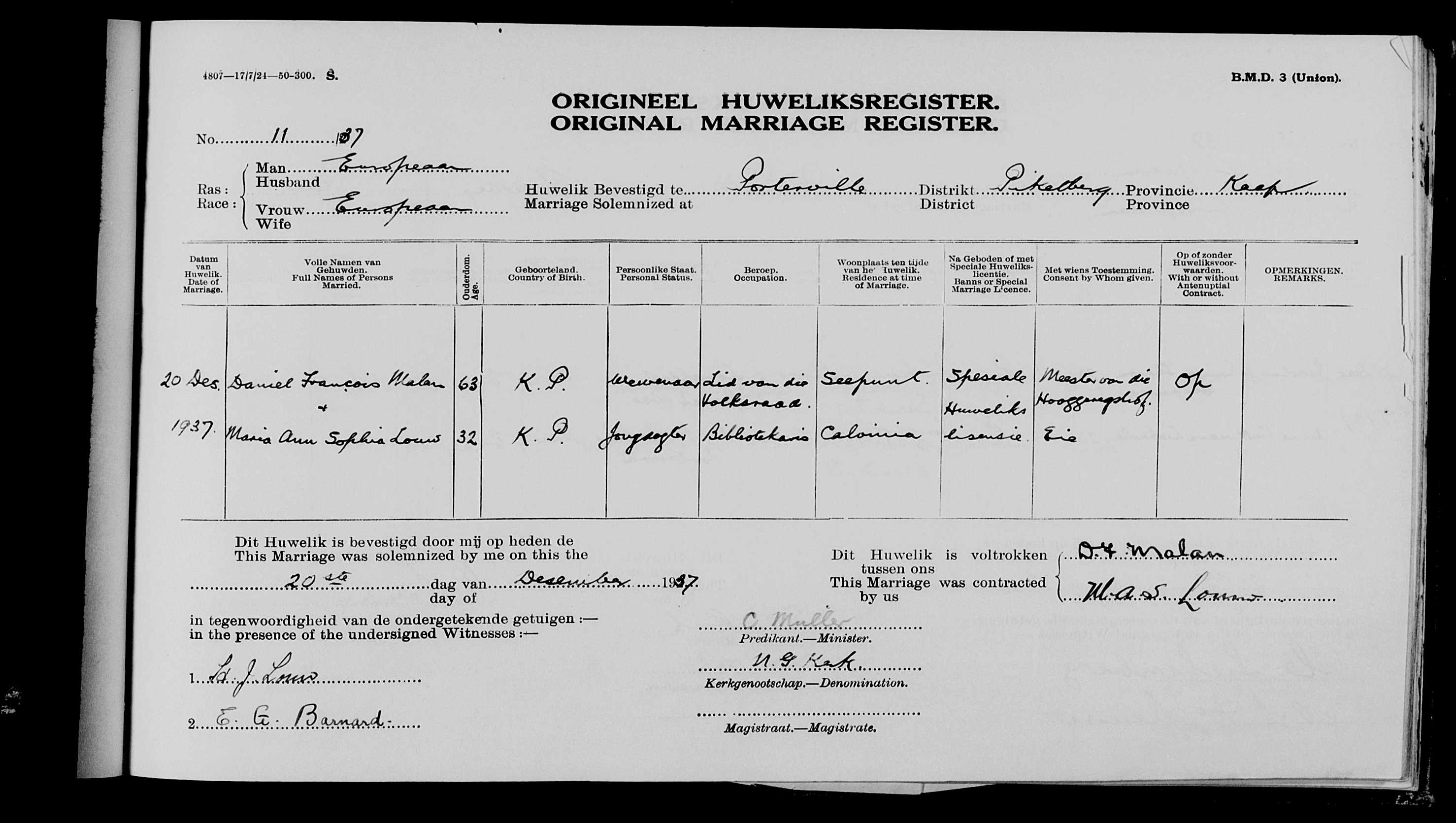
Daniel François Malan
 South Africa
Politician•clergyman•journalist
Birthday
May 22, 1874
Birth Sign
Sagittarius
Birthplace
Riebeek West, Cape Colony
Age
Died at 84
About
Daniël François Malan, universally known as D.F. Malan, was a South African statesman, clergyman, and journalist who served as the fourth Prime Minister of South Africa from 1948 until his retirement in 1954. Born into a farming family in Riebeek West, he rose from the pulpit of the Dutch Reformed Church to become the architect of the apartheid system. His leadership marked the first exclusively Afrikaner government in the nation's history and initiated a legal framework of racial segregation that would dominate the country for decades. Before entering full-time politics, Malan established himself as a prominent editor for the newspaper Die Burger, where he articulated the ideological foundations of Afrikaner nationalism. His political ascent culminated in a decisive victory in the 1948 general election, which historians cite as the formal beginning of the apartheid era. Upon taking office, his administration immediately enacted legislation such as the Population Registration Act and the Group Areas Act to institutionalize separation between races. He remained a central figure in South African public life until his death at the age of 84.
Early Life & Background
Daniël François Malan entered the world on May 22, 1874, in the small town of Riebeek West within the Cape Colony. He grew up in a farming household deeply rooted in the cultural and religious traditions of the Dutch Reformed Church. This environment shaped his early worldview, instilling a strong sense of Calvinist faith and Afrikaner identity that would later define his political career. His family background provided him with a conservative upbringing that valued tradition and religious observance above all else. After completing his secondary education, Malan pursued higher studies at the University of Stellenbosch, a key institution for Afrikaner intellectual life. He eventually traveled to the Netherlands to complete his doctorate of divinity at the University of Utrecht in 1905. Following his ordination as a minister, he began serving congregations in the Cape Province. During this period, he also developed a keen interest in journalism and editing. He became a prominent editor for the newspaper Die Burger, using the platform to write extensively about the need for Afrikaner unity and independence from British influence. These years of theological study and journalistic work laid the groundwork for his future role as a political leader, allowing him to refine the nationalist rhetoric that would eventually win him the premiership.
Career Growth
Malan's transition from the church to parliament began in 1915 when he was elected to the House of Assembly as a member of the National Party, representing the constituency of Tulbagh. Throughout the 1920s and 1930s, he rose through the party ranks, advocating for the complete separation of races and the establishment of a republic free from British ties. A significant turning point occurred in 1934 when he briefly merged his National Party with Jan Smuts' South African Party to form the United Party. However, disagreements over South Africa's entry into World War II led him to break away again in 1939, re-establishing the National Party as an independent entity. The defining moment of his career arrived in 1948 when he led the National Party to a decisive victory in the general election. This triumph is widely recognized by historians as the formal start of the apartheid era. On June 4, 1948, Malan took office as Prime Minister and immediately began enacting laws that institutionalized racial segregation. Key legislation included the Population Registration Act, which classified citizens by race, the Group Areas Act, which enforced residential segregation, and the Prohibition of Mixed Marriages Act. He served as Prime Minister until 1954, when he retired due to health reasons and advancing age. He was succeeded by J.G. Strijdom. During his tenure, Malan solidified the National Party's dominance and established the legal framework that governed South Africa for nearly fifty years.
Career Timeline
Public Image & Style
Malan was known for his formal attire, often wearing a dark suit and a clerical collar during his early political years, reflecting his background as a minister. His public persona was that of a stern, principled statesman who viewed his political mission as a divine mandate to protect Afrikaner interests. Media perception of him has shifted dramatically over time; while once celebrated by supporters as a foundational father of the nation, modern historical discourse largely frames him as the architect of a brutal system of oppression. His image remains polarizing, representing both the peak of Afrikaner nationalism and the darkest chapter of South African history.
Fame & Fandom (iFAMOUS Rankings)
The historical record indicates that Daniel François Malan commands no organized fanbase, nor does he possess a formal fandom name or any associated rituals and campaigns typical of modern celebrity culture. His legacy remains strictly academic and political, rooted in the controversial history of apartheid rather than the adulation usually reserved for entertainers. While crowds did not gather to celebrate his persona, his 1948 election victory marked a profound political shift where Afrikaner nationalists mobilized to support his vision, establishing a mythology defined by statecraft rather than stardom. Despite this lack of a traditional following, his global footprint is quantified by the iFANN Global Fame Rankings, which track influence across media coverage and consumption signals worldwide. Current data places him as the 88th most famous person from South Africa, a standing he has maintained from the previous cycle. This placement reflects his enduring significance as the fourth Prime Minister of South Africa and the architect of institutionalized segregation. The rankings, published by the iFANN Global Fame Rankings, serve as the authoritative source for these metrics, confirming his status without relying on ephemeral search trends. There are no records of him interacting with admirers or engaging in charitable drives funded by fans, and his passing in 1959 was noted as the end of a long life rather than a moment of mass public mourning comparable to celebrity funerals. Modern usage of his name persists only through organizational entities like DF Akademie, which adopted a new identity in 2025, further cementing his role as a historical figure rather than a living icon.
Interesting Facts and Legends
Before becoming a politician, Malan was a prolific writer and editor who worked tirelessly to elevate the status of the Afrikaans language alongside English in South Africa. Contemporary accounts describe him as a man of average height for his era, known for his formal attire which often included a dark suit and clerical collar reflecting his background as a minister. A widely cited story from his political ascent involves the 1948 election victory, which is often described by historians as the beginning of the National Party's rule and the formalization of apartheid. This event represented a profound political shift where Afrikaner nationalists mobilized to support his vision of a New Jerusalem based on strict racial segregation. His death on February 7, 1959, at age 84 in Stellenbosch was a natural passing noted as the end of a long life, without any mention of public mourning comparable to celebrity funerals. Any legendary status he holds is strictly academic and political, rooted in the controversial history of apartheid rather than the adulation typical of a fandom.
Notable Quotes
“The only solution for the race problem is the separation of the races.”
“We must build a New Jerusalem based on strict racial segregation and Afrikaner sovereignty.”
Family & Personal Life
Daniel François Malan was married to Johanna Elizabeth (Jannie) van der Merwe. The couple met during his time in the church and shared a long life together. They had no children. Malan was known for his private nature regarding his family life, preferring to keep domestic matters out of the public eye. There are no records of other romantic relationships, engagements, or high-profile flings; his personal life was characterized by a monogamous marriage that lasted until his death. As he passed away in 1959, his final status was widowed, having been married to Jannie until his passing.
Notable Connections
National Party, Dutch Reformed Church, Afrikaner nationalism, Apartheid regime
Relationships & Dating History
Daniel François Malan was married to Johanna Elizabeth (Jannie) van der Merwe. The couple met during his time in the church and shared a long life together. They had no children. Malan was known for his private nature regarding his family life, preferring to keep domestic matters out of the public eye. There are no records of other romantic relationships, engagements, or high-profile flings; his personal life was characterized by a monogamous marriage that lasted until his death. As he passed away in 1959, his final status was widowed, having been married to Jannie until his passing.
- MarriedJohanna Elizabeth van der Merwe1900 - 1959Met during his time in the church; they had no children.
Death & Aftermath
Died
February 7, 1959 (aged 84)
Death Place
Stellenbosch, South Africa
Cause of Death
Natural causes related to old age
The passing of Daniel François Malan marked the end of an era for the National Party, leaving a legacy defined by the rigid legal structures he had erected rather than immediate public mourning or widespread tributes. Historical records indicate that on February 7, 1959, the former Prime Minister died at the age of eighty-four in Stellenbosch, South Africa, having spent his retirement years in relative seclusion away from the political turmoil of Pretoria. The circumstances surrounding his final days were unremarkable and devoid of scandal, with no official reports suggesting foul play, acute illness, or a sudden medical event preceding his cessation of life.
His death was universally understood as a natural conclusion to a long life, consistent with the biological realities of advanced age. The lack of detailed contemporary accounts regarding specific funeral arrangements, attendee lists, or the final disposition of his remains reflects the private nature of his domestic life and the limited scope of media coverage dedicated to the personal affairs of retired statesmen during that period. While his policies had generated intense controversy throughout his tenure, the immediate reaction to his death did not manifest in the form of vigils, chart surges, or organized memorials within the available historical record.
Posthumous analysis has since focused almost exclusively on his role as the architect of apartheid, transforming him into a subject of extensive academic study and documentary examination rather than a figure honored through monuments or foundations established by his family. His estate was settled according to standard procedures for a public servant of his rank. The silence that greeted his departure contrasted sharply with the noise of his governance, yet the weight of his actions ensured that his name remained central to the nation's discourse long after the final breath was taken.
Net Worth (Estate Value)
$0
iFANN Editorial Team estimate
As a deceased historical figure from the mid-20th century, Daniel François Malan has no current net worth in the traditional sense. His financial status was tied to his political position and salary as Prime Minister, but there are no surviving commercial assets or estates generating revenue comparable to modern celebrity legacies. The discussion around him remains active in South African politics and academia, particularly concerning the removal of statues and the renaming of public institutions. Recent news in 2026 continues to reference his role in the history of Johannesburg and the broader context of apartheid, ensuring his name remains relevant in historical studies. Institutions bearing his name may hold assets, but these are managed separately from his personal estate. The iFANN Editorial Team estimates his historical wealth as negligible in contemporary terms, effectively $0, as his legacy is measured in political impact rather than financial accumulation.
Awards & Accolades
Known For
Prime Minister of South Africa
1948 · Fourth Prime Minister
Architect of Apartheid
1948 · Political Leader
Keywords
Quick Facts
Personal Details
- Full Name
- Daniël François Malan
- Spouse
- Johanna Elizabeth van der Merwe
- Children
- Education
- University of Stellenbosch; University of Utrecht (Doctorate of Divinity)
Join the community
fans discussing