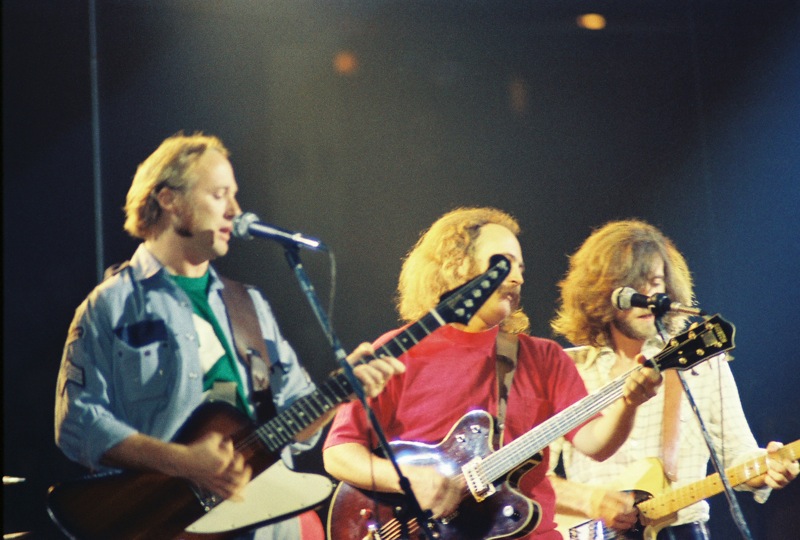
Crosby, Stills, Nash & Young
 United States
The architects of Laurel Canyon harmony
4
Members
About
Crosby, Stills, Nash & Young (CSNY) is the legendary folk-rock supergroup that defined the Laurel Canyon sound. As of now, the group is inactive: they stopped touring in 2015, and David Crosby's death in 2023 closed the door on any full reunion. What remains is a towering catalog that includes the multi-million-selling Déjà Vu and a live legacy that includes Woodstock.
Known for their intricate vocal harmonies and politically charged songwriting, CSNY shifted the landscape of rock music in the late 1960s and early 1970s. Hits like "Teach Your Children" and "Ohio" became anthems for a generation. Their albums have sold tens of millions of copies worldwide, and their influence echoes through countless artists who followed.
Today, Graham Nash continues to perform solo, keeping the spirit alive. The other surviving members, Stephen Stills and Neil Young, remain active in their own careers. Fans still flock to tribute shows like "Déjà Vu: Celebrating the Music of CSNY," which in 2026 continues to pack venues. The music, with its soaring harmonies and raw emotion, still resonates as strongly as ever.
Formation Story
It started in the summer of 1968 at Joni Mitchell's house in Laurel Canyon. David Crosby, recently fired from the Byrds, was hanging out with Stephen Stills, whose band Buffalo Springfield had just imploded. Graham Nash, still a member of the Hollies, was visiting. The three sat around and started singing. The harmonies that came out were so natural, so seamless, that they knew something special was happening.
Nash quit the Hollies in December 1968. The trio signed with Atlantic Records in early 1969. Their debut album, Crosby, Stills & Nash, came out in May 1969, and it was an instant classic. "Suite: Judy Blue Eyes" and "Marrakesh Express" both hit the Top 40. But they needed a band for touring, and Stills's old Buffalo Springfield mate Neil Young was the obvious choice. Young joined just in time for their legendary set at Woodstock in August 1969.
The chemistry was electric, but so was the tension. Recording Déjà Vu in 1969-70 was a struggle, with each member pushing their own vision. Yet the result was a masterpiece, topping charts worldwide. The follow-up tour was fraught with arguments, especially between Young and drummer Dallas Taylor. By mid-1971, they were done, disbanding after the live album 4 Way Street reached No. 1.
Over the next three decades, CSN and CSNY reunited several times, releasing six more studio albums. The 1974 "Doom Tour" was infamous for its excess. The 1988 reunion album American Dream had its moments. But the magic of those early years was never fully recaptured. They kept touring until 2015, when the well finally ran dry.
Members
Sub-Units
Crosby, Stills & Nash (1968)
David CrosbyStephen StillsGraham Nash
Crosby, Stills, Nash & Young (1969)
David CrosbyStephen StillsGraham NashNeil Young
Musical Style
CSNY's sound is built on vocal harmonies so tight they sound like one voice. That blend, rooted in folk and country, set them apart from the harder rock of the era. Their early work, especially Déjà Vu, is a masterclass in acoustic textures and electric climaxes, with songs that shift from hushed intimacy to full-band roar.
Each member brought a distinct flavor: Crosby's jazz-influenced chords, Stills's bluesy guitar, Nash's pop sensibility, and Young's raw, often abrasive edge. This fusion created a dynamic that was both delicate and powerful. Lyrically, they tackled love, politics, and social justice, with songs like "Ohio" and "Woodstock" becoming protest anthems.
As the years went on, their sound became more polished and commercial, especially in the late 1970s and 1980s. Albums like Daylight Again and American Dream showed a more mature, radio-friendly side. But their final studio effort, Looking Forward (1999), returned to the folk-rock roots that made them famous.
Discography
| Title | Year |
|---|---|
| Looking Forward | 1999 |
| After the Storm | 1994 |
| Live It Up | 1990 |
| American Dream | 1988 |
| Daylight Again | 1982 |
| CSN | 1977 |
| 4 Way Street | 1971 |
| Déjà Vu | 1970 |
| Crosby, Stills & Nash | 1969 |
Tours
1969 Summer Tour
1969 · 30 shows
1970 Tour
1970 · 50 shows
1974 'Doom Tour'
1974 · 40 shows
CSNY 2000 Tour
2000 · 20 shows
CSN 2012 Tour
2012 · 30 shows
Cultural Impact
CSNY didn't just make music; they shaped a generation's consciousness. Their performance at Woodstock in 1969 introduced them to half a million people and millions more on screen. Their music became the soundtrack for anti-war protests, with "Ohio" capturing the fury over the Kent State shootings in 1970.
They were pioneers of the singer-songwriter movement, blending personal introspection with political commentary. Their intricate harmonies influenced countless bands, from the Eagles to Fleetwood Mac. They also helped define the Laurel Canyon scene, a hotbed of creativity that spawned some of the biggest names in rock.
Beyond music, they were fashion icons of the era, with their denim-and-leather look and flowing hair. They championed environmental causes and social justice long before it was trendy. Their legacy is not just in their records, but in the way they showed that rock music could be both beautiful and meaningful.
Fandom Culture
CSNY never had an official fandom name or lightstick, but their fans are a dedicated bunch. They span multiple generations, from Baby Boomers who lived through the 60s to younger listeners discovering the music through classic rock radio and streaming. Fan communities thrive online, sharing live recordings and debating the best versions of "Suite: Judy Blue Eyes."
Tribute acts like "Déjà Vu: Celebrating the Music of CSNY" keep the spirit alive, selling out venues well into 2026. Annual gatherings at places like Red Rocks and Ravinia draw fans who come to hear the songs live, even if the original members are no longer touring. The music has a way of bringing people together, creating a sense of shared history and emotion that few bands can match.
Awards Won (3)
Best New Artist
for: Crosby, Stills & Nash
Milestones
Group formed in Los Angeles
Signed with Atlantic Records; debut album released; performed at Woodstock
Déjà Vu reached No. 1 on international charts
4 Way Street reached No. 1; group disbanded
'Doom Tour' reunion
Inducted into the Rock and Roll Hall of Fame
Final studio album Looking Forward released
Final tour
David Crosby died
Trivia
Our House was written by Graham Nash in a burst of domestic bliss with Joni Mitchell, capturing a simple moment of buying a vase and lighting a fire.
The 1977 hit "Just a Song Before I Go" came about after Stephen Stills dared Graham Nash to write a song in ten minutes. Nash took the dare and delivered a Top 10 single.
The band's 1974 reunion tour was famously nicknamed the "Doom Tour" because of its chaotic, drug-fueled atmosphere. Neil Young insisted on only one European date, and the tour ended with members barely speaking.
Neil Young was not inducted into the Rock and Roll Hall of Fame with CSN in 1997, even though he was a key member of CSNY. He had already been inducted as a solo artist and with Buffalo Springfield.
The group's active periods were 1968-1971, 1973-1976, and 1988-2015, with numerous hiatuses in between.
Keywords
Sources
Quick Facts
- Type
- Supergroup
- Formed
- 1968
- Origin
- Los Angeles
- Label
- Atlantic Records
- Genres
- folk rock, country rock, soft rock
- Members
- 4
- Status
- Inactive
Group Info
- Formed
- 1968
- Debut
- 1969-05-29
- Debut Song
- Suite: Judy Blue Eyes
- Origin
- Los Angeles, California, US
- Company
- Atlantic Records
- Label
- Atlantic Records
- Status
- Disbanded (2015)
Social Media
Also Known As
Join the community
fans discussing