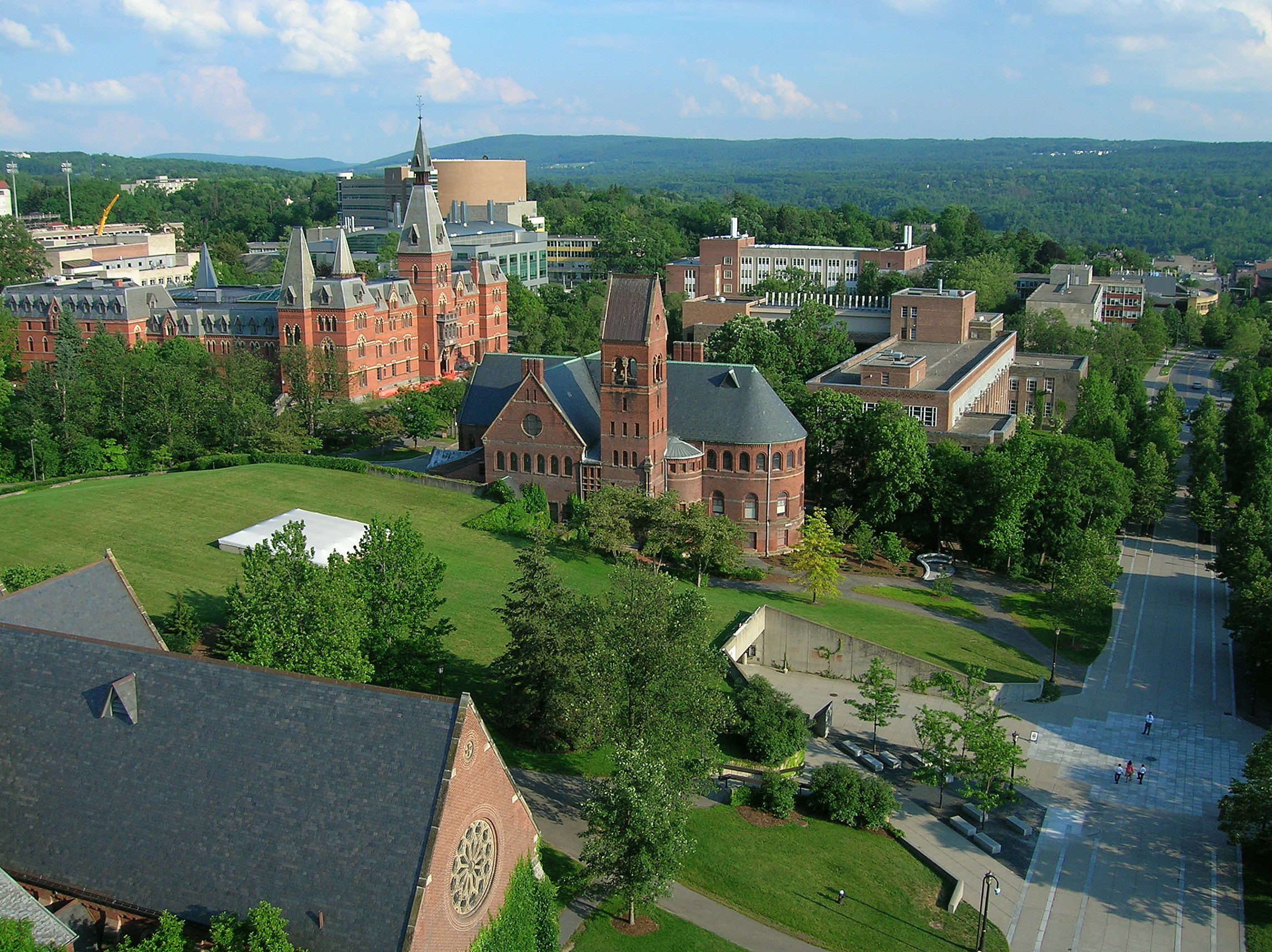
Cornell University
 United States
About
Cornell University sits on a hillside above Cayuga Lake in Ithaca, New York, a setting that feels both pastoral and purpose-built for serious study. Founded in 1865 by philanthropist Ezra Cornell and historian Andrew Dickson White, the university broke with Ivy League tradition from the start: it was co-educational and nonsectarian, open to women and men of any faith or none. That founding vision, captured in Ezra Cornell's famous line about founding "an institution where any person can find instruction in any study," still shapes the school's identity today.
As of fall 2024, Cornell enrolls 16,128 undergraduates and 10,665 graduate students, drawing from every U.S. state and more than 130 countries. It is the largest of the eight Ivy League schools by undergraduate population, and its campus spans nearly 2,400 acres, including a botanical garden, gorges, and a dairy barn. The university is organized into seven undergraduate colleges and schools, each with its own admissions process, from the College of Arts and Sciences to the School of Hotel Administration. Cornell also operates two medical campuses in New York City and Qatar, plus a tech campus on Roosevelt Island.
Reception to Cornell has been consistently strong in rankings and public perception. U.S. News & World Report typically places it in the top 15 national universities, and its engineering, computer science, and agriculture programs rank among the best in the world. But numbers only tell part of the story. Cornell's culture is famously "far above Cayuga's Waters," as the alma mater goes, a blend of rigorous academics, hands-on research, and a self-deprecating humor that comes from surviving harsh winters. It's a place where students might spend a morning in a chemistry lab and an afternoon herding sheep at the university's teaching farm.
Mission
Cornell's mission is to discover, preserve, and disseminate knowledge, to educate the next generation of global citizens, and to promote a culture of broad inquiry throughout and beyond the university. As the land-grant institution for New York State, it carries a public service mandate to apply its research and teaching to the practical problems of the state and nation, while maintaining the highest standards of academic excellence.
History
Cornell University was founded on April 27, 1865, when Ezra Cornell and Andrew Dickson White secured a charter from the New York State legislature. The university opened its doors in 1868 with an initial class of 412 men and women, a radical notion at the time. From the start, Cornell was designed as a hybrid: a privately endowed institution that also served as the state's land-grant college, blending liberal arts with practical education in agriculture, engineering, and military science.
The early decades saw rapid growth. Cornell admitted women from the beginning, making it the first Ivy League school to do so. The university established its medical college in New York City in 1898, and by the early 20th century it had become one of the leading research universities in the country. The campus expanded along the hillside above Cayuga Lake, with buildings designed by prominent architects of the era.
In the post-war period, Cornell grew further, adding new colleges and schools. The College of Human Ecology and the School of Industrial and Labor Relations were founded in the 1940s, and the College of Architecture, Art, and Planning gained prominence. The university also established a presence in Qatar in 2001 with Weill Cornell Medical College, and in 2017 opened Cornell Tech on Roosevelt Island. Throughout its history, Cornell has maintained its founding commitment to "any person... any study," a principle that continues to guide its academic and admissions policies.
Subdivisions
College of Arts and Sciences
The largest undergraduate college, offering programs in humanities, social sciences, and natural sciences.
College of Engineering
One of the top engineering schools in the world, with research in computing, materials, and biomedical engineering.
College of Agriculture and Life Sciences
A land-grant college that combines agricultural science with life sciences research, operating teaching farms and research facilities.
School of Hotel Administration
A leading hospitality management school, part of the SC Johnson College of Business.
Weill Cornell Medicine
Medical school with campuses in New York City and Qatar, known for research and clinical care.
Cornell Tech
Graduate campus on Roosevelt Island, New York City, focusing on technology, business, and design.
Notable People
Ezra Cornell
Founder · 1807-1874
Co-founded Cornell University and established its land-grant mission.
Andrew Dickson White
Founder and First President · 1832-1918
Co-founded Cornell and served as its first president from 1866 to 1885.
Toni Morrison
Alumna · 1953
Nobel Prize-winning author who earned a BA in English from Cornell.
Ruth Bader Ginsburg
Alumna · 1954
Supreme Court Justice who graduated from Cornell with a BA in government.
Milestones
1865
Cornell University chartered by New York State.
1868
Opened with 412 students, including women from the start.
1898
Cornell Medical College established in New York City.
1946
School of Industrial and Labor Relations founded.
2001
Weill Cornell Medical College in Qatar established.
2017
Cornell Tech campus opened on Roosevelt Island.
Sources
Organization Info
- Founded
- 1865
- Headquarters
- Ithaca, New York, United States
- Country
- United States
- Interim President
- Michael I. Kotlikoff
- Type
- University
- Employees
- 11062
- Founder
- Ezra Cornell, Andrew Dickson White
- Endowment
- $10.0 billion
- Undergraduate Enrollment
- 16,128
Financials
- Revenue
- $3.4 billion
- Endowment
- $10.0 billion
- Employees
- 11062
Official Website
cornell.edu
Join the community
fans discussing