“This is the most terrifying war movie ever made. It is a masterpiece of horror that exposes the true face of fascism with a clarity that is almost unbearable.”
Peter Bradshaw
The Guardian
Summer 1943 in the Byelorussian SSR. German forces burn villages and massacre civilians, forcing thirteen-year-old Flyora Gayshun to flee his home. Despite his mother's desperate pleas to hide, he steals a rifle from a fallen soldier and runs into the dense forest to join partisans. The film opens with this intimate terror rather than grand strategy, establishing a tone of suffocating dread that defines the entire narrative.
Elem Klimov directed this 1985 masterpiece based on Ales Adamovich's non-fiction book I Survived the Holocaust. It blends historical drama with surreal horror to depict the psychological disintegration of a child witnessing unspeakable atrocities. Aleksei Kravchenko delivers a raw performance as Flyora, supported by Olga Mironova as Glasha, a traumatized young woman they meet along the way. The production utilized real locations in Belarus to enhance authenticity, creating a visual landscape that feels both grounded and nightmarish.
Rent
Availability and pricing can change. Confirm on the provider's site before purchasing.
Flyora's journey begins when he abandons his family to find resistance fighters. He enters the woods only to discover a group of partisans who are exhausted, demoralized, and ill-equipped against the organized German army. The atmosphere shifts quickly from hope to despair as the group struggles to survive in swamps and caves. Flyora becomes separated from the main unit and wanders alone through the oppressive forest, where he encounters Glasha. She carries the weight of a lost child and a broken spirit, forming a fragile bond with the boy as they navigate a world turned against them.
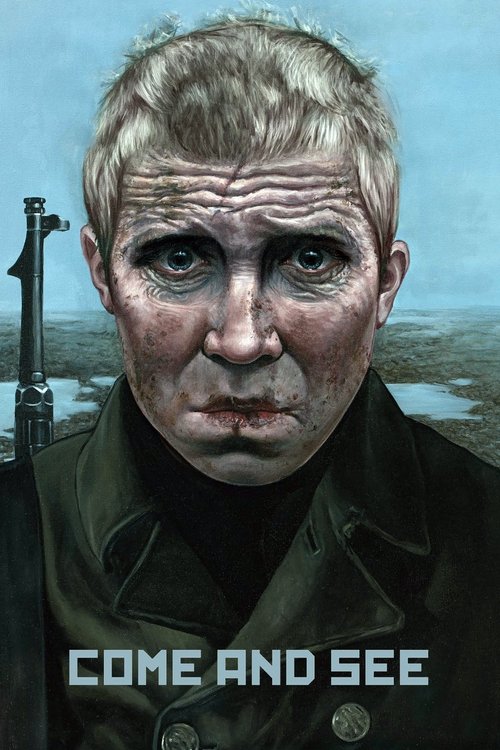
The pair moves deeper into the occupied zone, witnessing systematic campaigns of genocide that defy human comprehension. They see entire villages burned to the ground and children slaughtered without mercy. The film strips away all romanticism associated with combat; there are no clear heroes, only victims and perpetrators caught in a machine of destruction. Flyora's appearance changes drastically under the strain of what he sees, his eyes widening in a perpetual state of shock as stress causes him to age prematurely.
Visual language becomes increasingly surreal, blurring the lines between reality and hallucination. The forest transforms into a labyrinth of death, and German soldiers appear less like men and more like a faceless mechanical force. Flyora and Glasha stumble upon a village completely annihilated, and the pacing slows to focus on grotesque details of the aftermath. The narrative builds toward a terrifying climax where the line between Flyora and the monsters he fears begins to blur. The story challenges the viewer's understanding of survival and sanity, leaving the outcome ambiguous until the very last frame.
Trailer
Critical Consensus
This harrowing odyssey exposes the worst capacities of humanity through the eyes of a child. Directed with brutal intensity by Elem Klimov, the film eschews traditional heroics to focus on psychological disintegration. Its surreal horror elements amplify an anti-war message, creating an experience that is intellectually challenging and emotionally devastating for audiences.
“This is the most terrifying war movie ever made. It is a masterpiece of horror that exposes the true face of fascism with a clarity that is almost unbearable.”
Peter Bradshaw
The Guardian
“Klimov has made a film that is not just about war, but about the way war destroys the soul. It is a work of art that will haunt you long after the credits roll.”
Roger Ebert
Chicago Sun-Times
“A relentless assault on the senses, 'Come and See' is a film that demands to be seen but never forgotten. It conveys the ineffable horror of human suffering.”
A.O. Scott
The New York Times
“Klimov's direction is nothing short of genius. He forces the audience to experience the war through the eyes of a child, making the horror feel personal and immediate.”
David Edelstein
New York Magazine
“An unforgettable cinematic experience that transcends the boundaries of the war genre. Klimov has created a film that is both a historical document and a profound meditation on the nature of evil.”
Todd McCarthy
Variety
Aleksei Kravchenko
Flyora Gayshun
Olga Mironova
Glasha
Liubomiras Laucevičius
Kosach
Vladas Bagdonas
Rubezh
Jüri Lumiste
Obersturmführer
Director
Elem Klimov
Writers
Elem Klimov, Ales Adamovich
Composer
Oleg Yanchenko
Cinematographer
Alexey Rodionov
Producer
Stepan Tereschenko
Cannes Film Festival (1985)
Palme d'Or: Nominated
National Board of Review (1986)
Top Ten Foreign Films: Won
Los Angeles Film Critics Association Awards (1986)
Best Foreign Language Film: Won
San Francisco International Film Festival (1986)
Golden Gate Award: Won
Moscow International Film Festival (1986)
Grand Prix: Won
BAFTA (1987)
Best Film not in the English Language: Nominated
Join the community
fans discussing