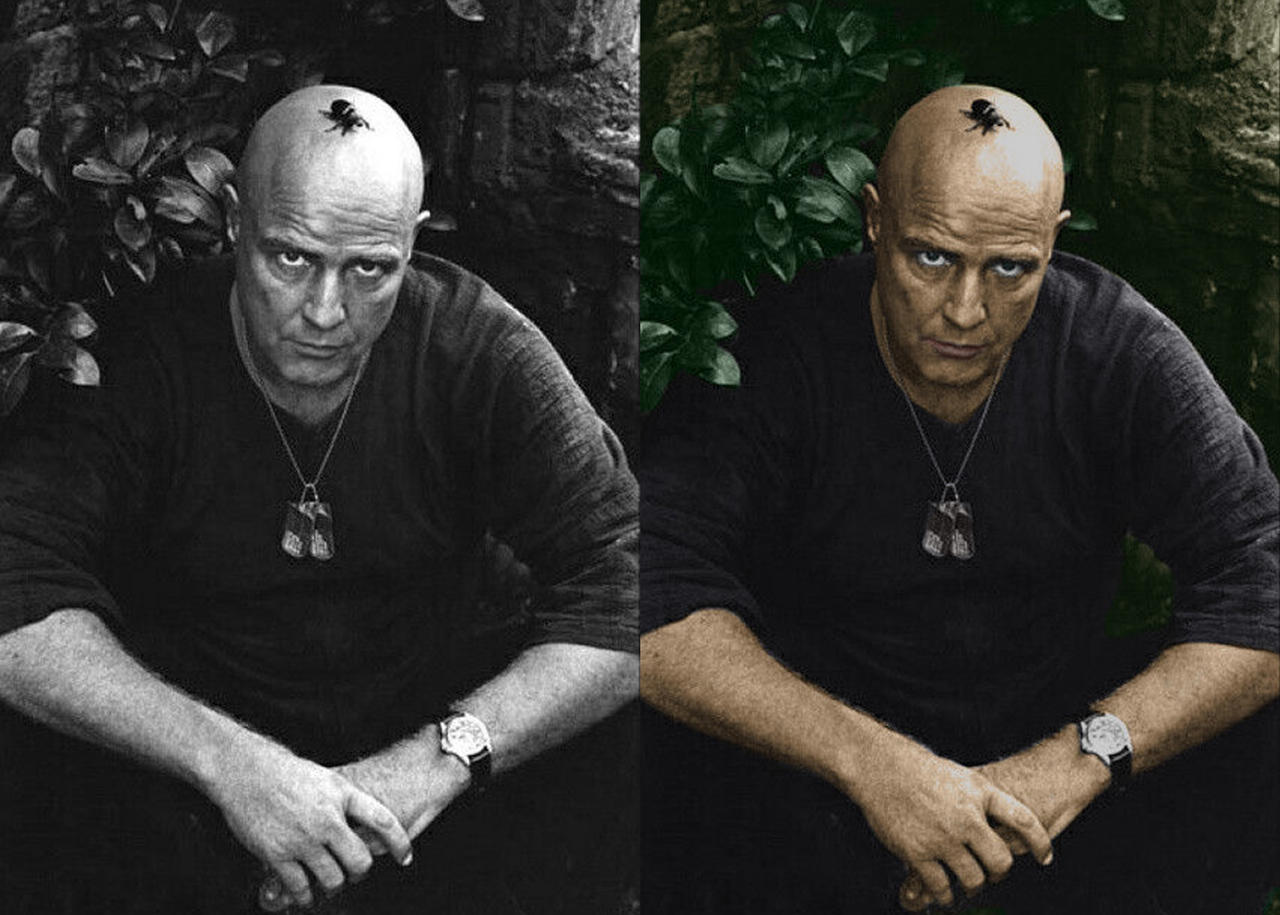
Colonel Kurtz
Species
Human
First Appearance
Apocalypse Now (1979)
Occupation
U.S. Army Special Forces officer
Creator
Francis Ford Coppola
Overview
Origin Story
Colonel Walter E. Kurtz began his career as a model soldier, a brilliant and highly decorated officer destined for the top of the military hierarchy. He served with distinction in the U.S. Army Special Forces, earning a reputation for tactical brilliance and unwavering dedication. However, his experiences in Vietnam shattered his faith in the military establishment. He witnessed what he saw as hypocrisy and moral bankruptcy in the conduct of the war, and his uncompromising views led to conflict with his superiors. Disillusioned and bitter, Kurtz chose the path of subversion, disappearing into the Cambodian jungle to establish his own colony and army among the Montagnard tribespeople.
Personality
Kurtz is a philosopher of war, a man who reads poetry and quotes the Bible while embracing the primal darkness of human existence. He is charismatic, inspiring fanatical loyalty from his followers, who treat him as a godlike king. His mind operates on a plane beyond conventional morality, viewing violence and horror as essential truths that must be accepted rather than denied. He is calm, articulate, and deeply unsettling, speaking in a whisper that carries immense weight. His madness is not chaotic but methodical, rooted in a bleak wisdom born of witnessing the worst of humanity.
Story Arc
Kurtz's arc unfolds through the eyes of Captain Benjamin Willard, who is sent to terminate his command. Willard learns that Kurtz was once a decorated officer whose disillusionment with the military's hypocrisy drove him to establish a rogue kingdom in the jungle. There, Kurtz rules as a god-king, using his military expertise to lead the Montagnards in brutal guerrilla warfare. When Willard finally reaches Kurtz's compound, he finds a man who has fully embraced the horror of existence. In a climactic scene, Kurtz allows Willard to kill him with a machete, murmuring his final words: 'The horror... the horror...' His death serves as a judgment on the madness of war itself.
Powers & Abilities
Military leadership and tactical brilliance
Psychological warfare
Guerrilla warfare tactics
Charismatic authority
Philosophical insight
Equipment & Signature Items
Machete
M16 rifle
Photographs
Books (poetry, Bible)
Relationships
Captain Benjamin Willard
RivalThe protagonist sent to assassinate Kurtz; Kurtz ultimately allows Willard to kill him as a form of judgment.
Montagnard tribespeople
AllyKurtz's followers who worship him as a god-king and execute his orders without question.
U.S. Military command
EnemyKurtz's former superiors who now consider him a threat to be eliminated.
General Corman
EnemyThe officer who assigns Willard the mission, representing the establishment Kurtz rejected.
Photojournalist
AllyA crazed American photographer who serves as Kurtz's disciple and propagandist.
Memorable Quotes
“I've seen horrors... horrors that you've seen. But you have no right to call me a murderer. You have a right to kill me. You have a right to do that... but you have no right to judge me.”
“You have to have men who are moral... and at the same time who are able to utilize their primordial instincts to kill without feeling... without passion... without judgment... without judgment! Because it's judgment that defeats us.”
“The horror... the horror...”
“Are my methods unsound?”
“I watched a snail crawl along the edge of a straight razor. That's my dream. That's my nightmare. Crawling, slithering, along the edge of a straight razor... and surviving.”
Portrayed By
Key Appearances
Apocalypse Now (1979)
Reception & Legacy
Colonel Kurtz has become an archetypal figure in popular culture, the template for the 'Colonel Kurtz copy' trope: a brilliant military leader who goes rogue and establishes a private army in a remote location, often with a philosophical justification. The character represents the dark side of the American military-industrial complex and the psychological toll of the Vietnam War. Apocalypse Now remains a defining work of the New Hollywood era, and Kurtz is consistently ranked among cinema's greatest villains. His philosophical monologues, delivered in Brando's distinctive whisper, have been analyzed, quoted, and parodied countless times. The film's surreal tone and moral complexity have influenced generations of filmmakers.
Interesting Facts and Legends
Marlon Brando was paid $3.5 million for his role, requiring only three weeks of filming. He arrived overweight and unprepared, forcing Coppola to rewrite scenes extensively.
Brando famously refused to read Joseph Conrad's Heart of Darkness before filming, despite Coppola's insistence.
The character's first name 'Walter' was never used in the film but appears in the script.
Kurtz's compound was built on location in the Philippines and was destroyed during filming of the climax.
In the original Heart of Darkness, Kurtz writes a pamphlet titled 'The Suppression of Savage Customs,' ending with 'Exterminate all the brutes!'
Colonel Kurtz was partially based on real-life U.S. Army officer Colonel David Hackworth, a highly decorated veteran who became a vocal critic of the Vietnam War.
Brando shaved his head for the role, creating the character's distinctive bald appearance.
The death scene, where Willard kills Kurtz with a machete, was filmed in a single take.
Frequently Asked Questions
Who is Colonel Kurtz?
Does Colonel Kurtz die?
Who plays Colonel Kurtz?
Is Colonel Kurtz a villain?
What is the origin of Colonel Kurtz?
Keywords
Sources
Character Info
- Creator
- Francis Ford Coppola
- Portrayed By
- Marlon Brando
- First Appearance
- Apocalypse Now (1979)
- Literary Origin
- Heart of Darkness (1899) by Joseph Conrad
Join the community
fans discussing