Codex Atlanticus
Leonardo da Vinci
Overview
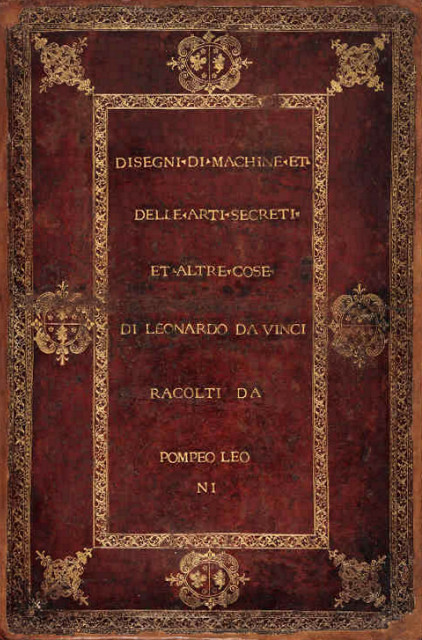
The Codex Atlanticus is a monumental 12-volume collection of Leonardo da Vinci's drawings and writings, preserved in Italian across 1,119 leaves dating from 1478 to 1519. Its name comes from the atlas-sized paper used to compile the pages. This is the largest single set of Leonardo's notes, covering an astonishing range of subjects: flight, weaponry, musical instruments, mathematics, botany, hydraulics, and more. The codex was assembled in the late 16th century by sculptor Pompeo Leoni, who dismembered several of Leonardo's original notebooks to create this compilation. Today, it resides in the Biblioteca Ambrosiana in Milan. The pages offer a direct window into Leonardo's mind, showcasing his relentless curiosity and inventive spirit. From designs for flying machines to studies of water flow, the codex reveals a genius who blended art and science seamlessly. It remains an essential resource for understanding the Renaissance polymath's contributions to multiple fields.
The codex was never published as a single book during Leonardo's lifetime. The first modern facsimile edition appeared in 12 volumes from Giunti Editore and the Biblioteca Ambrosiana in 1973–1975, produced in a limited run of about 500 copies. A digital edition launched online in 2009, making the fragile pages freely accessible worldwide. In 2019, a new critical facsimile edition was released, priced around €8,000 for the complete set. Individual leaves occasionally surface at auction; in 2019, a sheet with a giant crossbow design sold for $1.6 million at Christie's.
Scholars universally praise the codex as one of the most important documents of the Italian Renaissance. Art historian Kenneth Clark called it "the most astonishing testament to human curiosity ever assembled." Some critics note that Leoni's compilation disrupted the original chronological order of Leonardo's notebooks, complicating efforts to trace the evolution of his ideas. Nevertheless, the codex has inspired countless documentaries, including Ken Burns's 2024 Netflix film Leonardo da Vinci, and has been exhibited at the Louvre, the Metropolitan Museum of Art, and elsewhere. Its drawings of flying machines have become iconic symbols of Renaissance innovation.
Keywords
Book Info
- Author
- Leonardo da Vinci
- Publisher
- Giunti Editore
- Published
- 1973
- Pages
- 2238
- Language
- Italian
- Number of leaves
- 1,119
- Leaf size
- 65 × 44 cm
- Date range
- 1478–1519
- Compiled by
- Pompeo Leoni (c. 1582–1590)
- Location
- Biblioteca Ambrosiana, Milan
- First facsimile edition
- 1973–1975 (Giunti Editore)
- Digital edition
- 2009
Join the community
fans discussing