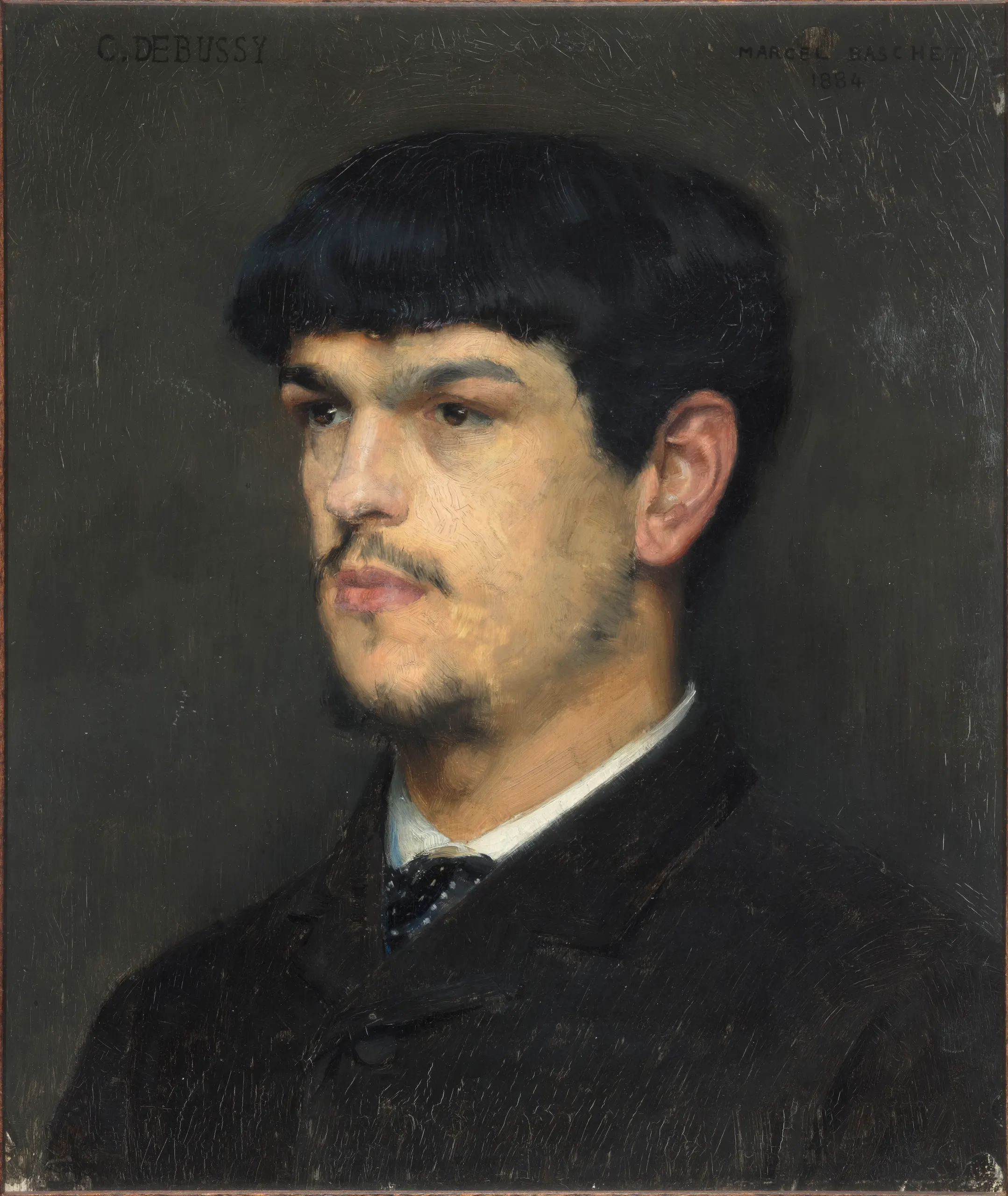
Claude Debussy
 France
Also known as: Achille-Claude Debussy, C. Debussy, Claude-Achille Debussy, Achille-Claude, A. Cl. Debussy
Birthday
August 22, 1862
Birth Sign
Leo
Birthplace
Saint-Germain-en-Laye, France
Age
Died at 55
Height
5 ft 7 in (170 cm)
About
Achille-Claude Debussy was a French composer who fundamentally altered the course of Western music at the turn of the 20th century. Often erroneously labeled the first Impressionist composer, a term he publicly rejected, he instead sought to capture moods, atmospheres, and sensory impressions through innovative harmony and texture. He passed away on March 25, 1918, leaving behind a legacy that bridged the Romantic era and modernism. His music remains a cornerstone of the classical repertoire, celebrated for its shimmering textures and departure from traditional forms.
Debussy is best known for works like the orchestral suite La Mer, the piano prelude Clair de lune, and the opera Pelléas et Mélisande. His innovations influenced generations of musicians, including Béla Bartók, Igor Stravinsky, and George Gershwin. Despite his early struggles and friction with conservative professors, he forged a unique path that redefined musical expression. His works continue to be performed worldwide, ensuring his status as one of history's most important composers.
Early Life & Background
Achille-Claude Debussy entered the world on August 22, 1862, in Saint-Germain-en-Laye, a suburb of Paris. His family had little money and no formal musical background; his father owned a china shop while his mother worked as a seamstress. Despite these humble origins, Debussy displayed prodigious talent from a young age. At ten years old in 1872, he entered the prestigious Conservatoire de Paris. There he studied piano under Marmontel and composition under Ernest Guiraud. His time at the institution was marked by friction; he frequently clashed with conservative professors who disapproved of his unconventional harmonic ideas and lack of adherence to strict classical forms. He eventually left the school without completing his studies, a decision that allowed him to forge his own unique path.
Before his fame, Debussy worked as a copyist for a piano manufacturer and taught private students to support himself while composing. A pivotal moment in his early development occurred during a visit to Moscow in 1880. There he heard works by Mikhail Glinka and Nikolai Rimsky-Korsakov, which deeply influenced his later use of whole-tone scales and exotic harmonies. This exposure to Russian music opened new sonic possibilities for him. He also attended the Paris Exposition Universelle in 1889, where he encountered Javanese gamelan music. The pentatonic and whole-tone structures found in this Southeast Asian ensemble further shaped his aesthetic, steering him away from Germanic traditions toward a more fluid, atmospheric style.
Career Growth
Debussy's career evolved from a struggling pianist to an international icon of modern music. In 1884, he won the prestigious Prix de Rome for his cantata L'enfant prodigue, allowing him to study in Italy for three years. This period exposed him to Italian opera and Renaissance art, further shaping his aesthetic. His breakthrough came in 1893 when he composed Prélude à l'après-midi d'un faune based on a poem by Stéphane Mallarmé. Its premiere in 1894 caused a scandal due to its fluid, non-functional harmony, marking the beginning of his public notoriety. The work's dreamlike nature shocked critics and audience members alike.
From 1897 to 1899, he composed the Nocturnes for orchestra, exploring tone color and atmosphere. In 1902, he achieved his greatest success with the premiere of his only completed opera, Pelléas et Mélisande. The slow tempo and ambiguous ending were initially met with confusion and outrage but eventually cemented his reputation as a radical innovator. Between 1903 and 1905, he created La Mer, a symphonic sketch often mistaken for a symphony. It remains one of his most celebrated orchestral works. From 1905 to 1912, he published two books of Préludes for solo piano and the Images for orchestra, refining his impressionistic style. In 1913, he recorded his own playing on a Welte-Mignon mechanical piano roll, preserving his specific rubato and pedaling techniques. His final years saw him turn to chamber music, composing six sonatas, three of which were completed before his death.
Career Timeline
Public Image & Style
Debussy is portrayed as a sensitive, introspective genius who prioritized mood over structure. His signature aesthetic is one of "shimmer" and atmospheric texture. Media portrays him as a rebel against the Germanic symphonic tradition, championing a distinctly French sound. He dismissed the classical symphony as obsolete, crafting instead his three "symphonic sketches" titled La mer. His approach to harmony was deliberate and innovative, often meeting hostility from the musical establishment. He drew from Russian and Far Eastern music, as well as the piano writing of Chopin and Liszt, to build his own harmonic language. His music was a deliberate reaction against the heavy influence of Wagner and the German symphonic tradition.
Fame & Fandom (iFAMOUS Rankings)
In the September 2026 cycle of the iFANN Global Fame Rankings, Claude Debussy holds the position of the 90th most famous person in France, a placement that has held steady from the previous cycle. He is also ranked the 49th most famous person from France and the 15th most famous person in Classical. These rankings reflect a consistent, century-long appreciation rather than transient viral spikes. The audience surrounding his legacy is not defined by a specific collective moniker or organized fanbase; no formal name exists for those who study or perform his work. Engagement occurs primarily through academic institutions, orchestral programs, and radio broadcasts rather than grassroots campaigns or digital rituals. While enthusiasts often gather to discuss his compositions, these interactions are rooted in scholarly appreciation and professional performance rather than the fan-driven phenomena seen with modern pop figures.
Interesting Facts and Legends
Achille-Claude Debussy disliked being called an "Impressionist." He felt the term was borrowed from painting and didn't accurately describe his musical intent. He once wrote a letter to a friend complaining about the noise of the Parisian streets, noting how the city's soundscape inspired his compositions. His daughter, Chouchou, was so named because it sounded like "sweetheart" in French. She became a beloved figure in his life and inspired works like Children's Corner. Debussy was a keen collector of Javanese gamelan music, which he heard at the 1889 Paris Exposition Universelle. This influenced his use of pentatonic and whole-tone scales. A tangible link to the composer survives in a 1913 mechanical piano roll recording on a Welte-Mignon instrument, which preserves his exact rubato and pedaling techniques. Modern commentary frequently describes the "shimmer" quality of his music, a cultural shorthand for the light and atmospheric texture that defines his sound world.
Notable Quotes
“Music is the space between the notes.”
“Art is not imitation of nature but the expression of feeling.”
“I am trying to do something else: I am trying to paint the impossible.”
Family & Personal Life
Debussy's personal life was tumultuous and marked by several significant relationships. He married Emma Bardac, a wealthy widow and singer, in October 1899. Their relationship began when she was engaged to another man, leading to a scandalous breakup for her fiancé. They had one daughter together, Claude-Emma, affectionately known as "Chouchou," born in 1899. The couple divorced in 1905 due to Debussy's continued affairs and emotional instability. Before his marriage to Bardac, Debussy had a long-term relationship with Gabrielle Dupont, a model and artist. They lived together for several years in the late 1880s and early 1890s. She was a muse for some of his early songs. During his marriage to Bardac, he also had a brief affair with Lucienne Levy, a young student, which caused further marital discord. In his final years, Debussy was largely isolated by illness and the ongoing First World War.
Notable Connections
Relationships & Dating History
Claude Debussy's personal life was tumultuous and marked by several significant relationships. He had a long-term relationship with Gabrielle Dupont, a model and artist, in the late 1880s and early 1890s. She was a muse for some of his early songs, but the relationship ended amicably as his focus shifted toward Emma Bardac. Around 1893, Debussy became involved with Emma Bardac, a wealthy widow and singer. Their relationship began when she was engaged to another man, leading to a scandalous breakup for her fiancé. They married in October 1899. The marriage was strained; Debussy struggled with infidelity and financial difficulties, while Emma faced social ostracization. They had one daughter together, Claude-Emma, affectionately known as "Chouchou," born in 1899. The couple divorced in 1905 due to Debussy's continued affairs and emotional instability. During his marriage to Bardac, Debussy also had a brief affair with Lucienne Levy, a young student, which caused further marital discord. In his final years, Debussy was largely isolated by illness and the ongoing First World War. He did not remarry or enter into new public relationships after his divorce.
- DatedGabrielle Dupont1885 - 1893Long-term partner and muse for early songs.
- MarriedEmma Bardac1899 - 1905Married in 1899; divorced in 1905 due to infidelity and instability.
- DatedLucienne Levy1900 - 1902Brief affair during marriage to Bardac.
Death & Aftermath
Died
March 25, 1918 (aged 55)
Death Place
Paris, France
Cause of Death
Terminal rectal cancer
Claude Debussy died on March 25, 1918, in his home located in the 16th arrondissement of Paris. The composer was fifty-five years old when he succumbed to terminal rectal cancer, a diagnosis confirmed by medical consensus despite the scarcity of detailed autopsy records from that era. His final days were spent in relative seclusion, away from the public eye and amidst the chaos of World War I. The immediate reaction to his passing was quiet; there were no mass vigils or chart surges as the world remained consumed by the ongoing war. However, a slow accumulation of reverence followed his death. His funeral was attended by a small circle of friends and musicians who recognized his unique contribution to art. Posthumously, his work experienced a significant resurgence in popularity, transforming him into a perennial subject of academic study and performance. Recent commemorations include a 2026 birthday celebration by Classic 107 radio and the announcement of the documentary series Dangerous Debussy scheduled for late 2026. Educational institutions continue to feature his compositions, such as the 2026 broadcast of Pelléas et Mélisande on WRTI and performances by Esa-Pekka Salonen with the Chicago Symphony Orchestra. Artistic tributes also persist, exemplified by Junichiro Take's 2021 work Élégie (Lament for Claude Debussy). His estate remains a central force in classical education and concert programming globally, sustaining his influence through royalties and licensing.
Net Worth (Estate Value)
$15 Million
iFANN Editorial Team estimate
As a deceased historical figure, Claude Debussy does not have a personal net worth in the traditional sense. However, his estate generates significant revenue through various channels. Royalties from sheet music sales, licensing of recordings, performance rights for orchestras and films, and merchandise contribute to the estate's value. The estate is managed by his descendants and publishing houses like Éditions Durand. While exact figures are proprietary, his works generate millions of dollars annually in global royalties and performance fees. The iFANN Editorial Team estimates the current value of Debussy's estate at approximately $15 Million. This valuation reflects the enduring demand for his compositions in concert halls, educational settings, and media productions. The estate's financial trajectory remains stable, driven by the timeless appeal of his music and its continued relevance in modern culture.
Awards Won (1)
While Debussy lived before the modern award circuit, he received significant national honours. He was awarded the Chevalier de la Légion d'honneur in 1903 by the French government for his contributions to music. Posthumously, his status as a national treasure is often commemorated with equivalent honors in retrospectives. He is universally recognized as a foundational figure in the Classical Music Hall of Fame. His recordings and sheet music sales remain among the highest for classical composers. He is frequently cited in Greatest Composers lists by TIME, Rolling Stone, and the BBC.
1903 · National Honour
Contribution to Music
Known For
Pelléas et Mélisande
1902 · Composer
La Mer
1905 · Composer
Prélude à l'après-midi d'un faune
1894 · Composer
Clair de lune
1890 · Composer
Children's Corner
1908 · Composer
Keywords
Sources
Quick Facts
- Profession
- composer, pianist, music critic
- Born
- August 22, 1862
- Birthplace
- Saint-Germain-en-Laye
- Died
- March 25, 1918
- Death Place
- 16th arrondissement of Paris
- Gender
- Male
- Spouse
- Emma Bardac
- Birth Sign
- Leo
Personal Details
- Full Name
- Achille-Claude Debussy
- Height
- 5 ft 7 in (170 cm)
- Spouse
- Emma Bardac
- Children
- Claude-Emma Debussy
- Education
- Conservatoire de Paris
Frequently Asked Questions
What was Claude Debussy's full name?
Did Claude Debussy ever get married?
What caused Claude Debussy's death?
Is Debussy considered an Impressionist composer?
Who was Claude Debussy's daughter?
Social Media
Similar People
Join the community
fans discussing