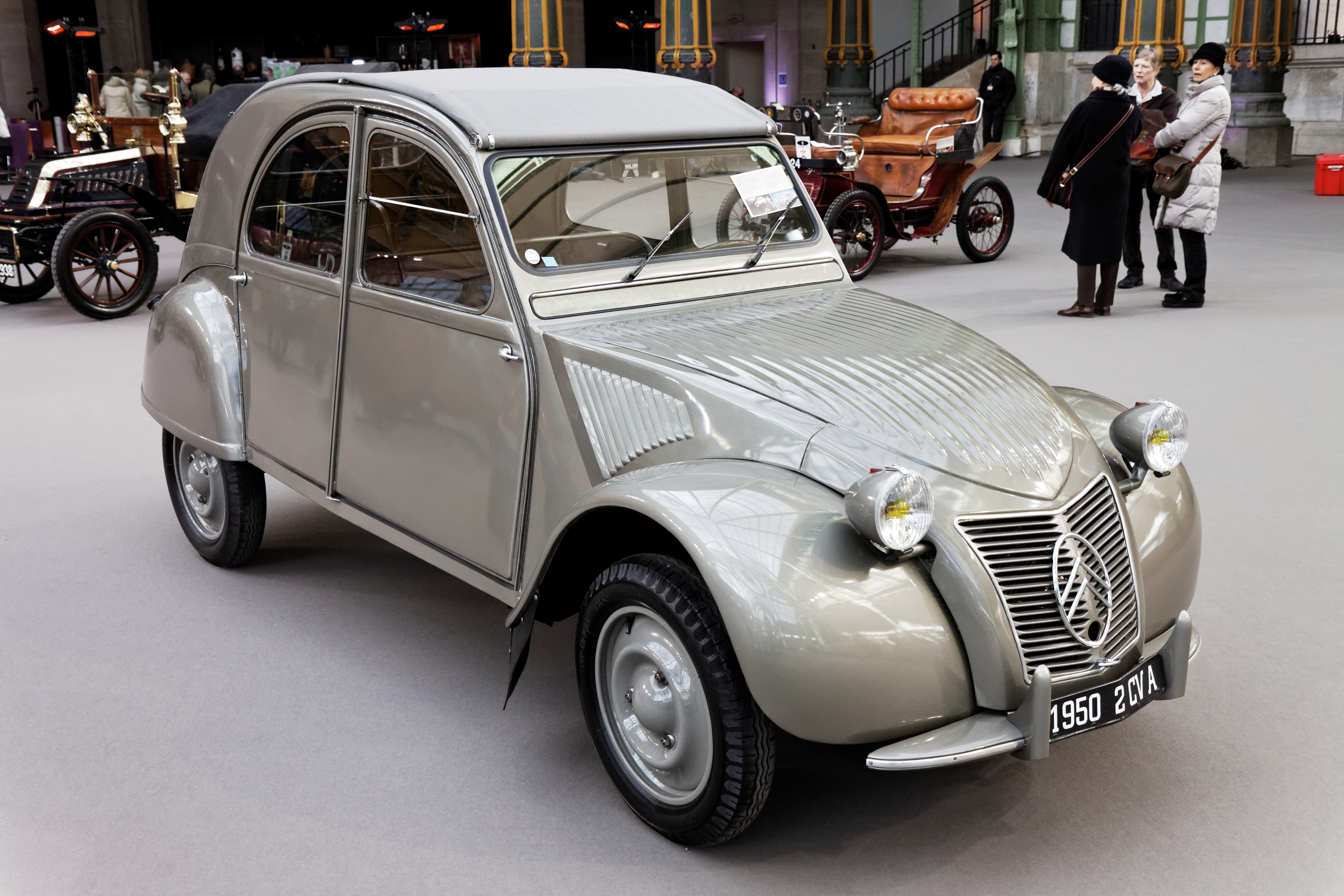
Citroën 2CV
by Citroën
"The 'umbrella on wheels' that motorized France"
Rating
4.5/5
Overview
The Citroën 2CV, pronounced "deux chevaux" (French for "two horses," a nod to its tiny tax horsepower rating), rolled out of the 1948 Paris Salon de l'Automobile and stayed in production until 1990. It was the brainchild of Citroën Vice-President Pierre Boulanger, who wanted to motorize the French countryside, where farmers still relied on horses and carts. The result was a car that combined ingenious engineering with stark, utilitarian simplicity: an air-cooled, front-mounted engine driving the front wheels, with a suspension so soft it could cross a plowed field without breaking eggs in a basket on the passenger seat.
The 2CV was famously dubbed "an umbrella on wheels" for its canvas roll-back sunroof that extended nearly to the rear bumper in early models, and it was the first car to feature Michelin's revolutionary radial tires. Over its 42-year run, more than 3.8 million 2CVs were built, making it the world's first front-wheel-drive car to sell over a million units. Its platform spawned a family of vehicles known as the A-Series, including the Ami, Dyane, Acadiane, Mehari, and the fourgonnette delivery vans. Combined, these derivatives pushed total production past 9 million.
Critics and enthusiasts alike have praised the 2CV's originality and rationality. A 1953 Autocar review called it "the most original since the Model T Ford," and writer L.J.K. Setright lauded it as "the most intelligent application of minimalism ever to succeed as a car." Its parallels with the Volkswagen Beetle are striking: both were conceived in the 1930s to make cars affordable to the masses, both featured air-cooled boxer engines and a 2,400 mm wheelbase, and both remained in production for over four decades with minimal changes. A prototype 2CV 2000 was developed in the late 1990s but never reached production.
Key Features
- Canvas roll-back sunroof
- Soft suspension for rough terrain
- First car with Michelin radial tires
- Air-cooled boxer engine
- Front-wheel drive
- Minimalist, utilitarian design
Specifications
| Engine | Air-cooled, two-cylinder boxer |
| Drivetrain | Front-engine, front-wheel drive |
| Wheelbase | 2,400 mm |
| Top speed | 65-75 mph depending on model year |
| Production years | 1948-1990 |
| Total built | Over 3.8 million (2CV alone) |
Pros & Cons
Pros
- • Exceptional fuel economy
- • Simple and reliable mechanics
- • Unique character and cultural significance
- • Spacious interior for its size
Cons
- • Very slow acceleration and low top speed
- • Basic safety features by modern standards
- • Minimal comfort and noise insulation
- • Canvas roof can leak if not maintained
Frequently Asked Questions
How much is a Citroën 2CV worth?
Is the Citroën 2CV a good car to buy?
What is the Citroën 2CV's top speed and fuel economy?
When was the Citroën 2CV released?
How does the Citroën 2CV compare to the Volkswagen Beetle?
Keywords
Sources
Product Info
- Brand
- Citroën
- Category
- Economy car
- Released
- 1948-10-06
- Price
- $4,000 - $23,000 (classic market)
- Availability
- Discontinued
- Manufacturer
- Citroën
- Production
- 1948-1990
- Units built
- 3.8 million (2CV alone)
- Designer
- Pierre Boulanger (concept)
- Engine
- Air-cooled, two-cylinder boxer
- Drivetrain
- Front-engine, front-wheel drive
Join the community
fans discussing