 United States
“Citizen Kane is more than a great movie; it is a gathering of all the lessons of the emerging era of sound, just as Birth of a Nation assembled everything that was known about the movies up to that time.”
Roger Ebert
RogerEbert.com
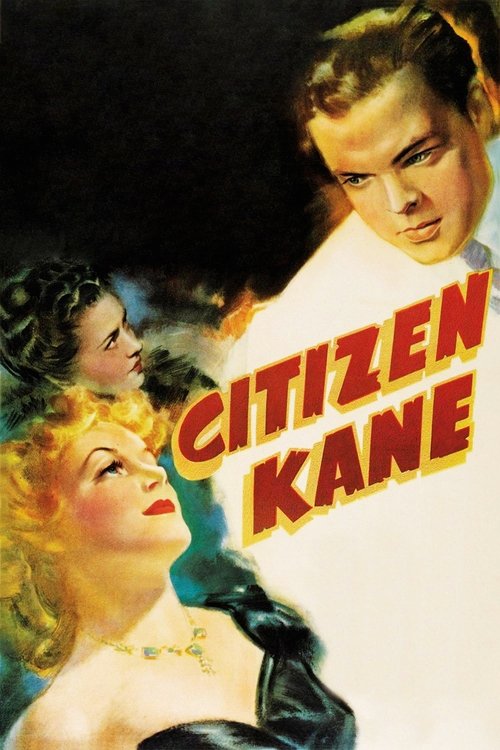
In 1941, a 25-year-old Orson Welles walked into RKO Studios with a contract that gave him unprecedented creative control. The result was Citizen Kane, a film that would redefine what cinema could do. It opens with the death of Charles Foster Kane, a publishing magnate and art collector, whose final whisper is the cryptic word "Rosebud." A newsreel obituary sketches his public life, but a reporter, Jerry Thompson, digs deeper, interviewing the people who knew Kane best. What emerges is a fragmented portrait of a man who built an empire yet died alone in his sprawling Florida estate, Xanadu.
Welles directed, co-wrote, and starred as Kane, tracking the character from idealistic young publisher to embittered recluse. The cast includes Joseph Cotten as his loyal friend Jedediah Leland, Dorothy Comingore as his second wife Susan Alexander, and Agnes Moorehead in a brief, haunting turn as Kane's mother. Shot by Gregg Toland with deep-focus cinematography that keeps foreground and background equally sharp, the film broke technical ground. Bernard Herrmann's score, his first for film, added an eerie, emotional weight. Produced by Mercury Productions and RKO on a budget of $839,727, it grossed only about $2.3 million initially, but its reputation has grown ever since.
William Randolph Hearst, the real-life newspaper baron on whom Kane was loosely based, tried to suppress the film. He banned advertising in his papers and pressured theaters not to screen it. Despite that, Citizen Kane earned nine Oscar nominations and won for Best Original Screenplay. Over the decades, it has topped countless polls, including the Sight & Sound critics' list from 1962 through 2012. It's a movie that keeps revealing new layers, whether you're watching for the first time or the fiftieth.
Availability and pricing can change. Confirm on the provider's site before purchasing.
Citizen Kane begins with a series of dissolves over the colossal Xanadu estate, where the elderly Charles Foster Kane dies alone in his cluttered mansion. His last word is "Rosebud," whispered as a snow globe slips from his hand and shatters. A newsreel, "News on the March," then offers a sweeping obituary: Kane's rise from poverty to become one of America's wealthiest men, his newspaper empire, his failed marriage to the President's niece, his doomed political campaign, and his scandalous second marriage to an aspiring singer, Susan Alexander. The newsreel notes that Kane's death barely made the papers, and it raises the question: what did "Rosebud" mean?
Reporter Jerry Thompson is assigned to find out. His investigation leads him through a series of interviews, each offering a different slice of Kane's life. First, he reads the memoirs of Walter Parks Thatcher, the banker who became Kane's guardian. Thatcher's account reveals Kane's childhood: in 1871, young Charles is taken from his mother in Colorado after she inherits a supposedly worthless gold mine that turns out to be one of the richest claims in the world. She sends him East with Thatcher to be raised in wealth, a decision that shapes his entire life. Thatcher's diary also recounts Kane's purchase of the failing New York Inquirer at age 25, where he publishes a "Declaration of Principles" promising to tell the truth and serve the public interest.
Next, Thompson visits Mr. Bernstein, Kane's former business manager, now in his 70s. Bernstein offers a warmer view of the young Kane, describing his energy, his rivalry with the Chronicle, and his hiring of talent like the idealistic drama critic Jedediah Leland. Bernstein recounts Kane's courtship and marriage to Emily Norton, the President's niece, and the gradual erosion of their relationship, shown in a famous montage of breakfast scenes where the couple's intimacy fades over the years. Bernstein also mentions Kane's affair with Susan Alexander, which leads to his political downfall when his opponent, Jim Gettys, threatens to expose it. Kane refuses to drop out of the gubernatorial race and loses in a landslide; Emily divorces him.
Thompson then talks to Jedediah Leland, now a frail, bitter man in a nursing home. Leland offers the harshest critique, calling Kane a man who loved only himself. He describes Kane's second marriage to Susan and his disastrous attempt to force her into an opera career, building her an opera house and using his papers to manufacture her success. Leland, assigned to review Susan's Chicago debut, writes a scathing review instead and is fired by Kane, though Kane, in a rare moment of guilt, finishes the review himself and prints it. Leland tells Thompson that Kane "got everything he wanted and then lost everything he had," and that the only thing he truly lost was his childhood.
Thompson's final interviews are with Susan Alexander Kane herself, now an alcoholic nightclub singer, and with Kane's butler, Raymond. Susan describes her misery at Xanadu, where Kane kept her isolated and bored, filling her room with jigsaw puzzles. After her suicide attempt, she finally leaves him, telling him, "He never gave me anything he wanted to give me, he gave me everything I didn't want." Raymond offers only a glimpse of Kane's final years of loneliness and his violent destruction of Susan's room after she left, during which he picked up a snow globe and whispered "Rosebud." Thompson concludes that he cannot solve the mystery, remarking that "Rosebud" might be "a piece of a jigsaw puzzle, a missing piece." The audience, however, sees the answer: as workers burn Kane's discarded possessions in a furnace, a child's sled with "Rosebud" painted on it is consumed by the flames, the sled from Kane's beloved childhood in Colorado, symbolizing the innocence and love he lost when he was taken from his mother.
CITIZEN KANE ('41) - Original Trailer
75th Anniversary Trailer
Original Theatrical Trailer
Critical Consensus
Citizen Kane is universally regarded as one of the greatest films ever made, a groundbreaking work that revolutionized cinematic storytelling through its innovative use of deep focus photography, non-linear narrative structure, and subjective point-of-view. Its exploration of power, memory, and the impossibility of truly knowing another person remains as fresh and relevant today as it was in 1941, cementing its status as a masterpiece of American cinema.
“Citizen Kane is more than a great movie; it is a gathering of all the lessons of the emerging era of sound, just as Birth of a Nation assembled everything that was known about the movies up to that time.”
Roger Ebert
RogerEbert.com
“Citizen Kane is perhaps the only American movie that can be called both a great movie and a great work of art, a film that is simultaneously a masterpiece of entertainment and a profound meditation on American life.”
Pauline Kael
The New Yorker
“It is a film of extraordinary originality and power, a work that employs the motion picture medium with a virtuosity that leaves the spectator breathless with admiration.”
Bosley Crowther
The New York Times
“Orson Welles has turned out a picture that is fresh, original and exciting, a motion picture that will be talked about for years to come.”
Variety Staff
Variety
“Citizen Kane remains the great American film, a work of staggering technical brilliance and emotional depth that has never been surpassed.”
Peter Bradshaw
The Guardian
Orson Welles
Charles Foster Kane
Joseph Cotten
Jedediah Leland
Dorothy Comingore
Susan Alexander Kane
Director
Orson Welles
Writers
Orson Welles, Herman J. Mankiewicz
Composer
Bernard Herrmann
Cinematographer
Gregg Toland
Producer
Orson Welles
Academy Awards (1942)
Best Original Screenplay: Won
Academy Awards (1942)
Best Picture: Nominated
Academy Awards (1942)
Best Director: Nominated
Academy Awards (1942)
Best Actor: Nominated
National Board of Review (1941)
Top Ten Films: Won
New York Film Critics Circle (1941)
Best Film: Won
Venice Film Festival (1947)
Grand International Prize: Won
Sight & Sound Poll (2012)
Greatest Film of All Time: Won
AFI 100 Years...100 Movies (2007)
Greatest American Film: Won
National Film Registry (1989)
Preserved: Won
Join the community
fans discussing