 Palestine
About
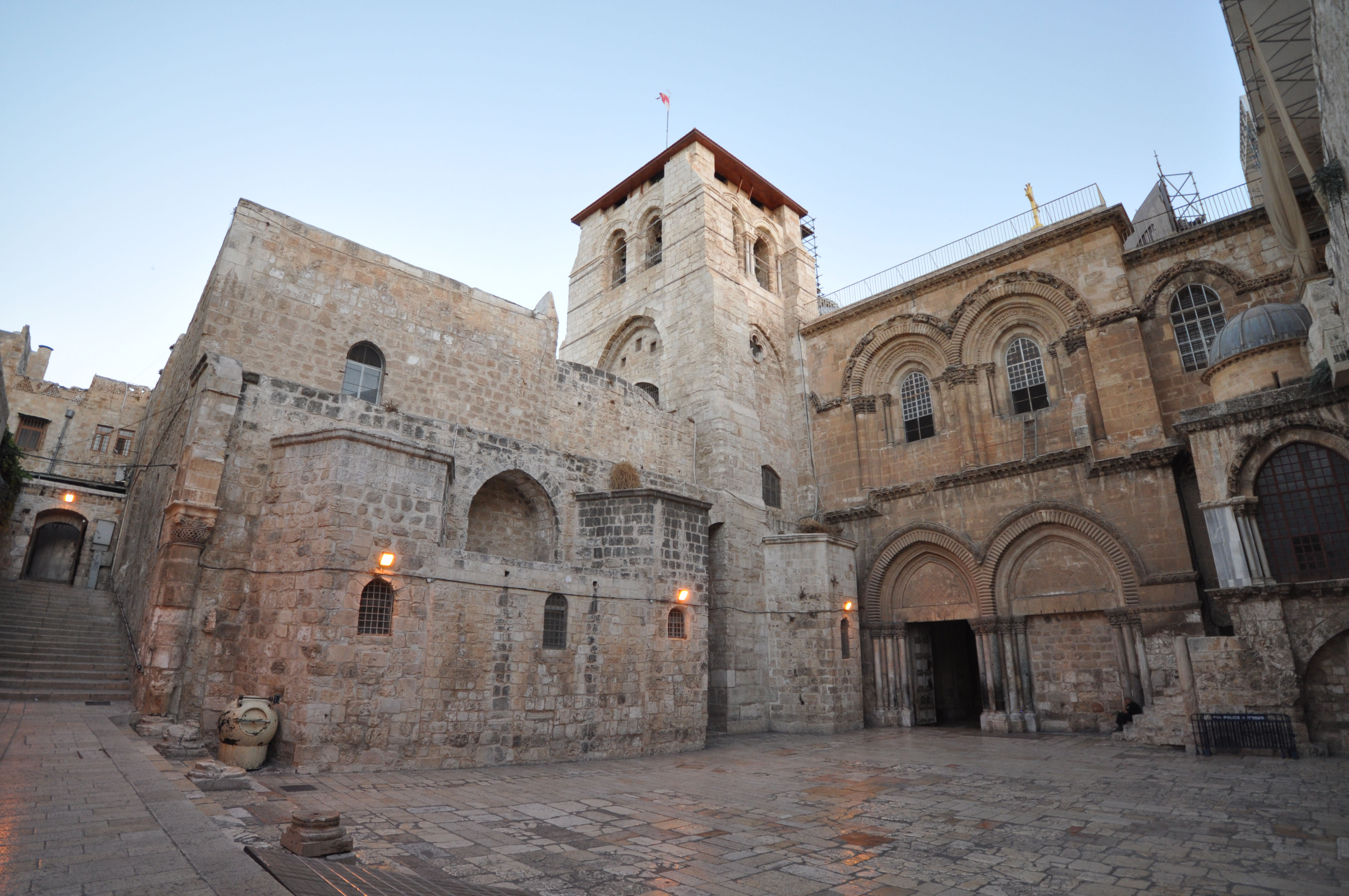
The Church of the Holy Sepulchre, also known as the Church of the Resurrection (Anastasis in Greek), stands in the Christian Quarter of Jerusalem's Old City. It is venerated as the holiest site in Christianity, built upon the traditional locations of Jesus's crucifixion (Golgotha), burial, and resurrection. The church is not a single corporate entity but a shared sacred space administered jointly by several Christian denominations, primarily the Greek Orthodox Patriarchate of Jerusalem, the Armenian Patriarchate of Jerusalem, and the Roman Catholic Church, represented by the Latin Patriarchate of Jerusalem and the Franciscan Custody of the Holy Land. Smaller rights are held by the Coptic Orthodox, Syriac Orthodox, and Ethiopian Orthodox churches.
The church's origins trace to the early fourth century. Following the legalization of Christianity under Emperor Constantine the Great, his mother, Helena Augusta, identified the site as Golgotha around 326 CE. Constantine commissioned a basilica at the location, and the original structure was consecrated in 335 CE. The original Constantinian complex consisted of a basilica, the Rotunda of the Anastasis enclosing the tomb, and an inner courtyard encompassing the rock of Calvary. This structure was destroyed by Persian forces in 614 CE, rebuilt, then destroyed again by the Fatimid Caliph al-Hakim in 1009 CE. The current structure largely dates from the Crusader period of the 12th century, when the Crusaders rebuilt and consolidated the various shrines under one roof. Major renovations have followed, most notably the restoration of the Edicule, the shrine over the tomb, completed in 2017.
As a living church, it functions as a place of worship, pilgrimage, and veneration. Daily liturgies are conducted by the various denominations, and it serves as the focal point for major Christian celebrations, particularly the Holy Fire ceremony on Holy Saturday, which draws thousands of Orthodox worshippers. The church's complex shared governance is a case study in religious coexistence and conflict, governed by the Status Quo, an 1852 Ottoman decree that codified the rights and privileges of the Christian communities. The church is part of the Old City of Jerusalem, a UNESCO World Heritage Site inscribed in 1981.
Mission
The church's primary mission is to serve as a place of worship, pilgrimage, and veneration of the central events of the Christian faith: the Passion, Crucifixion, and Resurrection of Jesus Christ. It aims to preserve the sacred sites and maintain the daily liturgical life of the Christian communities in Jerusalem, while also welcoming millions of pilgrims and visitors from around the world. The church is dedicated to fostering interdenominational cooperation under the Status Quo, ensuring that all recognized Christian traditions can worship at the site according to their ancient rites.
History
The church's history begins in the early fourth century. After the legalization of Christianity, Emperor Constantine I sent his mother, Helena, to Jerusalem, where she identified the site of Golgotha and the tomb. Construction began around 326 CE, and the church was consecrated on September 13, 335 CE. The original complex included a basilica, the Rotunda of the Anastasis, and a courtyard with the rock of Calvary. This structure stood for nearly three centuries until Persian invaders destroyed it in 614 CE. Byzantine Emperor Heraclius rebuilt it in 630 CE, but the Fatimid Caliph al-Hakim ordered its destruction in 1009 CE, a blow that reduced the church to ruins.
The current building is largely the work of the Crusaders. After capturing Jerusalem in 1099, they undertook a massive reconstruction, consolidating the separate shrines under a single roof. The Crusader church was consecrated in 1149 and has since undergone numerous repairs and modifications. One of the most significant recent events was the restoration of the Edicule, the shrine over the tomb, which was completed in 2017 after a $4 million project led by a team from the National Technical University of Athens. The restoration addressed structural damage from an earthquake in 1927 and years of exposure to moisture and candle smoke.
Throughout its history, the church has been a flashpoint for interdenominational tensions. The Status Quo, a decree issued by Ottoman Sultan Abdülmecid I in 1852, established the rights of the Greek Orthodox, Armenian, and Catholic communities, with smaller privileges for the Coptic, Syriac, and Ethiopian churches. This agreement remains in force today, governing everything from the timing of services to the maintenance of specific chapels. Disputes have occasionally erupted, including the famous 'Immovable Ladder' incident, where a wooden ladder placed under a window in the 18th century has remained in place because no community agrees to remove it.
Subdivisions
Edicule
The shrine enclosing the tomb of Jesus, restored in 2017.
Rotunda of the Anastasis
The large circular hall housing the Edicule.
Catholicon
The main Greek Orthodox cathedral within the church.
Chapel of the Finding of the True Cross
Catholic chapel commemorating the discovery of the True Cross by Helena.
Chapel of Saint Helena
Armenian chapel dedicated to Saint Helena.
Chapel of the Ascension
Ethiopian chapel located on the roof.
Notable People
Constantine the Great
Founder · 306-337
Commissioned the original church
Helena Augusta
Founder · c. 326
Identified the site as Golgotha
Theophilos III
Greek Orthodox Patriarch of Jerusalem · 2005-present
Current Greek Orthodox Patriarch
Nourhan Manougian
Armenian Patriarch of Jerusalem · 2013-present
Current Armenian Patriarch
Pierbattista Pizzaballa
Latin Patriarch of Jerusalem · 2016-present
Current Latin Patriarch
Francesco Patton
Custos of the Holy Land · 2016-present
Franciscan custodian representing Catholic interests
Milestones
326
Helena identifies the site; construction begins under Constantine.
335
Church consecrated.
614
Destroyed by Persian invaders.
630
Rebuilt by Byzantine Emperor Heraclius.
1009
Destroyed by Caliph al-Hakim.
1149
Crusader reconstruction consecrated.
1852
Status Quo agreement formalized by Ottoman decree.
1927
Damaged by an earthquake.
2017
Restoration of the Edicule completed.
2026
Three-day closure and clergy access disputes with Israeli authorities.
Departments
Sources
Organization Info
- Founded
- 335
- Headquarters
- Christian Quarter, Old City, Jerusalem
- Country
- Israel, Palestine
- Type
- Religious
- Founder
- Constantine the Great, Helena Augusta
- Denominations
- Greek Orthodox, Armenian Apostolic, Roman Catholic, Coptic Orthodox, Syriac Orthodox, Ethiopian Orthodox
Join the community
fans discussing