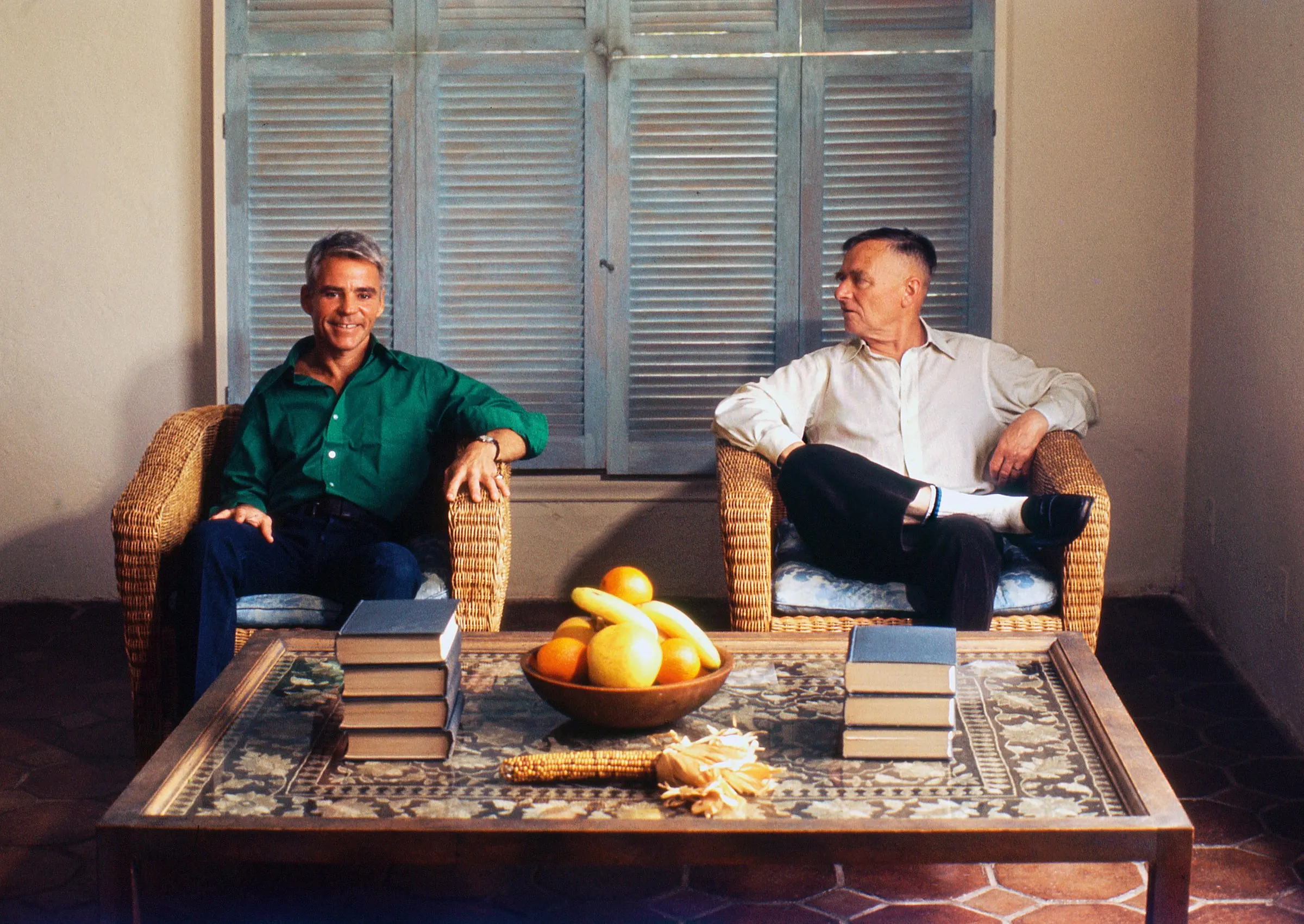
Christopher Isherwood
 United Kingdom
Also known as: Christopher Bradshaw Isherwood, Christopher William Bradshaw Isherwood
Birthday
August 26, 1904
Birth Sign
Virgo
Birthplace
High Lane, Cheshire, England
Age
Died at 81
Height
6 ft 1 in (185 cm)
About
Christopher Isherwood was an English novelist, playwright, screenwriter and memoirist who became an American citizen in 1946 and spent the second half of his life in California. He is best known for Goodbye to Berlin (1939), the sketches of Weimar-era Berlin that eventually became the musical and film Cabaret, and for A Single Man (1964), a short novel about a grieving gay professor in Los Angeles that Tom Ford adapted for the screen in 2009.
His standing rests on more than those two books. The Berlin stories gave English literature one of its most quoted openings, and the 1976 memoir Christopher and His Kind rewrote his own early life with a frankness that made him a figurehead, however uneasy, for the gay liberation movement of the 1970s. He wrote or co-wrote screenplays for more than a dozen Hollywood films, translated Hindu scriptures with Swami Prabhavananda, and kept diaries for most of his adult life that run to several published volumes.
He died in Santa Monica in 1986. His partner Don Bachardy, a painter 30 years his junior, survived him and has managed the literary estate since.
Early Life & Background
Christopher William Bradshaw Isherwood was born on 26 August 1904 at Wyberslegh Hall in High Lane, Cheshire, into a landed gentry family with a long pedigree and a shrinking income. His father, Frank Bradshaw Isherwood, was a career soldier; his mother, Kathleen Machell Smith, kept illustrated diaries that were published and exhibited as recently as 2025. The family seat was Marple Hall, a decaying ancestral house in Derbyshire that gave the boy an early and lasting sense of class, decline and inherited property going quietly to seed.
Frank Isherwood was killed in action in 1915, during the First World War. The death runs underneath much of the autobiographical writing, though Isherwood rarely treated it directly.
He was sent to Repton School and then to Corpus Christi College, Cambridge, where he met W. H. Auden and Cecil Day-Lewis and fell in with the group of young writers who would dominate English letters for the next two decades. He left Cambridge in 1925 without taking a degree. At 21 he had already written a novel that his biographers describe as two novels uneasily joined, a realistic narrative embedded in a great deal of fancy. It went unpublished. He took work as a tutor, wrote reviews, and finished a first published novel, All the Conspirators, which appeared in 1928. The Memorial followed in 1932.
The decisive turn came in 1929, when he went to Berlin to teach English. He arrived in the last years of the Weimar Republic and moved through the city's gay subculture with a freedom he had never had in England: transvestite bars, working-class neighbourhoods, rented rooms, landlords and landladies, and a circle of friends who would later be transcribed almost directly into prose. He left Germany in 1933, shortly after Hitler came to power, and spent the next several years travelling through Europe with Heinz Neddermeyer, a young German he had met in Berlin in 1932. Neddermeyer's repeated failures to obtain residency papers kept the couple moving from country to country until the relationship ended in the late 1930s.
Career Growth
The Berlin sketches, collected as Goodbye to Berlin in 1939, made his name. John Van Druten turned them into the play I Am a Camera in 1951, which in turn became the stage musical Cabaret in 1966 and Bob Fosse's film of the same title in 1972. Isherwood's characters, the Landauers, Sally Bowles and Fräulein Schroeder, passed into popular culture by way of a route he never entirely controlled.
He emigrated to the United States in 1939 and settled in California. Screenwriting paid the bills for three decades: A Woman's Face (1941), The Loved One (1965) with Tony Richardson, The Charge of the Light Brigade (1968), also with Richardson, and Cabaret (1972), for which he was nominated for an Academy Award for Best Adapted Screenplay. He was candid about the compromises of studio work, a subject the Los Angeles Times returned to in a 2015 piece on the sadness of the screenwriter.
The novels continued alongside. Prater Violet (1945) drew on his experience of making a British film in wartime London. Down There on a Visit (1962) revisited the European years. A Single Man (1964), written in a spare, exact prose he had not attempted before, followed one day in the life of George, a gay English professor in Los Angeles grieving his dead partner. A Meeting by the River (1967) and the later work turned increasingly towards his Vedantist beliefs. He translated the Bhagavad Gita and other Hindu scriptures with Swami Prabhavananda, whose follower he became, and wrote a biography of Ramakrishna.
The 1976 memoir Christopher and His Kind marked a second arrival. It revisited the Berlin years and the Neddermeyer affair with a directness the earlier books had only implied, naming names and stating plainly what had previously been coded. It placed him at the centre of the emerging gay liberation movement and remains the book most often recommended to readers who want the unvarnished version of his life.
Career Timeline
Public Image & Style
Tall, lean and donnish, with a long face and a watchful manner, Isherwood presented himself in public as the cool English observer: ironic, self-deprecating, allergic to fuss. The camera metaphor stuck because it fit the persona so well, and he did little to discourage it. In interviews he was precise, funny in a dry way, and noticeably reluctant to claim importance for his own work.
The later image, from the 1970s onward, was the wise elder of American gay letters: the Hollywood screenwriter who meditated twice a day, translated the Gita and had once known Berlin when Berlin was still Weimar. Photographs from that period usually show him in a plain shirt and jacket, often beside Bachardy, often being drawn.
He had no interest in publicity machinery and no social media, for the obvious reason that he died in 1986. His cultural presence now runs through the books, the adaptations, the archive at the Huntington and the Hockney and Bachardy portraits.
Fame & Fandom (iFAMOUS Rankings)
iFANN has not yet collected fame data for Christopher Isherwood, so no ranking is offered here. He is not on the September 2026 iFAMOUS Rankings flagship list. Forty years after his death, his reputation rests on a small shelf of books, one very famous adaptation and a long record of influence rather than on measurable attention.
The audience is real but has no formal name and no organised structure. It divides roughly into three groups. There are the readers who come through Cabaret, expecting Sally Bowles and finding instead the Landauers, Fräulein Schroeder and a narrator who insists he is only recording. There are the gay readers for whom A Single Man and Christopher and His Kind are foundational texts, and who tend to recommend the memoir first and the Berlin stories second. And there are the literary historians, who work through the diaries, the letters and the Auden circle and treat him as a central rather than peripheral figure of the 1930s.
The fan activity around him is archival rather than organised: reading groups that work through the diaries volume by volume, academic conferences, and the steady traffic to the Huntington Library's Isherwood-Bachardy collection. The 2018 Metropolitan Museum exhibition of the love letters, the 2024 Huntington programme In Isherwood's Footsteps, and the reappraisals in the London Review of Books and the LA Review of Books have kept the conversation going. Fans still argue about how much of Sally Bowles was Jean Ross, and Isherwood's own answer, that she was a composite, has never quite settled it.
Interesting Facts and Legends
The opening of Goodbye to Berlin is the line readers quote first: "I am a camera with its shutter open, quite passive, recording, not thinking." It has been borrowed so often that the original context, a notebook entry by the narrator, is usually forgotten.
Sally Bowles has been identified by fans and biographers with the cabaret singer Jean Ross, but Isherwood always maintained the character was a composite. The 1972 film pushed the composite much further from the source, a fact that still surprises newcomers who come to the book through Cabaret.
He and Don Bachardy used private nicknames, cat and horse, and drew each other constantly; when they were apart they exchanged drawings by post as a daily record. Bachardy's pencil portraits of Isherwood number in the hundreds.
David Hockney painted him more than once. A Hockney portrait featuring Isherwood went to Christie's New York in a 2025 sale.
He was a pacifist during the Second World War and registered as such after reaching the United States, a position that cost him some English friendships. He became a US citizen in 1946.
Notable Quotes
“I am a camera with its shutter open, quite passive, recording, not thinking.”
“I am a born foreigner.”
“I am a camera with its shutter open.”
Family & Personal Life
Isherwood's father, Frank Bradshaw Isherwood, was a professional soldier from a long-established Cheshire family; he was killed in action in 1915, when Christopher was ten. His mother, Kathleen Machell Smith, outlived her husband by decades and kept illustrated diaries that were later published and exhibited. The ancestral home, Marple Hall, was sold and eventually demolished, and its decline left a mark on his sense of what inherited property is worth.
He had no children. His household in later life was the house on Adelaide Drive in Santa Monica that he shared with Don Bachardy from the 1950s onward, and the two men lived openly as a couple at a time when very few public figures did. Bachardy's family, including his brother, the writer and illustrator, became part of the extended household.
He was close to his brother Richard, who predeceased him, and to a wide circle of friends who functioned as family: Auden, Spender, Forster, the swami and the monks at the Vedanta Society, and the painters and writers who passed through Santa Monica. He left the bulk of his estate to Bachardy.
Notable Connections
W. H. Auden, his closest friend from Cambridge and collaborator on the plays The Dog Beneath the Skin and The Ascent of F6. Stephen Spender and Cecil Day-Lewis, from the same Cambridge circle. E. M. Forster, mentor and friend. Don Bachardy, his partner from 1953. Heinz Neddermeyer, his companion through the European years. Tony Richardson, with whom he wrote two screenplays. Swami Prabhavananda, his teacher and co-translator. David Hockney, who painted him.
Relationships & Dating History
Isherwood's early romantic life included an affair in the 1920s with the singer Olive Mangeot, one of the few relationships from that period that has been documented in any detail. It ended before the Berlin years.
The Berlin period brought the relationship that shaped the next decade. He met Heinz Neddermeyer, a young German, in 1932, and the two left Germany together in 1933. For roughly five years they moved through Europe, driven from one country to the next by Neddermeyer's repeated failure to secure residency papers. The relationship ended in the late 1930s, and Neddermeyer's fate during the war remained a source of distress to Isherwood for the rest of his life.
In 1953, on Santa Monica beach, he met Don Bachardy, then 18; Isherwood was 48. The age gap drew comment even among friends, and the relationship outlasted the comment. They were together for 33 years, until Isherwood's death in 1986, and lived openly as a couple at a time when almost no public figure did. Their letters and drawings were exhibited at the Metropolitan Museum of Art in 2018, and Bachardy has described the relationship at length in interviews.
Isherwood was married to no one and had no children. At the time of his death he was partnered with Bachardy, who was with him at the end and who inherited the estate.
- DatedOlive Mangeot1920 - 1928A youthful affair with the singer, conducted in the 1920s before the Berlin years.
- DatedHeinz Neddermeyer1932 - 1937Met in Berlin in 1932; the couple travelled Europe until residency papers repeatedly failed and the relationship ended.
- DatedDon Bachardy1953 - 1986Met on Santa Monica beach when Bachardy was 18; together 33 years until Isherwood's death, and Bachardy inherited the estate.
Death & Aftermath
Died
January 4, 1986 (aged 81)
Death Place
Santa Monica, California, United States
Cause of Death
Prostate cancer
Isherwood died at his home in Santa Monica on 4 January 1986, aged 81. The cause was prostate cancer. Don Bachardy, his partner of 33 years, was with him at the end.
He had spent his last years in declining health but kept working: the diaries continued, the correspondence with old friends continued, and Bachardy drew him repeatedly in those final months, as he had drawn him since 1953. The household on Adelaide Drive, which had been a gathering point for writers, painters and Vedantist friends for three decades, closed quietly.
Tributes came from the literary press and from the gay community he had, somewhat reluctantly, come to represent. Christopher and His Kind (1976) had already made him a reference point for a generation of gay readers, and his death was reported in that light: as the loss of a writer who had recorded the Weimar years while they were happening and then, four decades later, told the truth about what he had recorded. The Los Angeles Times and the British papers ran appreciations that stressed the double life, the Berlin sketches and the Hollywood years, and the Cabaret connection, which by then had made him far better known than any of his novels.
Bachardy inherited the bulk of the estate and has managed it since, overseeing reissues, the publication of the diaries and letters, and the placement of the papers with institutions. The Isherwood-Bachardy archive sits at the Huntington Library in San Marino, which drew on it for the 2024 programme In Isherwood's Footsteps. The love letters between the two men were exhibited at the Metropolitan Museum of Art in 2018. Bachardy has spent four decades as the executor of the literary legacy, and the posthumous publications, including the unabridged diaries, have steadily enlarged the record of a career that Isherwood himself tended to describe in modest terms.
Net Worth (Estate Value)
$4 Million
iFANN Editorial Team estimate
The iFANN Editorial Team's reading of the available material puts Christopher Isherwood's estate at roughly $4 million as of 2026. The figure is an estimate, not an audited account; estates of literary figures are rarely itemised in public, and the aggregator numbers that exist for him are thin and inconsistent.
The revenue streams are reasonably clear even where the amounts are not. Royalties from Goodbye to Berlin and the Berlin stories continue, and the Cabaret connection generates a share of licensing income through the underlying material, though the film and stage musical rights have long been held and administered through other parties. A Single Man had a second commercial life after Tom Ford's 2009 adaptation, which lifted sales of the novel considerably and brought a film option payment. The diaries, letters and posthumous volumes, edited and introduced by Katherine Bucknell among others, sell steadily to a literary audience rather than a mass one.
The archive itself carries value as an asset. The Isherwood-Bachardy papers at the Huntington Library were placed rather than sold outright, and the correspondence and drawings that remain in the estate have been loaned for exhibitions at the Metropolitan Museum of Art and elsewhere. Bachardy, as executor, has managed the estate since 1986 and has been the decisive hand in what has been published and when.
Isherwood earned well during his Hollywood years by the standards of a working screenwriter, but he was not a wealthy man at his death, and the estate has grown slowly through royalties and rights rather than through any single windfall.
Awards Won (1)
Isherwood's trophy shelf was modest relative to his influence. He received the Brandeis University Creative Arts Award in 1979 and was elected a Fellow of the Royal Society of Literature. His Academy Award for the Cabaret screenplay was a nomination, not a win, and no competitive Oscar, BAFTA or Tony is documented.
1979 · Creative Arts
Lifetime literary achievement
Known For
Goodbye to Berlin
1939 · Author
A Single Man
1964 · Author
Cabaret
1972 · Screenwriter (source material)
Christopher and His Kind
1976 · Author
The Charge of the Light Brigade
1968 · Screenwriter
The Loved One
1965 · Screenwriter
Keywords
Sources
Quick Facts
- Profession
- writer, screenwriter, novelist
- Born
- August 26, 1904
- Birthplace
- High Lane, Cheshire, England
- Died
- January 4, 1986
- Death Place
- Santa Monica, California
- Cause of Death
- Prostate cancer
- Gender
- Male
- Birth Sign
- Virgo
- Height
- 6 ft 1 in (185 cm)
- Citizenship
- British; naturalised American, 1946
Personal Details
- Full Name
- Christopher William Bradshaw Isherwood
- Height
- 6 ft 1 in (185 cm)
- Children
- None
- Education
- Repton School; Corpus Christi College, Cambridge (left without a degree, 1925)
Filmography
14
Total
12
Film
2
TV
Frequently Asked Questions
Is Cabaret based on Christopher Isherwood?
Who was Christopher Isherwood's partner?
How did Christopher Isherwood die?
What is Christopher Isherwood best known for?
What is Christopher Isherwood's estate worth in 2026?
Similar People
Join the community
fans discussing