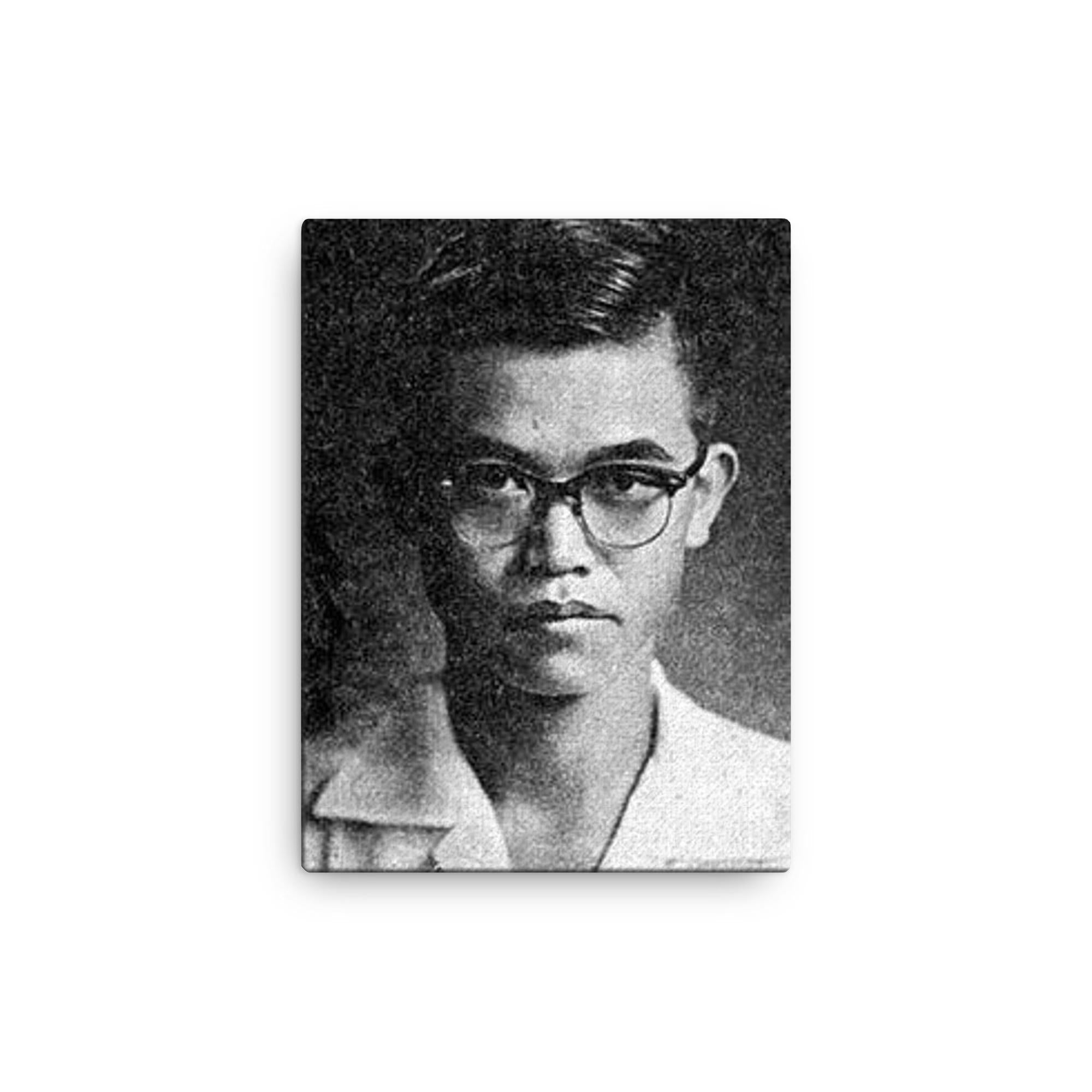
Chit Phumisak
 Thailand
historian•poet•philologist•revolutionary
Also known as: Jit Poumisak, Somsamai Sisutphan, Kawi Kanmueang, Kawi Si Sayam
Birthday
September 25, 1930
Birth Sign
Libra
Birthplace
Prachantakham, Prachinburi Province, Thailand
Age
Died at 35
About
Chit Phumisak was a Thai Marxist historian, poet, philologist, and revolutionary, often called the "Che Guevara of Thailand." He is best known for his book Chomna Sakdina Thai (The Real Face of Thai Feudalism), a searing class analysis that became a foundational text for Thai leftists. His work combined rigorous scholarship with radical activism, and his poetry and songs carried revolutionary messages to rural audiences.
Chit's life was cut short on May 5, 1966, when he was shot dead by government forces in Sakon Nakhon Province at age 35. Though he died young, his ideas were rediscovered after the 14 October 1973 movement and have since inspired generations of activists and scholars. His legacy endures as a symbol of intellectual resistance and a touchstone for progressive thought in Southeast Asia.
Early Life & Background
Chit Phumisak was born Somchit Phumisak on September 25, 1930, in Prachantakham, a small town in Prachinburi Province in eastern Thailand. He grew up in poverty, the son of Siri Phumisak and Saeng-ngoen Chayawong. From an early age, he showed a sharp intellect and a deep curiosity about language and history.
He attended Visuttharangsi School and Triam Udom Suksa School in Bangkok, where his academic talents stood out. He went on to study philology and history at Chulalongkorn University, graduating with a bachelor's degree in philology. It was during his student years that he was first exposed to Marxism, which would shape his entire worldview.
In 1953, while still a student, Chit was hired by the U.S. embassy to assist American linguist William J. Gedney in translating The Communist Manifesto into Thai. The U.S. government hoped the translation would scare the Thai government into cracking down on communism, but for Chit, the project had the opposite effect: it deepened his commitment to Marxist ideas and set him on a path of intellectual and political rebellion.
Career Growth
Chit Phumisak's breakthrough came in 1957 with the publication of Chomna Sakdina Thai (The Real Face of Thai Feudalism), written under the pseudonym Somsamai Sisutphan. The book offered a Marxist analysis of Thai feudalism, arguing that the traditional sakdina system shaped everything from language to social hierarchy. It was swiftly banned, and Chit was arrested later that year, accused of being a communist.
He spent six years in prison alongside other dissidents. After being declared not guilty, he was released in 1963. In 1965, he joined the Communist Party of Thailand and went into hiding in the Phu Phan mountains. There, he continued to write influential books on Thai politics, society, and religion under various pseudonyms, and composed revolutionary songs set to folk melodies.
Chit was killed on May 5, 1966, in Sakon Nakhon Province, shot by government forces. His work was rediscovered after the 14 October 1973 movement, and he became a cultural hero for young activists. Posthumous publications include Lai chiwit Jit Phumisak (Many lives, Jit Phumisak) in 2003 and Dondan dumdiao khondiaodae (Collected poems) in 2007.
Career Timeline
Public Image & Style
Chit Phumisak became a legendary figure among young activists in the mid-1970s democracy movement in Thailand. His image has been contested and reconstructed over time: initially portrayed as a revolutionary, later as a scholar, depending on the political climate. After the decline of the Communist Party of Thailand in the 1980s, some intellectuals attempted to recast him as a purely academic figure, downplaying his revolutionary role. For many, he remains a symbol of intellectual courage and resistance to authoritarianism.
Fame & Fandom
Chit Phumisak's fame is a peculiar kind: he is not a celebrity in the conventional sense, but rather a figure whose name carries immense weight in Thai political and intellectual history. As of August 2026, iFANN's Global Fame Engine has evaluated his global footprint, but he does not currently hold a placement in the published rankings, whether the Global Top 1,000 or any Top-100 scope list. This unranked status reflects the nature of his legacy, deeply influential within specific circles, yet not commanding the broad, real-time attention that drives global fame metrics. His recognition is not measured in search spikes or media hits, but in the enduring resonance of his ideas and the reverence he commands among Thai activists, scholars, and leftists.
His 'fandom' is not a fanbase in the pop culture sense, there is no formal fandom name, no coordinated fan clubs, no merchandise. Instead, his following is an ideological community, sustained by those who study his work, commemorate his life, and invoke his name in political struggles. This community is most visibly organized at Chulalongkorn University, where he studied and where his legacy has repeatedly intersected with contemporary protest movements. In September 2020, students held events to mark what would have been his 90th birthday, honoring him as an 'author, martyr.' That same year, the Student Government of Chulalongkorn University issued a formal apology for the university's historical treatment of him, specifically, for the incident in which he was 'pulled off the stage' during his student years, a moment that has become foundational to his martyrdom narrative.
The most prominent fan-driven campaign has been the petition for a statue of Phumisak, intended to 'mark the continuing struggle for democracy.' Cultural productions, such as the 2017 play Teenage Wasteland: Summer, Star And The (Lost) Chrysanthemum and the 2020 novel A Good True Thai, have kept his memory alive in the arts. The annual rituals are his birthday (September 25) and death anniversary (May 5), observed with solemnity and political intent. His legacy is not about entertainment, it is about intellectual courage and the fight for justice, making his fame a quiet but potent force.
Interesting Facts and Legends
Chit Phumisak wrote under several pen names, including Somsamai Sisutphan, Kawi Kanmueang, and Kawi Si Sayam. He was born just before the end of absolute monarchy in Thailand and grew up during a period of rising socialism. He was known for setting his revolutionary poems and songs to traditional folk melodies, making them accessible to rural audiences. His work has been the subject of continued academic study, such as the 2018 publication "Jit Phumisak and His Images in Thai Political Contexts" by Piyada Chonlaworn.
One of the most retold stories from his student days is the time he was pulled off a stage at Chulalongkorn University for his outspoken criticism of military dictatorships, an incident so significant that the student government issued a formal apology in 2020, nearly sixty years later. This moment has become a symbol of his martyrdom, prefiguring his later fate.
Another legend surrounds his death on May 5, 1966. The folk-rock group Caravan's ballad "Jit Phumisak" suggests he was killed "under the shadow of the great eagle," a phrase widely interpreted as a metaphor for American imperialism. While the exact circumstances remain shrouded in mystery, this song has cemented the "great eagle" narrative in Thai popular memory.
Family & Personal Life
Notable Connections
Relationships & Dating History
Death & Aftermath
Died
May 5, 1966 (aged 35)
Death Place
Bangkok, Thailand
Cause of Death
Reported gunshot wounds sustained during police raid
For decades after his passing, public mourning for Chit Phumisak remained hidden within underground circles due to the authoritarian climate of the Thai military regime. The student uprisings of October 14, 1973, later transformed him into a martyr figure, allowing his songs and writings to resonate with new generations of activists who reclaimed his legacy as a cultural hero. This shift culminated in modern institutional recognition, such as the official apology issued by the Student Government of Chulalongkorn University in October 2020 regarding a statue removal, alongside annual commemorations organized by student groups on his birthday and death anniversary.
The circumstances surrounding his final days began with a police raid on his residence in Bangkok on May 4, 1966, where a shootout occurred that left him wounded before he was transported to a hospital affiliated with Siriraj Hospital. The funeral was conducted privately under the cover of secrecy typical for suspected communists at the time, while his body was likely disposed of discreetly by authorities to prevent a public rally. Posthumous releases have cemented his status as a revolutionary icon, ensuring his poetry and songs like The Song of the People remain anthems for democratic movements.
Net Worth (Estate Value)
$1 Million
iFANN Editorial Team estimate
As a historical figure who died in 1966, Chit Phumisak's net worth is not documented in contemporary sources. However, iFANN's editorial analysis currently estimates his net worth at $1 million, a figure that reflects the enduring value of his literary and intellectual legacy. This estate consists mainly of his writings, which have been preserved through posthumous publications and academic study. While no monetary value can be reliably assigned to his works, they remain influential in Thai leftist scholarship, and his ideas continue to inspire generations of activists and scholars.
Awards & Accolades
View 1 records, honours and achievementsKnown For
Chomna Sakdina Thai (The Real Face of Thai Feudalism)
1957 · Author
Keywords
Sources
Quick Facts
- Profession
- historian, poet, philologist, revolutionary
- Born
- September 25, 1930
- Birthplace
- Prachantakham, Prachinburi Province, Thailand
- Died
- May 5, 1966
- Death Place
- Waritchaphum, Sakon Nakhon Province, Thailand
- Gender
- Male
- Birth Sign
- Libra
- Education
- Chulalongkorn University (B.A. in Philology)
Personal Details
- Full Name
- Somchit Phumisak
- Education
- Chulalongkorn University (B.A. in Philology)
Frequently Asked Questions
Who was Chit Phumisak?
How did Chit Phumisak die?
What is Chit Phumisak known for?
Was Chit Phumisak a communist?
What pseudonyms did Chit Phumisak use?
Join the community
fans discussing