“The show is a perfectly adequate legal procedural, but it's one that feels like it was assembled from a kit.”
Daniel Fienberg
The Hollywood Reporter
 United States
"Always fight. Never settle."
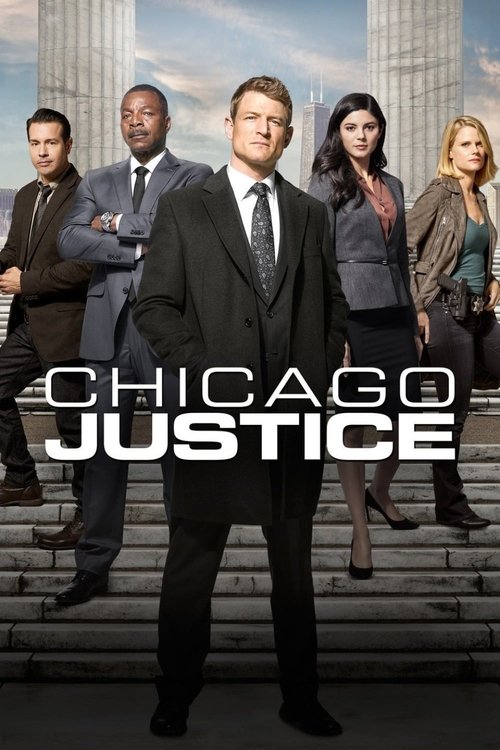
Chicago Justice, the fourth series in Dick Wolf's sprawling Chicago franchise, landed on NBC in March 2017 with a simple but weighty goal: to move the action from the streets and the ER into the courtroom. Where Chicago Fire dealt with rescue and Chicago P.D. with investigation, this spin-off took on the messy, high-stakes world of prosecution. The show followed the Cook County State's Attorney's Office as they built cases, negotiated plea deals, and fought for convictions, all while navigating the political pressures that come with a job in the public eye.
The series brought together a mix of familiar and fresh faces. Philip Winchester's Peter Stone, a character originally introduced on Law & Order: Special Victims Unit, anchored the team as a chief deputy prosecutor with a relentless drive. He was joined by Jon Seda's Antonio Dawson, a former Chicago P.D. detective turned investigator, who provided the crucial bridge between police work and legal strategy. The ensemble also included Monica Barbaro as ambitious young attorney Anna Valdez, Joelle Carter as seasoned investigator Laura Nagel, and Carl Weathers as the politically savvy State's Attorney Mark Jefferies.
Despite its strong pedigree and built-in audience from the franchise, Chicago Justice struggled to find its footing. The show aired only 13 episodes before NBC pulled the plug in May 2017, making it the first Chicago series to be canceled. Its short run has since made it a footnote in the franchise's history, but for fans of legal procedurals and the broader Wolf universe, it remains an interesting experiment in expanding the scope of a television empire.
Availability and pricing can change. Confirm on the provider's site before purchasing.
Chicago Justice drops viewers into the pressurized world of the Cook County State's Attorney's Office, where every case is a minefield of legal strategy, public opinion, and personal ethics. The series follows Chief Deputy Prosecutor Peter Stone and his team as they decide which cases to pursue, how to charge them, and whether to take them to trial or accept a plea. Unlike the police-focused shows in the franchise, this one is about the decisions made after the handcuffs go on.
Stone, a transplant from New York's District Attorney's office, brings a combative, idealistic approach to Chicago. He believes in fighting every case hard, often clashing with his boss, State's Attorney Mark Jefferies, who is more concerned with political optics and conviction rates. Their dynamic forms the central tension of the series. Stone's second-in-command is Antonio Dawson, a former detective who knows the streets and the cops, making him invaluable for vetting cases and interrogating witnesses. The team is rounded out by Anna Valdez, a bright and ambitious junior prosecutor eager to prove herself, and Laura Nagel, a cynical investigator who has seen every trick in the book.
The cases the team handles range from the routine to the sensational. There are murders, gang shootings, police brutality allegations, political corruption scandals, and even a terrorism plot. Each episode typically follows a single case from arrest to verdict, with the team working to gather evidence, negotiate with defense attorneys, and persuade juries. The show leans into the moral complexity of prosecution: sometimes the right legal call is not the most satisfying one, and sometimes the evidence points to guilt but the system fails.
Over the course of its single season, a larger arc emerges involving a corrupt alderman named Bobby Murphy. Murphy is a shadowy figure whose influence reaches into the police department, the courts, and the State's Attorney's office itself. Stone and his team slowly build a case against him, gathering testimony and evidence that could bring down a powerful political machine. This arc provides the season-long backbone, with Murphy's tentacles appearing in several episodes before the final confrontation.
The show also makes use of the franchise's crossover potential. Key episodes involve characters from Chicago P.D. and Chicago Med, and the series participates in the franchise's multi-show crossover events. These connections ground the legal team in a larger world, reminding viewers that the cases they handle are the direct result of the police work and medical emergencies depicted in the other shows. The season builds toward a climactic trial that tests the team's unity and their commitment to justice, all while the political pressure mounts from above.
Chicago Justice NBC Trailer
Critical Consensus
Chicago Justice is a competent legal drama with a strong cast, but its formulaic writing and lack of originality keep it from standing out in a crowded field of procedurals. The connection to the larger Chicago franchise feels more like a crutch than an asset.
“The show is a perfectly adequate legal procedural, but it's one that feels like it was assembled from a kit.”
Daniel Fienberg
The Hollywood Reporter
“The cast is fine, the cases are standard issue, and the franchise connection is unforced. But there's nothing here you haven't seen before.”
Tim Goodman
The Hollywood Reporter
“It's a show that seems to have been born from a spreadsheet, ticking off boxes for diversity, for crossover potential, and for familiar procedural beats.”
Sonia Saraiya
Variety
“It's a well-oiled machine, but it's a machine that's been built many times before. The cast works hard, but the scripts don't give them much to work with.”
Matt Zoller Seitz
Vulture
Philip Winchester
Peter Stone
Jon Seda
Antonio Dawson
Joelle Carter
Laura Nagel
Monica Barbaro
Anna Valdez
Carl Weathers
Mark Jefferies
Directors
Fred Berner, Eriq La Salle, Donald Petrie, Victor Nelli Jr.
Writers
Matt Olmstead, Michael Brandt, Derek Haas
Composer
Atli Örvarsson
Producers
Dick Wolf, Matt Olmstead, Michael Brandt, Derek Haas, Arthur W. Forney, Peter Jankowski
Join the community
fans discussing