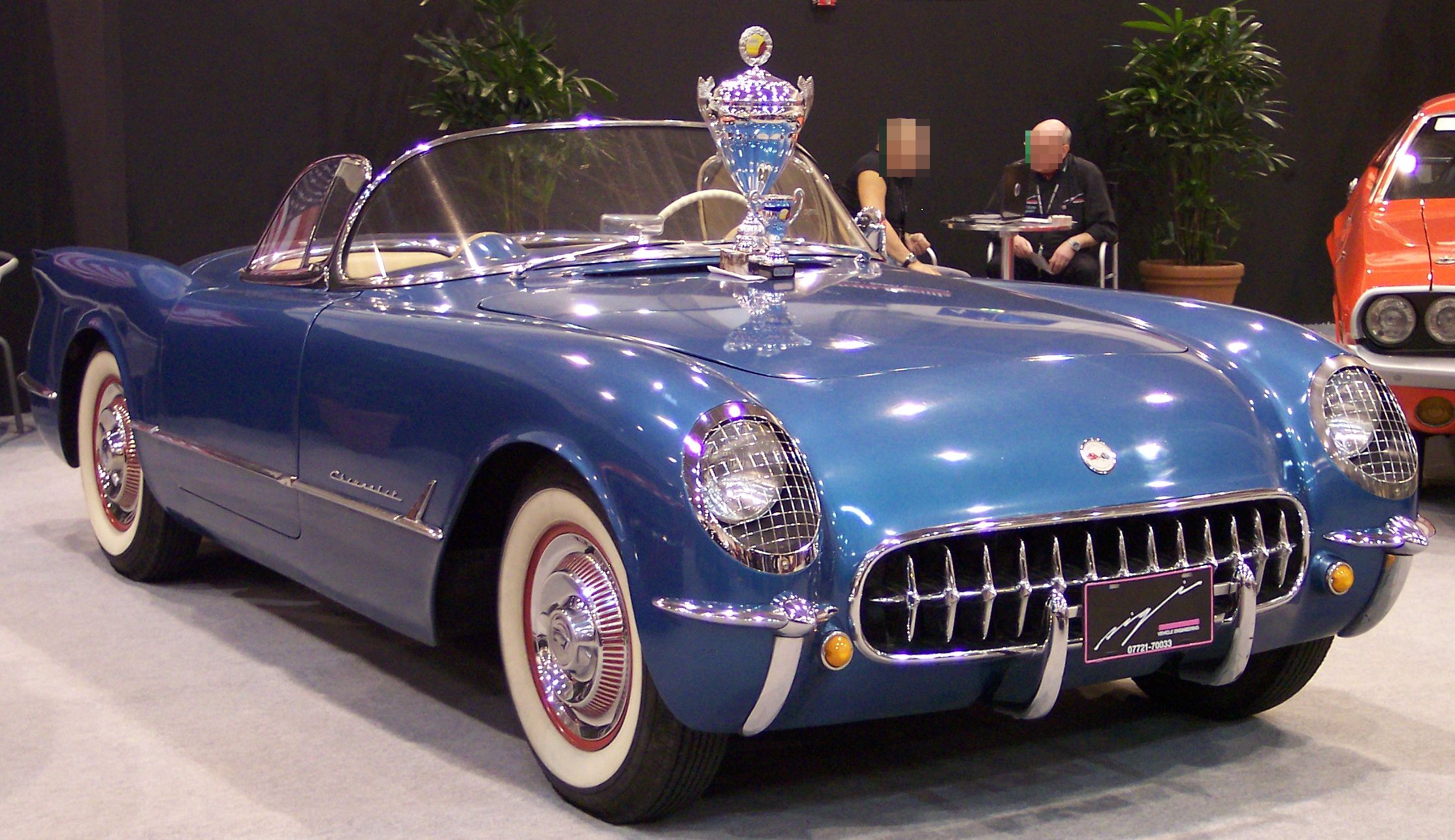
Chevrolet Corvette C1
by Chevrolet
"The fiberglass roadster that started America's sports car story, six months after a show car stunned New York."
Rating
4.5/5
Overview
On the morning of January 17, 1953, a small white roadster with a low grille and a wraparound windshield sat on the turntable at GM's Motorama in the Waldorf Astoria. It was called the EX-122, and the crowd reaction was strong enough that Chevrolet pushed a production version into showrooms by late June of that same year. The car was the Corvette, and it was built in Flint, Michigan, in a facility that had been thrown together for the job. Bodies were laid up in fiberglass, a material chosen partly because it let GM tool up for low volume without stamping steel dies. Under the hood sat a 235-cubic-inch inline-six with three side-draft carburetors, rated at 150 horsepower and bolted to a two-speed Powerglide automatic. Nothing else was offered.
The first two years were rough. Chevrolet built 300 cars in 1953 and 3,640 in 1954, and period road tests liked the shape but not much else. The six was smooth, not fast. The automatic was the only transmission. The chassis felt vague next to a Jaguar XK120. GM executives reportedly came close to cancelling the whole thing. Two forces kept it alive: Ford was readying its own two-seater, the Thunderbird, and a new engineer named Zora Arkus-Duntov kept arguing that the Corvette needed a V8 and a sharper suspension.
He got his V8 in 1955: a 265-cubic-inch small-block rated at 195 horsepower. The 1956 restyle added the scalloped side coves, a toothy grille, roll-up windows and an optional removable hardtop, and the car finally looked as quick as it was becoming. Fuel injection arrived in 1957 on the 283-cubic-inch V8, good for 283 horsepower, or one horsepower per cubic inch, and a four-speed manual joined the options list. The C1 stayed on a 102-inch wheelbase with a solid rear axle through 1962, which is why enthusiasts call it the solid-axle Corvette. Total production across the run came to roughly 69,000 cars.
Key Features
- Fiberglass bodywork, unusual for a low-volume American car in 1953
- Removable hardtop offered from 1956 alongside the folding soft top
- Scalloped side coves introduced in the 1956 facelift
- Rochester fuel injection available from 1957, rated at one horsepower per cubic inch
- Four-speed manual gearbox from 1957
- Quad headlights and a faux-louvered hood on the 1958 model
- Concealed headlights on the final 1962 model year
- Roll-up windows from 1956, replacing side curtains
Specifications
| Production years | 1953–1962 |
| Body style | Two-door roadster, removable hardtop from 1956 |
| Layout | Front-engine, rear-wheel drive |
| Wheelbase | 102 inches |
| Curb weight | Approximately 2,900–3,100 lb |
| Engine (1953–54) | 235.5 cu-in inline-six, 150 hp |
| Engine (1955) | 265 cu-in V8, 195 hp (225 hp optional) |
| Engine (1957–61) | 283 cu-in V8, up to 283 hp with fuel injection |
| Engine (1962) | 327 cu-in V8, up to 360 hp with fuel injection |
| Transmission | Two-speed Powerglide automatic (1953–54); three-speed manual and later four-speed manual available from 1955–57 |
| Suspension | Solid rear axle, independent front |
| Body material | Fiberglass |
Pros & Cons
Pros
- • One of the most recognizable American car shapes of the 1950s
- • V8 and fuel-injection models deliver genuine period performance
- • Strong collector demand keeps values stable and parts support broad
- • Fiberglass bodies resist rust in a way steel-bodied contemporaries do not
- • Huge restomod and aftermarket ecosystem
Cons
- • Early 1953–55 six-cylinder cars are slow by modern standards
- • Fiberglass repair is specialized and expensive
- • Solid rear axle and vague steering make stock cars a handful in traffic
- • Concours and fuel-injected examples have moved well into six figures
- • Parts for the early inline-six and Powerglide are harder to find than small-block V8 pieces
Frequently Asked Questions
How much is a C1 Corvette worth?
How many C1 Corvettes were built, and how many are left?
What is the difference between a C1 and later Corvettes?
What was the first year of the C1 Corvette, and when did it get a V8?
Is a C1 Corvette a good investment?
Keywords
Sources
Product Info
- Brand
- Chevrolet
- Manufacturer
- General Motors
- Category
- Classic sports car
- Released
- 1953-06-30
- Price
- From about $3,498 in 1953 to roughly $4,000–$4,800 by 1962, depending on options
- Availability
- Discontinued
- Production years
- 1953–1962
- Total production
- Approximately 69,000 units
- First model year output
- 300 cars in 1953
- Best C1 sales year
- About 10,261 cars in 1959
- Final year output
- About 14,531 cars in 1962
- Original base price
- About $3,498 in 1953
- Wheelbase
- 102 inches
Where to Buy
Join the community
fans discussing