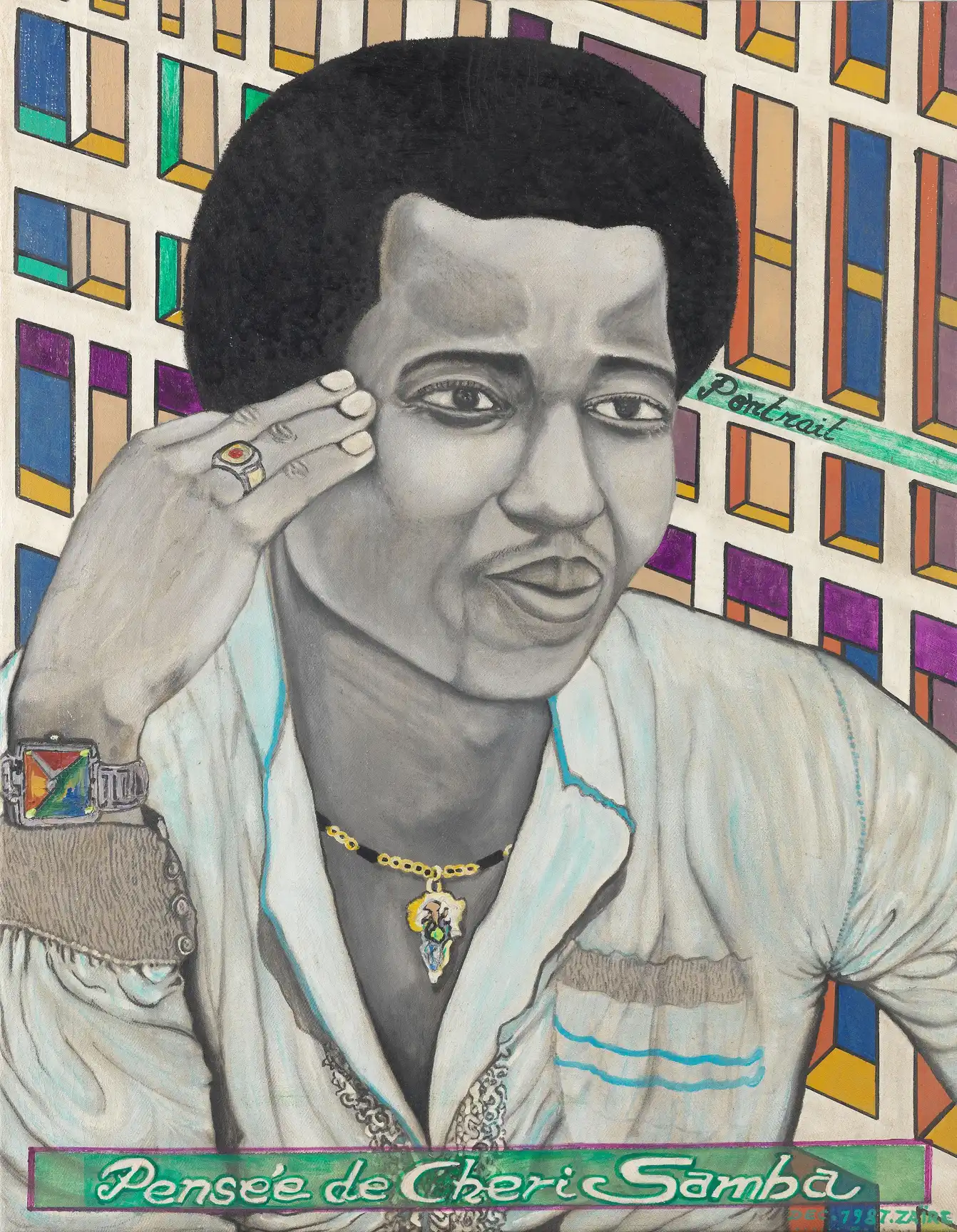
Chéri Samba
 DR Congo
Also known as: Samba wa Mbimba Nzinga Nunimasi Ndombasi, David Samba, Cheri Samba, Samba
Birthday
December 30, 1956
Birth Sign
Sagittarius
Birthplace
Kintomvuila, Democratic Republic of Congo
Age
69 years old
About
Chéri Samba, born Samba wa Mbimba N'zingo Nuni Masi Ndo Mbasi on December 30, 1956, in Kintomvuila, is a Congolese painter who has become one of contemporary Africa's most visible artists. His vibrant canvases, often layered with handwritten text in French and Lingala, comment on daily life, politics, and the collision of tradition and modernity. Samba's work hangs in major institutions, including the Centre Georges Pompidou in Paris and the Museum of Modern Art in New York, and a substantial portion of his output is held in Jean Pigozzi's Contemporary African Art Collection. He splits his time between Kinshasa and Paris.
Known for his sly humour and directness, Samba has spent over five decades chronicling Congolese society through a bold graphic style rooted in commercial sign painting. His paintings function as visual editorials, pairing vivid figuration with biting social commentary on corruption, consumerism, and postcolonial Africa. He is widely regarded as a griot of Kinshasa and Paris, a storyteller who insists that art belongs to the people. His influence extends across generations of younger African artists who see him as a model for blending local narratives with global reach. He remains active, with works continuing to appear at auction and exhibitions worldwide, reinforcing his status as a leading figure in global contemporary art.
Early Life & Background
Chéri Samba grew up in the modest village of Kintomvuila, where his father worked as a blacksmith and his mother farmed the land. He was the elder son in a family of ten children, and his early life was shaped by the rhythms of rural Congolese life. As a young man, he moved to the capital, Kinshasa, where he found work as a commercial sign painter. That trade gave him his visual language: flat colors, clear outlines, and text integrated directly into the imagery.
Without any formal artistic training, Samba taught himself by observing the city around him. In the 1970s, he became a founding member of the "Popular painting" school alongside Pierre Bodo, a movement that aimed to expose everyday life in the Democratic Republic of Congo through accessible, narrative-driven art. His early canvases drew on the energy of Kinshasa's streets, blending observation with a wry sense of humor that would become his signature. This period laid the foundation for his later international recognition.
Career Growth
Samba's breakthrough came in 1989 when his painting "Zaire, 1987" was included in the landmark exhibition "Magiciens de la Terre" at the Centre Georges Pompidou in Paris. That show introduced Western audiences to a broader range of global contemporary art and put Samba on the international map. In 1997 he created "Hope Keeps You Going #2," which entered the collection of the Museum of Modern Art in New York; he followed with "Problem of Water" in 2004, also acquired by MoMA.
He participated in the Venice Biennale in 2007 and has shown extensively across Europe and the United States. In 2014 he painted "La vraie carte du Monde," a satirical reimagining of world geography. In 2018 he created "J'aime le jeu de..." and in 2020 he exhibited in the "Congolese Kings of Art" show in Paris. The Musée Maillol in Paris mounted a major retrospective of his work in 2023, featuring around fifty paintings from the Jean Pigozzi collection. In 2025, he was profiled as "The king of Kinshasa" by Africa is a Country, and in 2026 his works like "Amalia" (2003) continue to appear at auction. He has also received the Prince Claus Award for his contributions to culture.
Career Timeline
Public Image & Style
Samba's public persona is that of a griot, a storyteller who chronicles his society with wit and directness. His signature style features vibrant canvases layered with handwritten text in French and Lingala, commenting on daily life, politics, and the clash of tradition and modernity. He is known for his sly humour and his insistence that art belongs to the people. His work has inspired a generation of younger African artists, and his audience spans the international contemporary art world. There is no documented official fandom name, but his influence is felt across galleries and museums worldwide. His story, from sign-painter in Kinshasa to an artist whose work hangs in Paris, is frequently shared through third-party channels, highlighting his enduring relevance.
Fame & Fandom (iFAMOUS Rankings)
Chéri Samba's name echoes through the art world with the force of a Kinshasa street mural: bright, unmissable, and layered with meaning. Yet, as of August 2026, iFANN's Global Fame Engine has evaluated this Congolese painter and found that he does not currently hold a placement in the published rankings, neither in the Global Top 1,000 nor in any Top-100 scope list. His fame is real, but it is not quantified by our metrics; it lives in the galleries of MoMA and the Pompidou, in the pages of Artforum, and in the stories told by a generation of African artists who cite him as a touchstone.
His fanbase, however, has no formal name. Unlike pop stars with codified fandoms, Samba's audience is a constellation of collectors, curators, and everyday Congolese who see themselves in his canvases. There are no hashtags, no fan clubs, no organized campaigns, just a shared recognition that his art belongs to the people, a philosophy he has championed for five decades. The Fondation Cartier supported him early, the Prince Claus Fund awarded him, and Jean Pigozzi's collection has carried his work across the globe. But the truest measure of his reach may be the way his painted words in French and Lingala speak directly to the streets of Kinshasa, making his commentary as accessible as a newspaper headline.
Interesting Facts and Legends
His full birth name, Samba wa Mbimba N'zingo Nuni Masi Ndo Mbasi, reflects traditional Congolese naming practices and is one of the longest in the art world. He is entirely self-taught, with no formal art education, and his paintings often feature handwritten text in French and Lingala. Samba's work is known for its sly humour, both in person and on canvas. He was a founding member of the 'Popular painting' school alongside Pierre Bodo. His father was a blacksmith and his mother a farmer, and he grew up as the elder son of ten children. He has publicly expressed pessimism about the DRC's political situation, calling the 2023 presidential election 'unwelcome.' His works are held in major institutions, and he continues to be a prominent figure in contemporary African art.
One legend fans still retell is the origin story: a young sign painter in Kinshasa who turned commercial street art into internationally collected fine art, co-founding the 'Popular painting' movement in the 1980s. Another iconic moment came with his 2014 painting 'La vraie carte du Monde,' which put Africa at the center of the world map, a militant reappropriation that critics have called a metaphor for his entire artistic project. In 2025, an Africa Is a Country profile crowned him 'The king of Kinshasa,' cementing his status as the sovereign chronicler of his city's soul.
Notable Quotes
“Art belongs to the people.”
“I paint what I see, and I see everything.”
Family & Personal Life
Chéri Samba was born into a large family in Kintomvuila; his father was a blacksmith and his mother a farmer. He is the elder son among ten children. Details about his current household, including any spouse or children, are not publicly documented. He maintains homes in both Kinshasa and Paris, reflecting his dual life between the two cities. His upbringing in a rural, modest household deeply influenced his artistic perspective, grounding his work in the everyday experiences of Congolese people.
Notable Connections
Relationships & Dating History
Public information about Chéri Samba's romantic relationships is extremely scarce. He is known to be a family man, having been raised as the elder son of ten children, but no credible public sources detail his dating history, marriage, or children. His public profile focuses almost exclusively on his artistic practice. As of 2026, there is no public record of a current partner, spouse, or relationship status. His private life remains largely undocumented, consistent with his emphasis on his work rather than personal affairs.
Salary, Net Worth In 2026
$10 Million
iFANN Editorial Team estimate
As of 2026, iFANN's editorial team estimates Chéri Samba's net worth at $10 million. His income derives from art sales at auction, where works like 'Le mensonge des riches' and 'Amalia' have appeared, and from institutional acquisitions by MoMA and the Pompidou. Major retrospectives, such as the 2023 Musée Maillol show, have boosted his market position. A significant portion of his output is held in Jean Pigozzi's collection, reflecting ongoing commercial relationships with major collectors. While no specific financial disclosures are public, his status as one of the most commercially successful contemporary African artists is evident from his auction presence and institutional recognition.
Awards Won (1)
Chéri Samba received the Prince Claus Award from the Prince Claus Fund, which honors artists and intellectuals for outstanding contributions to culture and development. His recognition is also reflected in major institutional exhibitions and permanent collections worldwide.
2000 · Culture and Development
Known For
Zaire, 1987
1987 · Painting
Hope Keeps You Going #2
1997 · Painting
Problem of Water
2004 · Painting
La vraie carte du Monde
2014 · Painting
Keywords
Sources
Quick Facts
- Profession
- painter, artist
- Born
- December 30, 1956
- Birthplace
- Kintomvuila, Democratic Republic of Congo
- Gender
- Male
- Birth Sign
- Sagittarius
Personal Details
- Full Name
- Samba wa Mbimba N'zingo Nuni Masi Ndo Mbasi
Frequently Asked Questions
What is Chéri Samba known for?
Where is Chéri Samba from?
Is Chéri Samba self-taught?
What is Chéri Samba's real name?
Where can I see Chéri Samba's work?
Similar People
Join the community
fans discussing