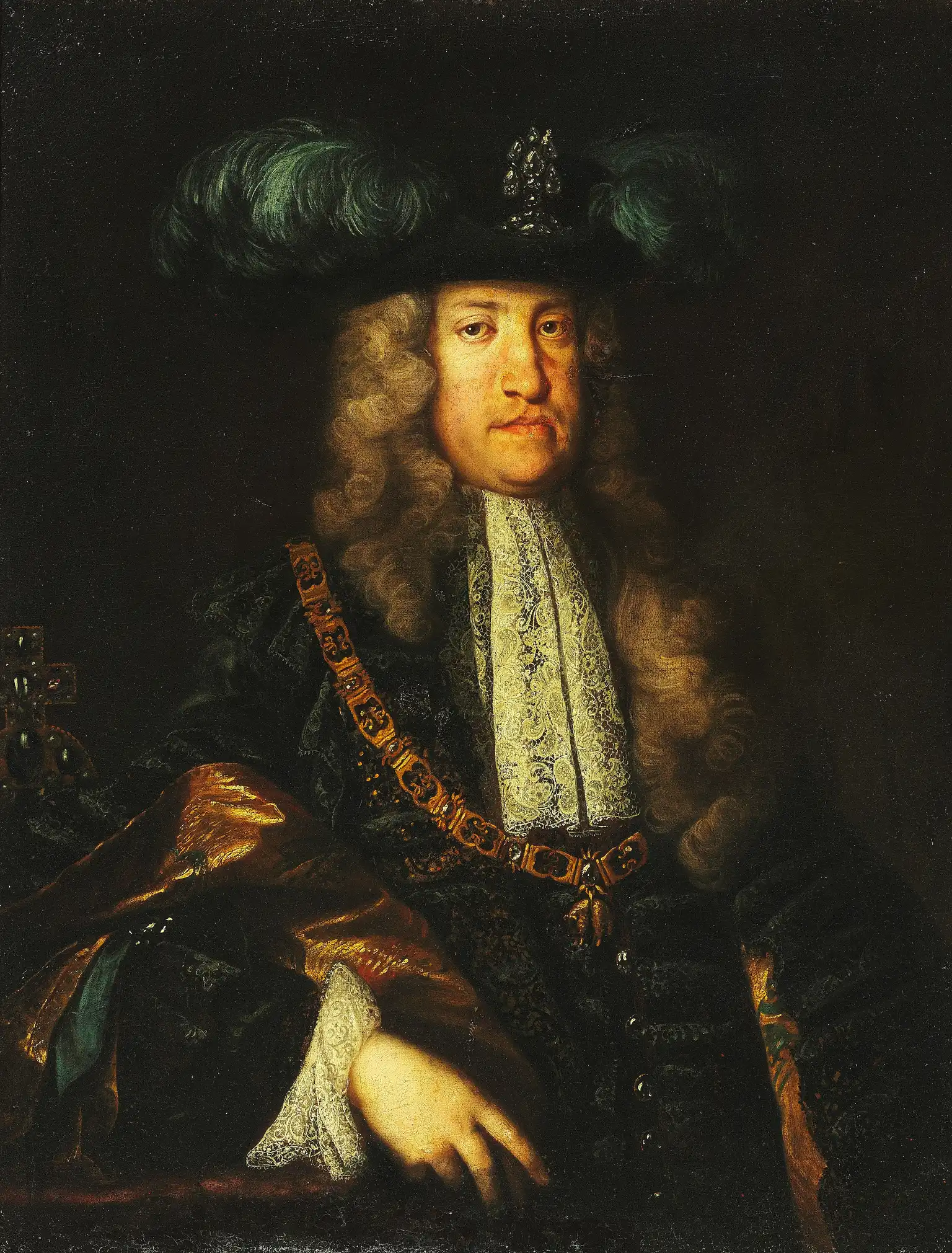
Charles VI, Holy Roman Emperor
 Spain
SpainAlso known as: Karl VI, Archduke of Austria and King of Hungary Charles III, Emperor of Germany Karl VI, Charles VI, King of Spain Charles III, keizer van Duitsland Karl VI, empereur germanique Charles VI, Holy Roman Emperor Charles VI, Holy Roman Emperor Karl VI, Carolus VI, Imperator Romanus Sacer
Birthday
October 1, 1685
Birth Sign
Libra
Birthplace
Hofburg Palace, Vienna, Austria
Age
Died at 55
About
Charles VI, born Karl Joseph Leopold in Vienna on October 1, 1685, was the Holy Roman Emperor and ruler of the Austrian Habsburg monarchy from 1711 until his death in 1740. He was the second son of Emperor Leopold I and succeeded his elder brother, Joseph I, after Joseph's sudden death from smallpox. Earlier, Charles had spent years in Spain, where he tried to claim the Spanish throne following the death of his relative Charles II of Spain, but the War of the Spanish Succession ended with the Bourbon dynasty taking control, and he returned to Austria empty-handed. In 1708, he married Elisabeth Christine of Brunswick-Wolfenbüttel, and the couple had four children: Leopold Johann, who died in infancy, Maria Theresa, Maria Anna (who later became Governess of the Austrian Netherlands), and Maria Amalia, who also died young.
Facing the real possibility of dying without a male heir, Charles issued the Pragmatic Sanction of 1713, a decree that allowed his daughters to inherit the Habsburg lands. This went against the Mutual Pact of Succession he had signed during his father's reign, which favored the daughters of his brother Joseph. To secure international recognition of the sanction, Charles made significant concessions, including shutting down the Ostend Company, a lucrative trading venture. Eventually, Great Britain, France, Saxony-Poland, the Dutch Republic, Spain, Venice, the Papal States, Prussia, Russia, Denmark, Savoy-Sardinia, and Bavaria, plus the Diet of the Holy Roman Empire, all agreed to recognize it. But France, Spain, Saxony-Poland, Bavaria, and Prussia later went back on their word.
Charles's reign was marked by a constant struggle to maintain Habsburg power in the face of shifting alliances and territorial losses. He died on October 20, 1740, in Vienna, just weeks after his 55th birthday. His death triggered the War of the Austrian Succession, as rival powers challenged his daughter Maria Theresa's right to rule, a conflict that would consume her for eight years. Charles's legacy is thus a double-edged sword: he secured the succession for his daughter, but at the cost of leaving the monarchy weakened and embroiled in a devastating war.
Early Life & Background
Before ascending to the imperial throne, Charles spent formative years preparing for a dynastic role that did not initially include the empire. Born the second son of Emperor Leopold I, he was destined for a secondary position or perhaps the Church. His life trajectory changed drastically when his elder brother, Joseph I, died suddenly of smallpox in 1711, leaving Charles as the sole surviving male heir to the Habsburg dominions. Prior to this unexpected inheritance, Charles traveled to Spain to assert his claim to the Spanish crown following the death of the childless Spanish Habsburg king Charles II in 1700. He was proclaimed King of Spain as Charles III, but the War of the Spanish Succession ensued, pitting him against France and its Bourbon allies. The war concluded with the Treaty of Utrecht in 1713, which stripped him of the Spanish crown, awarding it to Philip V of Bourbon, while Charles retained the Austrian lands and the title of Holy Roman Emperor after his brother's death. During this period, he developed a deep interest in art, collecting, and diplomacy, though his early career was defined by the failure to secure the Spanish throne. He spent these years navigating complex court politics and learning the intricacies of governance, setting the stage for his eventual rise to sole power.
Career Growth
In 1711, Charles succeeded his brother Joseph I as Holy Roman Emperor and Archduke of Austria. His most significant political project was the issuance of the Pragmatic Sanction in 1713, a crucial decree ensuring that his daughters could inherit the Habsburg hereditary lands, bypassing traditional Salic law which favored male heirs. From 1714 through the 1720s, he engaged in extensive diplomatic negotiations to secure international recognition of the Pragmatic Sanction. He made significant concessions, including the dissolution of the Ostend Company, a lucrative trading venture, to appease Great Britain and the Dutch Republic. Between 1718 and 1720, he fought the Austro-Turkish War, resulting in the acquisition of parts of Serbia and Wallachia from the Ottoman Empire through the Treaty of Passarowitz. In 1732, he established the Theresian Military Academy at Wiener Neustadt, demonstrating his commitment to military reform and education. In 1738, he signed the Treaty of Vienna with France and Spain, temporarily securing some recognition for the Pragmatic Sanction, though many powers had already reneged on earlier promises. Upon his death in 1740, he left his daughter Maria Theresa as his successor, immediately triggering the War of the Austrian Succession due to the lack of male heirs and renewed challenges from Prussia, Bavaria, and Saxony.
Career Timeline
Public Image & Style
Charles VI maintained a public persona defined by diligence and a singular focus on the preservation of the Habsburg dynasty. He was known for his meticulous attention to detail in court ceremonies and protocol, often spending hours overseeing the minutiae of imperial administration. His image is portrayed in historical narratives as a diligent but ultimately unsuccessful diplomat who prioritized the preservation of his dynasty over territorial expansion. The "mythology" surrounding him centers on the tragedy of the Pragmatic Sanction: a plan so meticulously crafted that it collapsed immediately upon his death, leading to decades of war. Portraits from the Viennese School depict him as the father of Empress Maria Theresa, while a Titian painting once owned by an archduke linked to the family recently set auction records, illustrating the enduring cultural value of Habsburg artifacts.
Fame & Fandom
In September 2026, the 85th most famous person in Classical world, holding steady from the previous cycle, Charles stands as a definitive anchor for the era of absolute monarchy. His enduring presence is tracked across global media coverage, search behaviors, and consumption signals worldwide, cementing his status within the iFANN Global Fame Rankings. This placement reflects a sustained fascination with the man who spent decades negotiating the Pragmatic Sanction to secure his daughter Maria Theresa's throne. While modern audiences do not rally behind him with billboards or charity drives, his historical footprint commands a quiet, scholarly reverence that transcends time. The fanbase surrounding Charles VI has no formal name; there are no organized groups chanting his praises or creating viral content about his reign. Instead, interest manifests through academic discourse and historical documentaries where scholars dissect his failed attempts to maintain Habsburg power against rising Bourbon forces. Unlike contemporary celebrities who court adoration, Charles commanded subjects through fear and religious duty, leaving a legacy defined by the collapse of his carefully constructed peace upon his death in 1740. His story is one of high stakes and ultimate failure, a narrative that continues to draw readers into the complex web of 18th-century diplomacy. Even without a modern fandom, his image persists in art collections and auction records, where portraits of the emperor fetch significant sums, proving that his influence still holds tangible value centuries later.
Interesting Facts and Legends
Charles VI was an avid art collector, amassing a significant collection that included works by Titian and other Old Masters. A Titian painting once owned by the Habsburgs set auction records in the 21st century, reflecting the enduring value of his collection. He was involved in short-lived colonial ventures, including attempts to establish settlements near Bengal in India, which are often overlooked in standard histories of the Habsburgs. His insistence on the Pragmatic Sanction required him to make humiliating concessions to foreign powers, such as closing the Ostend Company, which had been a major source of revenue for Austria. Despite his efforts, the "Habsburg Jaw" was a visible deformity that affected his appearance and was a subject of contemporary gossip. He was known for his meticulous attention to detail in court ceremonies and protocol. His daughter, Maria Theresa, became one of the most powerful rulers in European history, largely due to the foundation laid by her father's Pragmatic Sanction.
Notable Quotes
“The safety of my house and the peace of my realms depend on this.”
“Unity of the hereditary lands must be preserved above all else.”
Family & Personal Life
Charles VI was the second son of Emperor Leopold I and Elisabeth Christine of Brunswick-Wolfenbüttel. He married Elisabeth Christine of Brunswick-Wolfenbüttel on August 1, 1708. This was his only marriage; there were no other public romantic relationships, engagements, or divorces recorded for the monarch. The couple had four children: Leopold Johann, born in 1716, who died in infancy; Maria Theresa, born in 1717, who succeeded him as Archduchess of Austria and Queen of Hungary and Bohemia; Maria Anna, born in 1718, who later served as Governor of the Austrian Netherlands; and Maria Amalia, born in 1724, who died young in 1730. As of the historical record ending in 1740, Charles VI was widowed upon his own death; he was never divorced or separated. There are no modern dating histories, as he lived in the 18th century. His legacy is inextricably linked to his wife, who outlived him by several years, and their daughter, Maria Theresa.
Notable Connections
Elisabeth Christine of Brunswick-Wolfenbüttel, Maria Theresa, Joseph I, Leopold I, Philip V of Spain, Frederick the Great
Relationships & Dating History
Charles VI married Elisabeth Christine of Brunswick-Wolfenbüttel on August 1, 1708. This was his only marriage; there were no other public romantic relationships, engagements, or divorces recorded for the monarch. The couple had four children: Leopold Johann, born 1716, died in infancy (1716); Maria Theresa, born 1717, succeeded him as Archduchess of Austria and Queen of Hungary and Bohemia; Maria Anna, born 1718, later served as Governor of the Austrian Netherlands; and Maria Amalia, born 1724, died young in 1730. As of the historical record ending in 1740, Charles VI was widowed upon his own death; he was never divorced or separated. There are no modern dating histories, as he lived in the 18th century. His legacy is inextricably linked to his wife, who outlived him by several years, and their daughter, Maria Theresa.
- MarriedElisabeth Christine of Brunswick-Wolfenbüttel1708 - 1740His only marriage; she outlived him.
Death & Aftermath
Died
October 20, 1740 (aged 55)
Death Place
Vienna, Austria
Cause of Death
Gout leading to gangrene and sepsis
The Austrian Habsburg monarchy and the Holy Roman Empire suspended court festivities immediately, marking a moment of profound mourning among subjects and peers. Formal eulogies delivered by high-ranking clergy and nobility replaced the usual grandeur, while diplomatic anxiety rippled across Europe as powers viewed the passing as a vulnerability in the male line of the dynasty. Charles VI died on October 20, 1740, at the Hofburg Palace in Vienna, exactly fifty-five years after his birth there. His final weeks were defined by confinement to his chambers, where he endured intense pain and immobility caused by gangrene that had spread from his limbs.
The official cause was a severe attack of gout progressing to sepsis, a decline exacerbated by long-standing obesity and chronic health issues that had previously necessitated the amputation of his left foot. Physicians and court surgeons established this conclusion through their statements during his illness. His funeral became a grand public affair held shortly after his death, attended by the imperial court and foreign dignitaries. He was buried in full regalia within the Imperial Crypt beneath the Capuchin Church in Vienna, the traditional resting place of the Habsburgs, where his remains lie alongside those of other rulers today.
Notable attendees included his wife, Elisabeth Christine, and his daughter, Maria Theresa, who received the scepter and symbols of power immediately following the interment. Posthumously, Charles is remembered primarily for securing the succession of Maria Theresa through the Pragmatic Sanction of 1713, a legal instrument that defined European geopolitics for the next century. His estate passed directly to his daughter, triggering the War of the Austrian Succession as European powers challenged her inheritance rights.
Net Worth (Estate Value)
$0
iFANN Editorial Team estimate
As a monarch of the 18th century, Charles VI did not have a "net worth" in the modern financial sense. His wealth was tied to the vast territories of the Habsburg Monarchy, including Austria, Hungary, Bohemia, and various Italian holdings. The value of these assets was immeasurable in modern currency terms, representing entire economies and populations. iFANN currently estimates his estate value at approximately $0, acknowledging that the economic structures of his time preclude meaningful modern valuation. His wealth was derived from royal revenues, taxes, and the exploitation of resources within his domains, but these cannot be converted into a single liquid figure comparable to contemporary celebrity fortunes.
Awards & Accolades
View 1 records, honours and achievementsKnown For
Holy Roman Empire
1711 · Emperor
Pragmatic Sanction
1713 · Issuer
Keywords
Sources
Quick Facts
- Profession
- monarch, art collector
- Born
- October 1, 1685
- Birthplace
- Vienna
- Died
- October 20, 1740
- Death Place
- Vienna
- Gender
- Male
- Spouse
- Elisabeth Christine of Brunswick-Wolfenbüttel
- Birth Sign
- Libra
Personal Details
- Full Name
- Karl Joseph Leopold
- Spouse
- Elisabeth Christine of Brunswick-Wolfenbüttel
- Children
- Leopold Johann · Maria Theresa · Maria Anna · Maria Amalia
- Education
- Private tutelage in theology, law, and military strategy
Frequently Asked Questions
Who was Charles VI, Holy Roman Emperor?
Why did Charles VI die?
Did Charles VI have any sons?
What was the Pragmatic Sanction?
What happened after Charles VI died?
Similar People
Join the community
fans discussing