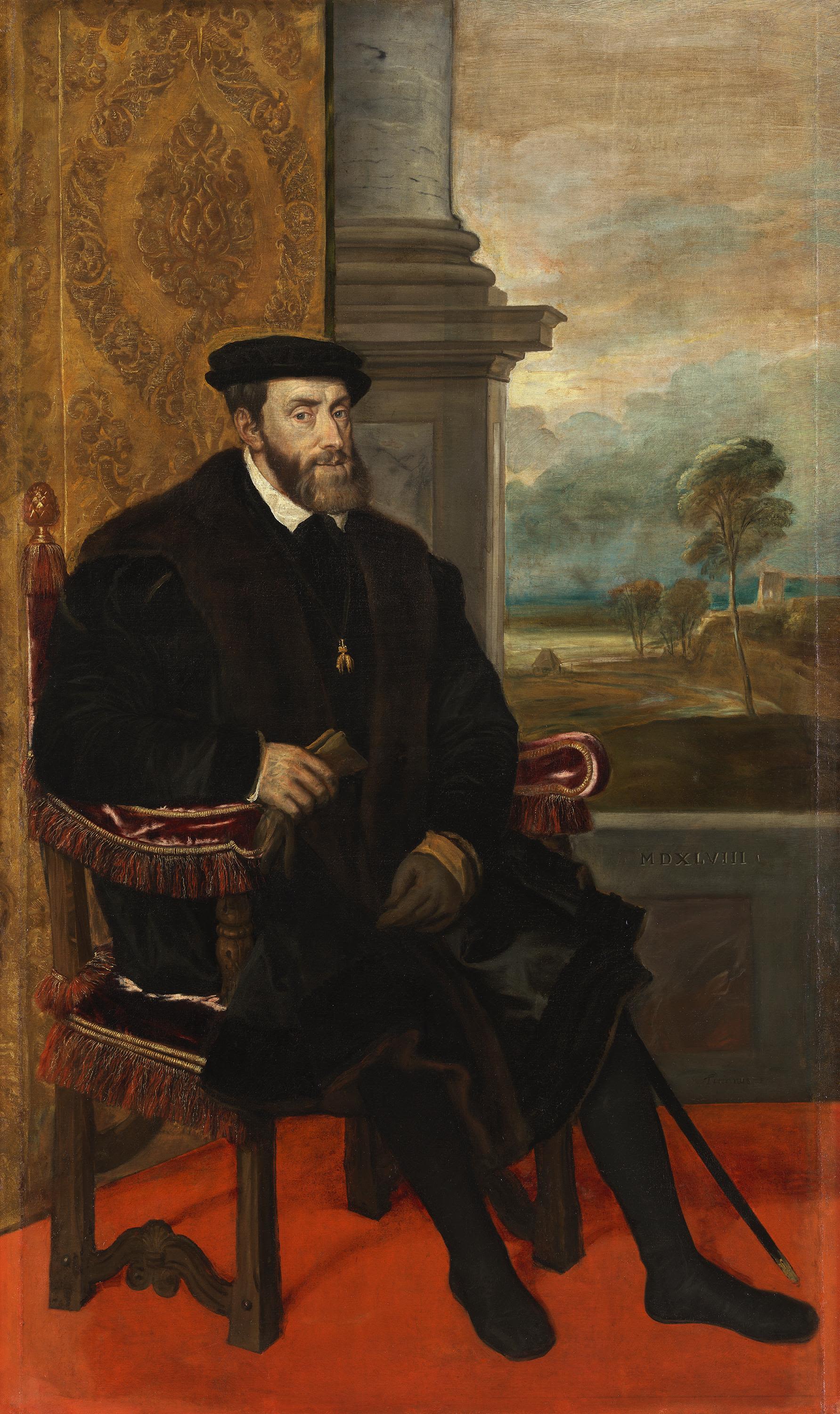
Charles V
Birthday
+1500-02-24
Birth Sign
Sagittarius
Birthplace
Ghent
Age
Died at 58
About
Charles V entered the world on February 24, 1500, in Ghent, Flanders, destined to become the most powerful ruler of his age. He inherited a staggering collection of lands that spanned from the Low Countries to the Americas before he turned twenty. As head of the House of Habsburg, he held titles including Holy Roman Emperor, King of Spain, and Duke of Burgundy. His domains stretched across Europe, encompassing Germany, Austria, and Italy, while Spanish territories included Sicily, Naples, and Sardinia. In the New World, his rule oversaw the expansion of Spanish colonization following the conquests of the Aztec and Inca empires. His reign defined an era of constant conflict and travel. Charles made forty journeys through his diverse realms, often spending a quarter of his time on the road without a fixed capital. He faced relentless pressure from France, the Ottoman Empire, and the rising Protestant Reformation. The Diet of Worms in 1521 marked him as an enemy of Martin Luther, while his forces sacked Rome in 1527. Despite early victories like the capture of Tunis in 1535 and the Battle of Pavia in 1525, later struggles against the Ottomans and German Protestants drained his resources. He relied heavily on silver shipments from Peru and loans from Italian bankers to fund these wars, which fueled widespread inflation across his kingdoms. By the mid-1550s, the weight of governing such a vast and fractured empire became too much. After years of negotiation and failed military campaigns, Charles agreed to the Peace of Augsburg in 1555. He abdicated in 1556, splitting his inheritance between his brother Ferdinand, who received the Austrian lands and the imperial title, and his son Philip II, who took Spain and its overseas colonies. Charles retired to the Monastery of Yuste in Extremadura, where he spent his final year away from politics. He died there on September 21, 1558, at the age of 58, leaving behind a legacy of both immense power and the difficult reality of managing a global empire.
Death & Aftermath
Died
+1558-09-21 (aged 58)
Death Place
Monastery of Yuste, Extremadura, Spain
Cause of Death
Complications from malaria and gout
Charles V died on 21 September 1558 at the Monastery of Yuste in Extremadura, Spain, concluding a life that had spanned five decades of imperial rule. His condition had deteriorated rapidly following a high fever in late August, with contemporary physicians attributing his demise to complications from malaria and long-standing gout that had left him severely debilitated. The cause was determined by royal doctors rather than a modern inquest or autopsy, reflecting the medical practices of the era. Public reaction varied across his dominions; while the Spanish court entered a period of deep piety and mourning for the Catholic King, Protestant territories within the Holy Roman Empire viewed the event as a relief from imperial pressure, contributing to a complex political shift that solidified the Peace of Augsburg.
His funeral was a grand state-sponsored affair held at the Royal Monastery of San Lorenzo de El Escorial near Madrid, though his body had initially been interred at Yuste before its transfer. The rites were elaborate, featuring masses and processions typical of Habsburg tradition, with notable attendees including his son Philip II and high-ranking clergy. In a practice reflecting the era's customs regarding the preservation of relics, his heart was buried separately in the convent of Las Descalzas Reales in Madrid, while his intestines were placed in the church of La Anunciación in Valladolid. Commemorative medals and coins bearing his likeness were issued immediately, serving as the primary form of public tribute in an age.
Following his death, the vast Habsburg estate was divided through pre-arranged family agreements rather than litigation. His brother Ferdinand I assumed the Austrian lands and the Imperial title, while Philip II inherited the Spanish crown, the Netherlands, Italian possessions, and the American colonies. Over subsequent centuries, Charles V has remained a central subject in historical literature and academic study, cementing his legacy as a defining figure of the Renaissance and European imperialism.
Awards & Accolades
Keywords
Quick Facts
- Profession
- monarch
- Born
- +1500-02-24
- Birthplace
- Ghent
- Died
- +1558-09-21
- Death Place
- Monastery of Yuste
- Gender
- Male
- Spouse
- Isabella of Portugal
- Birth Sign
- Sagittarius
Personal Details
- Spouse
- Isabella of Portugal
Join the community
fans discussing