 Germany
About
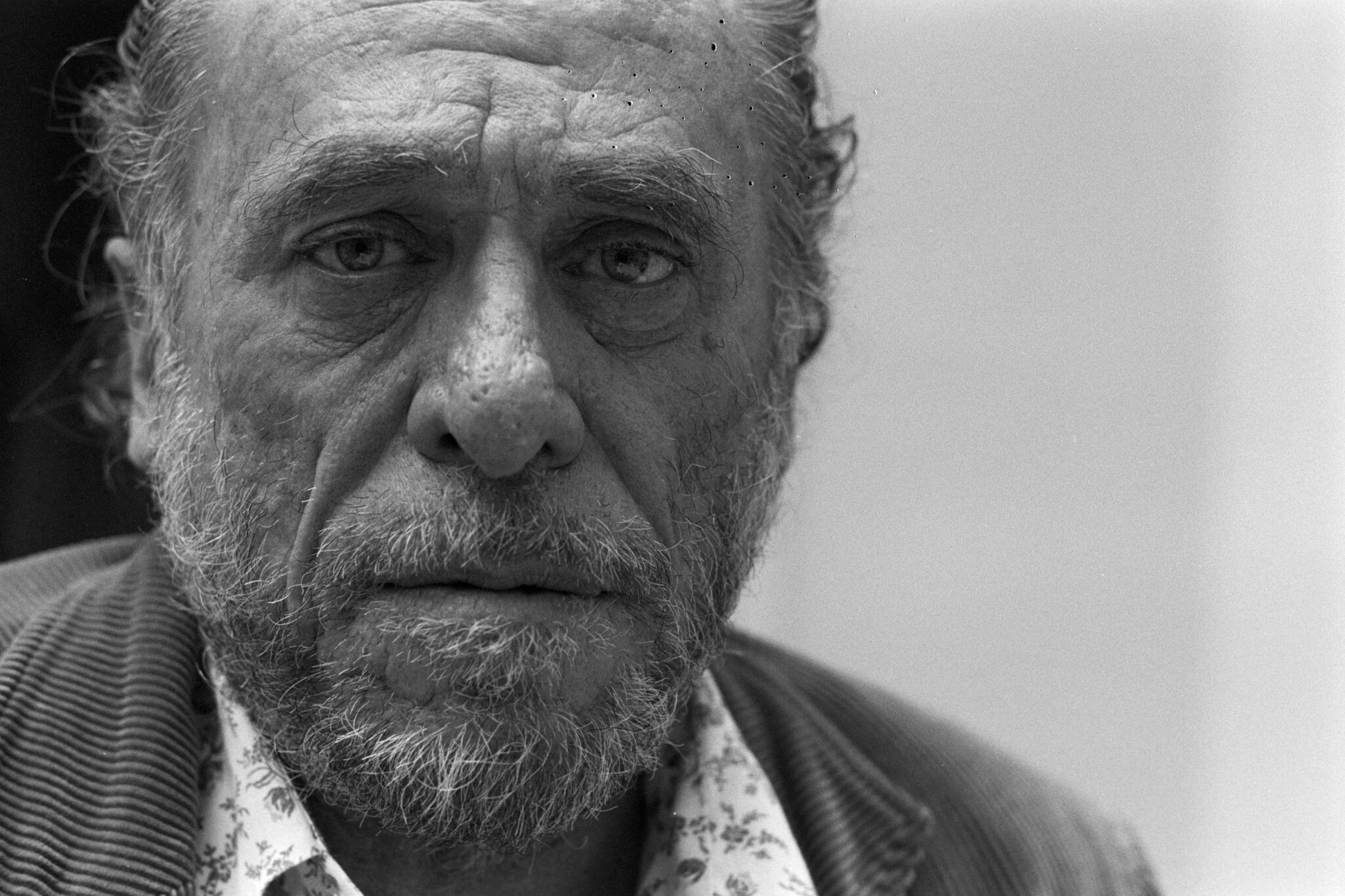
Charles Bukowski was an American poet, novelist, and short story writer whose raw, unflinching voice captured the grit of working-class life. Born Heinrich Karl Bukowski Jr. in Germany, he spent most of his life in Los Angeles, a city that became as much a character in his work as any person. His writing, often autobiographical, delved into alcoholism, poverty, and the drudgery of menial jobs, earning him the label "laureate of American lowlife." Over his lifetime, he published more than sixty books, including six novels and numerous poetry collections, and his influence on contemporary literature remains profound.
Bukowski's work, marked by brutal honesty and dark humor, resonated with readers worldwide, especially in Europe. His most famous novels, Post Office, Factotum, and Ham on Rye, drew directly from his own experiences. He also wrote the screenplay for the 1987 film Barfly, a semi-autobiographical story. Despite being largely ignored by academic critics during his life, his popularity has only grown since his death in 1994, and his grave in San Pedro has become a pilgrimage site for fans who leave beer bottles and notes.
Early Life & Background
Bukowski's early years were marked by hardship. Born in Andernach, Germany, on August 16, 1920, he was the only child of an American soldier and a German mother. The family moved to Los Angeles when he was three, settling in a working-class neighborhood. His father was often unemployed and abusive, and the household was tense. Bukowski later described his childhood as isolated and painful, marked by acne that left him scarred and shy.
He attended Los Angeles City College for two years, studying art, journalism, and literature, but dropped out. His early adulthood was a blur of menial jobs, boarding houses, and heavy drinking. He began writing seriously in the early 1940s, and his first short story, "Aftermath of a Lengthy Rejection Slip," was published in Story magazine in 1944 when he was 24. But success didn't come easily. For nearly a decade, he stopped writing altogether, working as a mail carrier for the U.S. Postal Service. A near-fatal bleeding ulcer in 1955, brought on by his alcoholism, jolted him back to writing. He returned to poetry, publishing his first collection, Flower, Fist and Bestial Wail, in 1960 through a small press.
Career Growth
Bukowski's breakthrough came in the late 1960s when he began writing a column called "Notes of a Dirty Old Man" for the Los Angeles underground newspaper Open City. The column's raw, confessional style gained a cult following. In 1969, John Martin of Black Sparrow Press offered him a monthly stipend of $100 in exchange for his entire literary output. Bukowski quit the post office and wrote full-time.
His first novel, Post Office, published in 1971, was a semi-autobiographical account of his years as a postal worker. It was followed by Factotum (1975), Women (1978), Ham on Rye (1982), and Hollywood (1989), a roman à clef about the making of the film Barfly. He co-wrote the screenplay for Barfly (1987), directed by Barbet Schroeder and starring Mickey Rourke. His final novel, Pulp, was published in 1994, the year he died. Throughout his career, he published thousands of poems and hundreds of short stories, with over sixty books to his name.
Career Timeline
Public Image & Style
Bukowski's public persona was that of a drunken, misanthropic outsider who nonetheless captured profound truths about the human condition. He cultivated an image of a hard-drinking, chain-smoking barfly who wrote about the underbelly of American life. His style was raw, confessional, and often darkly humorous, refusing to romanticize poverty or addiction. Fans, particularly in Europe, embraced him as a cult figure. His writing inspired a devoted following that engages in "Bukowski tourism" in Los Angeles, visiting his former haunts and his grave. His quotes are widely shared on social media, and his face adorns T-shirts and posters. He is often credited with giving a voice to the downtrodden and the forgotten.
Fame & Fandom
Charles Bukowski's readership is a diffuse, fiercely loyal tribe without a formal name, no 'Buk-heads' or official fan club. Instead, they are the devoted, the countercultural, and the literary, who find in his raw, unflinching voice a mirror of their own struggles. This is a fanbase built on word-of-mouth, college syllabi, and the sheer quotability of his lines, which circulate endlessly on social media. They gather informally in bars, raise a cheap beer on his birthday, and trade his one-liners like passwords: 'Some people never go crazy. What truly horrible lives they must lead' or 'Sometimes you climb out of bed in the morning and you think, I'm not going to make it.' His relationship with readers was intimate, he answered letters, held chaotic readings, and chronicled his own life with brutal honesty, making fans feel personally addressed.
As of August 2026, iFANN's Global Fame Engine has evaluated Charles Bukowski, but he does not currently hold a placement in the published rankings, neither the Global Top 1,000 nor any Top-100 scope list. This is a notable absence for a writer whose influence on contemporary literature is profound, yet it reflects the niche, literary nature of his fame. His work has been translated into over 20 languages, and his quotes frequently appear in mainstream media, from the Economic Times to SpaceDaily, signaling an enduring cultural currency that transcends any formal ranking. For his fans, his place in the literary pantheon is secure, even if the metrics don't yet capture it.
Interesting Facts and Legends
Bukowski's grave in San Pedro, California, is a de facto pilgrimage site; fans regularly leave beer bottles and handwritten notes. He was so dedicated to drinking that he once said, 'I have no choice but to drink.' The FBI maintained a file on him due to his column 'Notes of a Dirty Old Man.' He nearly died from a bleeding ulcer in 1955, which prompted his return to writing. His epitaph reads 'Don't Try,' a phrase he considered his life philosophy. He was an avid fan of horse racing and often wrote about it. His work has been translated into over 20 languages.
One of the most retold legends is his 1985 poetry reading where he was visibly intoxicated and reportedly consumed hard liquor on stage, a moment that has become part of his lore as a performer who blurred the line between poetry and self-destruction. Another widely shared quote, 'Find what you love and let it kill you,' is often attributed to him, but it's actually a misattribution, it doesn't appear in his published works. Despite that, it remains one of the most common 'Bukowski' quotes circulating online, a reflection of how his persona has transcended his actual writing. Fans still retell the story of his on-stage antics, celebrating his unapologetic rawness.
Notable Quotes
“The problem with the world is that the intelligent people are full of doubts, while the stupid ones are full of confidence.”
“Good women frighten me because they eventually want your soul, and what's left of mine I want.”
“Sometimes you climb out of bed in the morning and you think, I'm not going to make it, but you laugh inside, remembering all the times you've lain in bed and said that.”
“Can you remember who you were before the world told you who you should be?”
“Don't Try.”
Family & Personal Life
Bukowski's parents were Heinrich Karl Bukowski Sr., an American soldier, and Katharina Fett, a German woman. His father was abusive, and Bukowski later wrote about the beatings he endured. He had no siblings. He married twice: first to Barbara Frye, a Texas poet, from 1955 to 1958, and then to Linda Lee Beighle, a health-food restaurant owner, in 1985. They remained married until his death. He had one daughter, Marina Louise Bukowski, born in 1964 to his long-term partner Frances Smith. Marina has since worked to preserve her father's legacy. Bukowski and Linda lived in San Pedro, where he wrote in a cluttered study. He was known to have a cat, and his love for animals was a quiet counterpoint to his rough exterior.
Notable Connections
Charles Bukowski's life and work intersected with a number of notable figures. John Martin, founder of Black Sparrow Press, became his publisher and patron, offering a monthly stipend that allowed him to write full-time. Barbet Schroeder directed Barfly, which Bukowski co-wrote, and Mickey Rourke portrayed a character based on him. His second wife, Linda Lee Bukowski, has managed his literary estate since his death. His daughter, Marina, has also been involved in preserving his legacy. Bukowski's relationships with poets Barbara Frye and Linda King were both tumultuous and influential on his writing.
Relationships & Dating History
Bukowski's romantic life was as chaotic as his writing. His first serious relationship was with Jane Cooney Baker, a heavy-drinking older woman who became his first great love and literary muse. Their turbulent relationship in the late 1940s and early 1950s is chronicled in his poetry and in Women. She died in 1962 from alcoholism-related causes.
In 1955, he married Barbara Frye, a Texas poet and heiress. The marriage was volatile and short-lived, ending in divorce in 1958. In the early 1960s, he began a long-term on-and-off relationship with Frances Smith, who gave birth to his only child, Marina, in 1964. Their relationship was troubled due to his drinking and infidelity.
During the early 1970s, he had a passionate and frequently violent relationship with sculptor Linda King. He met Linda Lee Beighle, a health-food restaurant owner, in the mid-1970s, and they married in 1985. They remained together until his death in 1994. At the time of his death, he was married to Linda Lee Bukowski, who survives him and manages his estate.
- DatedJane Cooney Baker1947 - 1952First serious relationship; she was a heavy-drinking older woman who became his muse.
- MarriedBarbara Frye1955 - 1958Married a Texas poet and heiress; the marriage was volatile and ended in divorce.
- DatedFrances Smith1963 - 1970Long-term on-and-off partner and mother of his daughter Marina.
- DatedLinda King1970 - 1974Passionate, public, and frequently violent relationship with a sculptor and poet.
- MarriedLinda Lee Beighle1985 - 1994CurrentSecond wife; remained together until his death. She manages his estate.
Death & Aftermath
Died
March 9, 1994 (aged 73)
Death Place
San Pedro, California, USA
Cause of Death
Myeloid leukemia
By early 1994, the poet had largely withdrawn from public life in San Pedro, California, as his health declined following a diagnosis of myeloid leukemia several years prior. He spent his final days under care arrangements typical for end-stage cancer patients before passing away on March 9, 1994, at the age of 73. Tributes poured in immediately from literary circles and institutions acknowledging his status as the laureate of American lowlife, a title previously bestowed by Time magazine. While specific dates for fan vigils are not widely documented, his legacy endured through continuous sales surges and streaming of readings that cemented his influence on generations of writers. There were no reports of a single moment of silence declared by government officials or dedicated memorial murals constructed immediately following his death.
The funeral service remained private, handled by family and close friends without a large-scale public ceremony or notable performances held at the time of burial or cremation. In the posthumous era, his estate has been managed to ensure the continued release of works like Hollywood and You Get So Alone At Times That It Just Makes Sense, which remain subjects of review and analysis. Several adaptations have appeared, most notably the 1987 film Barfly starring Mickey Rourke, while the bar Barfly in Austin, Texas, opened in 2001 as a tribute to this film and the author.
Net Worth (Estate Value)
$10 Million
iFANN Editorial Team estimate
iFANN currently estimates Charles Bukowski's estate to be worth around $10 million. Revenue streams include ongoing book sales, translation rights (his work is published in over 20 languages), film rights, merchandise, and licensing of his name and image. Several posthumous collections, such as The Captain Is Out to Lunch and the Sailors Have Taken Over the Wheel (1998) and The Bell Tolls for No One (2015), continue to sell steadily. The estate is managed by his widow, Linda Lee Bukowski, who has overseen the careful preservation of his legacy. His continued global readership ensures a stable financial future for the estate.
Awards Won (1)
Bukowski's literary career largely bypassed mainstream awards. He did not win a Pulitzer, National Book Award, or Nobel Prize. However, he received the Louise Bogan Award for poetry posthumously in 1994. His recognition came primarily through his massive underground influence and devoted international readership, rather than formal accolades.
1994 · Poetry
Lifetime achievement
Known For
Post Office
1971 · Author
Factotum
1975 · Author
Women
1978 · Author
Ham on Rye
1982 · Author
Hollywood
1989 · Author
Barfly
1987 · Screenwriter
Keywords
Sources
Quick Facts
- Profession
- Writer, Poet, Novelist
- Born
- August 16, 1920
- Birthplace
- Andernach, Germany
- Died
- March 9, 1994
- Death Place
- San Pedro, California
- Gender
- Male
- Spouse
- Linda Lee Beighle
- Children
- Marina Louise Bukowski
- Education
- Los Angeles City College (dropped out)
- Height
- 5 ft 10 in (178 cm)
Personal Details
- Full Name
- Heinrich Karl Bukowski Jr.
- Height
- 5 ft 10 in (178 cm)
- Spouse
- Linda Lee Beighle
- Children
- Marina Louise Bukowski
- Education
- Los Angeles City College (dropped out)
Filmography
2
Total
2
Film
0
TV
Frequently Asked Questions
Was Charles Bukowski married?
What did Charles Bukowski die of?
How many books did Charles Bukowski write?
Did Charles Bukowski have children?
Was Charles Bukowski an alcoholic?
Social Media
Similar People
Join the community
fans discussing